
EU and Ukraine Launch Drone Deal 2026 — Europe's 300 Million Test for Defense Industry
 Dr. Klaus Weber
EU and Ukraine Launch Drone Deal 2026 — Europe's 300 Million Test for Defense Industry
300 million euros are not a defense budget. They are not even a large procurement item. But the sum that Ukrainian defense companies are to gradually open up for European funding and procurement programs after the EU-Ukraine drone partnership agreed upon today in Kyiv is politically more significant than many billion-euro announcements of recent years. It marks the attempt to not only admire Ukrainian wartime experience but to institutionally integrate it into Europe's defense industry.
According to consistent reports from Reuters, DW, and Ukrainian media, Commission President Ursula von der Leyen and President Volodymyr Zelensky agreed in Kyiv on a so-called Drone Deal. The goal is to closely intertwine drone production, development, testing, and procurement between the EU and Ukraine. At the same time, a broader defense package worth around two billion euros is being discussed. The exact architecture is not yet fully public. Precisely for this reason, the sober question is worth asking: Is a European capability being created here, or just a new funding loop for an already overloaded Ukrainian ecosystem?
The Operational Core Lies Not in Brussels, but in Ukrainian Workshops
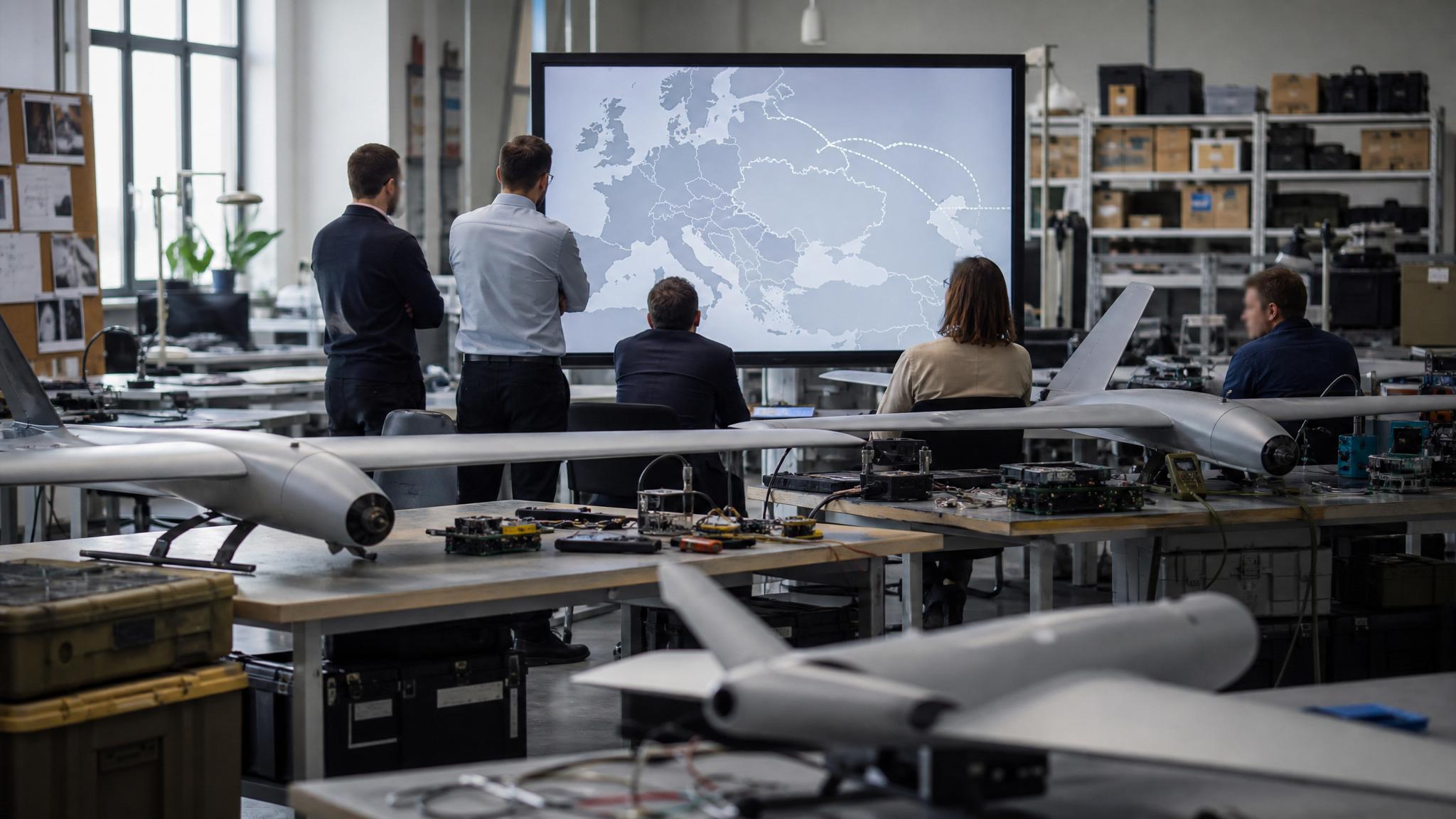
Ukraine does not produce drones like classic European armament programs produce tanks or frigates. It works in short development cycles, with many small companies, improvised supply chains, and immediate feedback from the front. The Ukrainian goal, under the new partnership, to potentially produce up to 20 million drones annually sounds like industrial exaggeration. However, even if only a fraction is achieved, the gap to European peace bureaucracy remains obvious.
Europe has money, certification rules, export control procedures, and large prime contractors. Ukraine has tactical learning curves. An FPV system that was sensible in January can be outdated by electronic countermeasures by April. This speed is difficult to reconcile with the usual EU model. The European Defense Fund, PESCO projects, and national procurement offices were not created for a weapons economy where software, sensors, radio modules, and combat procedures change monthly.
The drone deal is therefore less a conventional industry agreement than a test of whether European institutions can adopt a Ukrainian innovation model without stifling it through their own procedures. This is not a romantic question. It determines whether Europe's defense spending is transformed into capabilities or into paper folders.
The 300 Million Euros Solve the Wrong Problem if Supply Chains Are Excluded
The first temptation in Brussels will be to sell the agreement as proof of European action capability. However, money is not the scarcest factor here. Drones are cheap compared to aircraft or air defense systems, but their dependence on commercial components is strategically uncomfortable. Cameras, radio modules, chips, batteries, motors, and control units often come from Asian, frequently Chinese, supply chains. The Financial Times reported today that Ukrainian procurement with EU funds could also include Chinese drone components. This is militarily understandable and politically embarrassing.
This embarrassment should not be morally overstated. A Ukrainian commander needs available drones, not industrially clean supply chains. But from a European perspective, a contradiction arises: The EU finances the defense against Russia, wants strategic autonomy from China, and simultaneously accepts that the most important mass weapon of the war remains dependent on Chinese electronics. It is precisely here that it is decided whether the Drone Deal is more than crisis management.
- First, Europe must integrate Ukrainian companies into funding programs without tying them to multi-year project cycles.
- Second, the EU needs a component strategy for engines, optics, radio, batteries, and semiconductors, not just final assembly.
- Third, procurement must allow for front feedback. A product that is perfectly documented after 18 months may already be militarily worthless.
This sounds technical, but it is institutional. Europe's problem is rarely the lack of a decision. It is the translation of a decision into series-capable, replaceable, scalable equipment.
The New Missile Defense Coalition Shows the Same Pattern on a Larger Scale
The drone deal is not isolated. Just a day earlier, nine European states and Ukraine announced an integrated Anti-Ballistic Missile Coalition in Paris. According to Al Jazeera and the Associated Press, Denmark, France, Germany, Italy, the Netherlands, Norway, Spain, Sweden, the United Kingdom, and Ukraine are among the signatories. Notably absent are the USA, as well as Poland, Finland, and the Baltic states.
Here too, the central message is: Europe wants to translate Ukrainian wartime experience into its own capability architecture. In missile defense, the bottleneck is particularly brutal. Patriot interceptors cost millions, production is insufficient, and European alternatives like SAMP/T are politically important but limited in quantity. Zelensky spoke in Paris about the possibility of advancing a mass-producible, cheaper defense system based on Ukrainian programs within twelve months. This is ambitious. Germany's Arrow-3 procurement shows a different timeline: order in 2023, first battery by the end of 2025, full operational capability only towards 2030.
The institutional difference is simple: Ukraine measures armament by the next wave of attacks. Europe measures armament by budget years, coalition agreements, and industrial returns.
The drone deal and the missile defense coalition are therefore two sides of the same problem. Ukraine brings demand, experience, and speed. Europe brings money, industrial depth, and political fragmentation. Whether defense capability emerges from this depends on which side shapes the other's way of working more strongly.
Why Germany Must Pay Particular Attention
For Berlin, the agreement is uncomfortable. Germany has mobilized a lot of money since the turning point and has expanded its role as the most important European supporter of Ukraine. However, the Bundeswehr and the procurement office remain stuck in a logic that fails with mass consumer goods. Drones are not platforms for 30 years. They are ammunition, sensors, communication nodes, and software products at the same time.
If Germany views the Drone Deal merely as another EU funding framework, it will learn little. If it understands it as reform pressure on its own procurement system, it could become more important than some national large orders. The Bundeswehr needs not only more drones. It needs the ability to continuously change, lose, replace, and tactically re-integrate drones. This is a cultural challenge for an administration that still treats every system as if it must primarily be audit-proof.
European Integration Through Wartime Experience Instead of Summit Declarations
The most remarkable aspect of today's agreement is not the sum. It is the direction of integration. For decades, the EU understood defense integration as harmonization among member states. Now, a non-member that is at war is becoming the innovation center of European defense. This does not fit into the classic categories of Common Security and Defense Policy. But it corresponds to reality.
Europe has long tried to plan strategic autonomy from the top down. Ukraine is now forcing it to learn autonomy from the bottom up: from workshops, front reports, electronic warfare, and destroyed cities. This is more efficient but politically uncomfortable because it challenges the traditional European division of labor. Those with experience set standards. Those who only provide money follow.
The Drone Deal can be a beginning. However, it can also become another European formula that shows activity and conceals dependencies. 300 million euros open doors. They do not build supply chains, reform procurement offices, or replace strategic decisions. Europe's paradox remains: It must integrate the Ukrainian war economy to become more defensible, but it must not Europeanize it until its pace is lost.
The EU and Ukraine established a drone partnership in Kyiv, aiming to enhance drone production and procurement by integrating Ukrainian war experience into European defense strategies. This initiative, valued at 300 million euros, is part of a broader defense package of approximately 2 billion euros. The collaboration seeks to produce up to 20 million drones annually, marking a significant shift in European defense integration.
- EU and Ukraine agreed on a drone deal worth 300 million euros.
- The partnership aims to integrate Ukrainian war experience into European defense.
- The deal includes a broader defense package of around 2 billion euros.
- Ukraine aims to produce up to 20 million drones annually under the new partnership.
- The agreement reflects a shift in European defense integration towards incorporating non-member states.