
EU and Ukraine unite 18 drone companies — Europe's defense fund tests industrial reality
 Dr. Klaus Weber
EU and Ukraine unite 18 drone companies — Europe's Defense Fund tests industrial reality
On September 17, 2026, the European Union and Ukraine presented a drone alliance involving 18 participating companies. At the same time, several sources reported that Brussels intends to utilize previously unused funds from European defense programs for joint projects with the Ukrainian defense industry. This sounds like the long-demanded collaboration between European capital and Ukrainian combat experience. Institutionally, however, it is initially just a test: Can the EU actually turn Ukraine's innovation advantage into industrial capacity?
The alliance is an industrial policy step
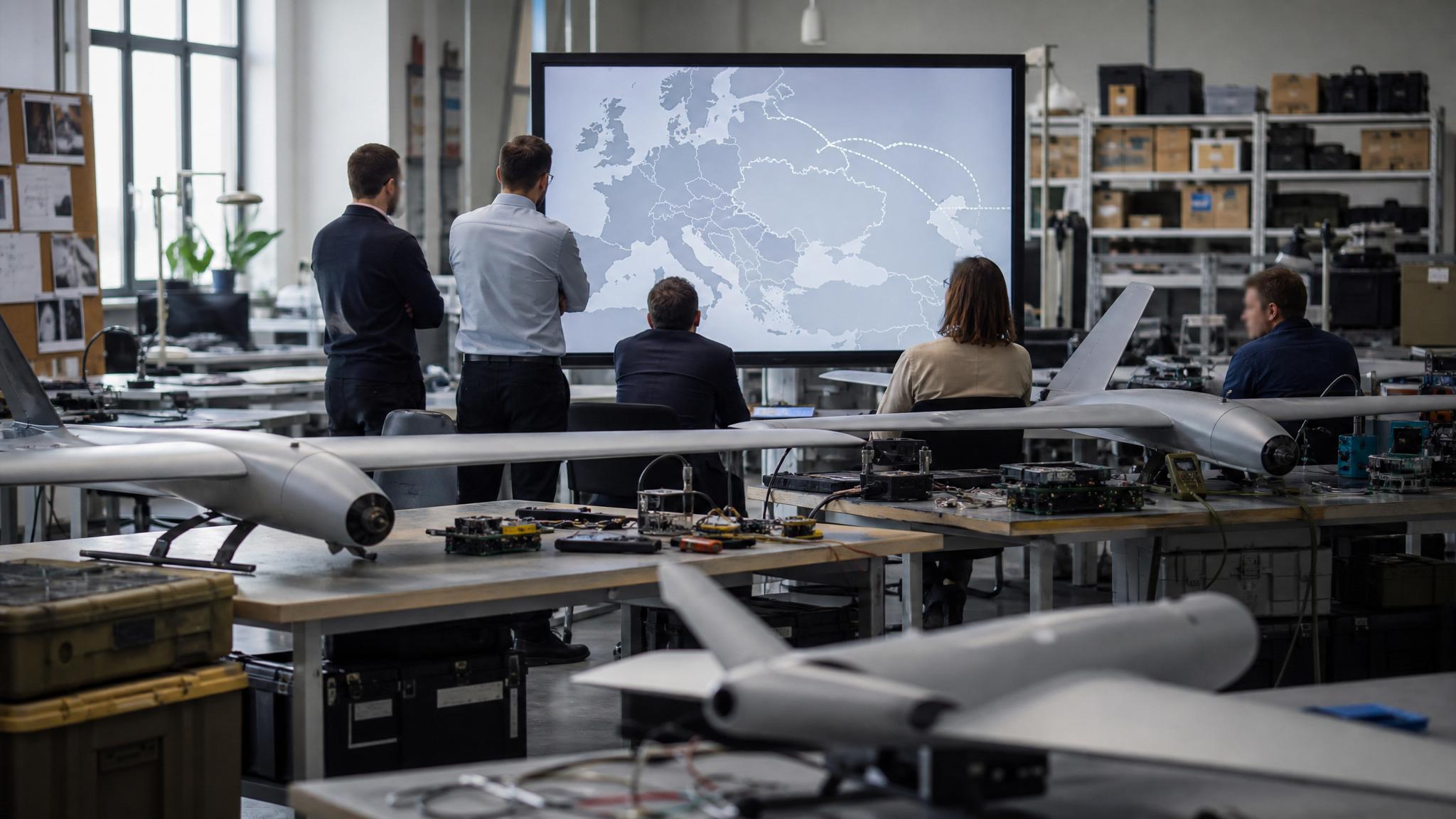
The new structure aims to establish the production of drones and drone defense systems on a broader industrial basis. The number of 18 companies is politically more significant than it initially appears militarily. It signals that Ukraine is no longer treated merely as a recipient of defense aid but as a partner with its own technological and operational competence. Ukrainian manufacturers have an experience advantage in cost-effective reconnaissance drones, first-person view systems, electronic warfare, and the rapid adaptation of software to front-line realities.
This is a different approach than traditional European procurement. In Brussels, capabilities are usually organized through multi-year programs, tenders, and national industry quotas. In Ukraine, however, the cycle between deployment, evaluation, and new production series often dictates decisions. Therefore, the value of the alliance lies not only in additional quantities. The crucial question is whether the EU can change its processes so that Ukrainian companies can participate in the short learning loops of war.
European funds only partially solve the funding problem
According to reports from Euromaidan Press, the EU aims to make billions in unallocated defense funds available for projects with Ukraine. This would be a sensible correction to the previous funding logic. European defense programs do not primarily suffer from a lack of political declarations but from slow fund allocation, national reservations, and a complicated definition of what constitutes the European defense industry.
However, unallocated money does not equate to industrial capability. Between a political commitment and an operational system lie approvals, supply chains, testing procedures, spare parts planning, and reliable demand over multiple budget years. Especially with drones, there is a strong temptation to measure success by contract values or announced production numbers. This would be the familiar European mistake in new packaging: allocations are not deliveries, and loans are not capacities.
Why Ukrainian experience disrupts European planning
The war in Ukraine has shown that drones do not function as isolated products. A reconnaissance platform is only militarily relevant when data transmission, electronic protection measures, artillery, air defense, and a functioning command network fit together. Similarly, drone defense must continuously adapt to new frequencies, flight profiles, and attack patterns. Therefore, the Ukrainian industry works closer to the operational problem than many European large programs.
For Germany, France, and the EU, this poses an uncomfortable institutional question. Those who involve Ukrainian manufacturers in European projects must provide them not only with money but also access to test sites, standards, and procurement decisions. This touches on national industrial interests. A member state can hardly claim that Europe must become strategically autonomous while simultaneously insisting that every relevant technology is produced in its own country and every contract is accounted for nationally.
The strategic benefit extends beyond Ukraine
The alliance is not just a tool to support Kyiv. It could become the core of a European drone and counter-UAS architecture. NATO states today require systems that can counter not only individual projectiles but also massive, cheap, and adaptable swarms. Expensive individual interceptors alone are unsuitable for this. Europe needs a combination of sensors, jammers, kinetic interceptors, domestic drone production, and reliable software updates.
Ukraine offers the most demanding available testing ground for this development. However, this must not lead to an instrumental relationship in which Europe takes over Ukrainian data and testing experience without sharing industrial risks. Partnership in this case means shared ownership rights, fair contracts, and long-term maintenance capability. Otherwise, the alliance will merely become a European purchasing window for Ukrainian front-line technology.
The real test begins after the announcement
Brussels should measure the success of the 18-company alliance against a few verifiable criteria: How quickly are prototypes tested? How many systems actually reach Ukrainian and European units? Which components remain dependent on individual non-European suppliers? And can a successful front-line system be adapted within months, or does it disappear into a multi-year approval process?
For Germany, this entails a particular responsibility. Berlin rhetorically supports European defense integration but continues to protect national procedural patterns. With drones, this tension is hard to conceal because the technology thrives on speed, low costs, and rapid iteration. Those who provide European funds for this must also accept that not every winning product comes from a German or French large industry.
Conclusion
The EU and Ukraine have found the right institutional place for a new attempt with the drone alliance. However, only the direction has been decided; the capability has not yet been proven. Europe's Defense Fund can accelerate Ukrainian innovation if it simplifies procurement and shares industrial risks. It can just as easily slow it down if national quotas and budget logic become more important than the deployment cycle.
The bitter truth is, therefore: Europe does not have too little money this time, but too little time and too many procedures. Ukraine can show how modern drone warfare works. Whether the EU turns this into a lasting capability will not be decided at the founding of the alliance but at the first bureaucratic exception approval.
Sources
- Defence Industry Europe, September 17, 2026 — Report on the EU–Ukraine Drone Alliance with 18 participating companies.
- Euromaidan Press, September 17, 2026 — Report on the use of unallocated EU defense funds for joint projects with Ukraine.
- Kyiv Post, September 16, 2026 — Contextualization of the alliance and its significance for the European drone industry.
On September 17, 2026, the European Union and Ukraine announced a drone alliance involving 18 companies to enhance drone production and defense capabilities. This initiative aims to utilize unused EU defense funds for joint projects with the Ukrainian defense industry, leveraging Ukraine's expertise in drone technology. The alliance signifies a shift in how Ukraine is viewed in defense collaborations, moving from a recipient to a partner with operational competence.
- The EU and Ukraine announced a drone alliance involving 18 companies.
- Unused funds from European defense programs will be allocated for joint projects with Ukraine.
- Ukrainian manufacturers have expertise in cost-effective reconnaissance drones and electronic warfare.
- The alliance aims to enhance drone production and defense capabilities in Europe.
- The success of the alliance depends on the EU's ability to adapt its procurement processes.