
EU-Ukraine Drone Deal 2026 Releases 1 Billion Euros — Why FPV Drones Disrupt Europe's Procurement Logic
 Dr. Klaus Weber
EU-Ukraine Drone Deal 2026 Releases 1 Billion Euros — Why FPV Drones Are Disrupting Europe's Procurement Logic
One billion euros is not an unusual amount in Brussels. What is unusual is what it was released for on July 15, 2026: not for a classic multi-year armaments program, but explicitly to support Ukrainian drone capabilities as part of the 90 billion euro Ukraine Support Loan. At the same time, the European Commission and Ukraine signed a new defense industry partnership and launched an EU-Ukraine Drone Deal for drone and counter-drone technologies. It sounds technical. In reality, it is a test of whether the European Union can learn at war speed.
The Commission describes the agreement as a step towards integrating the European and Ukrainian defense industries. Reuters summarized the same process more soberly: The EU and Ukraine want to expand production and create joint ventures. It is precisely in this difference that the political core lies. Integration is an institutional category. Production is a military category. Ukraine needs the latter immediately; the EU is organizationally built for the former.
The New Contract Is Smaller Than Its Strategic Significance
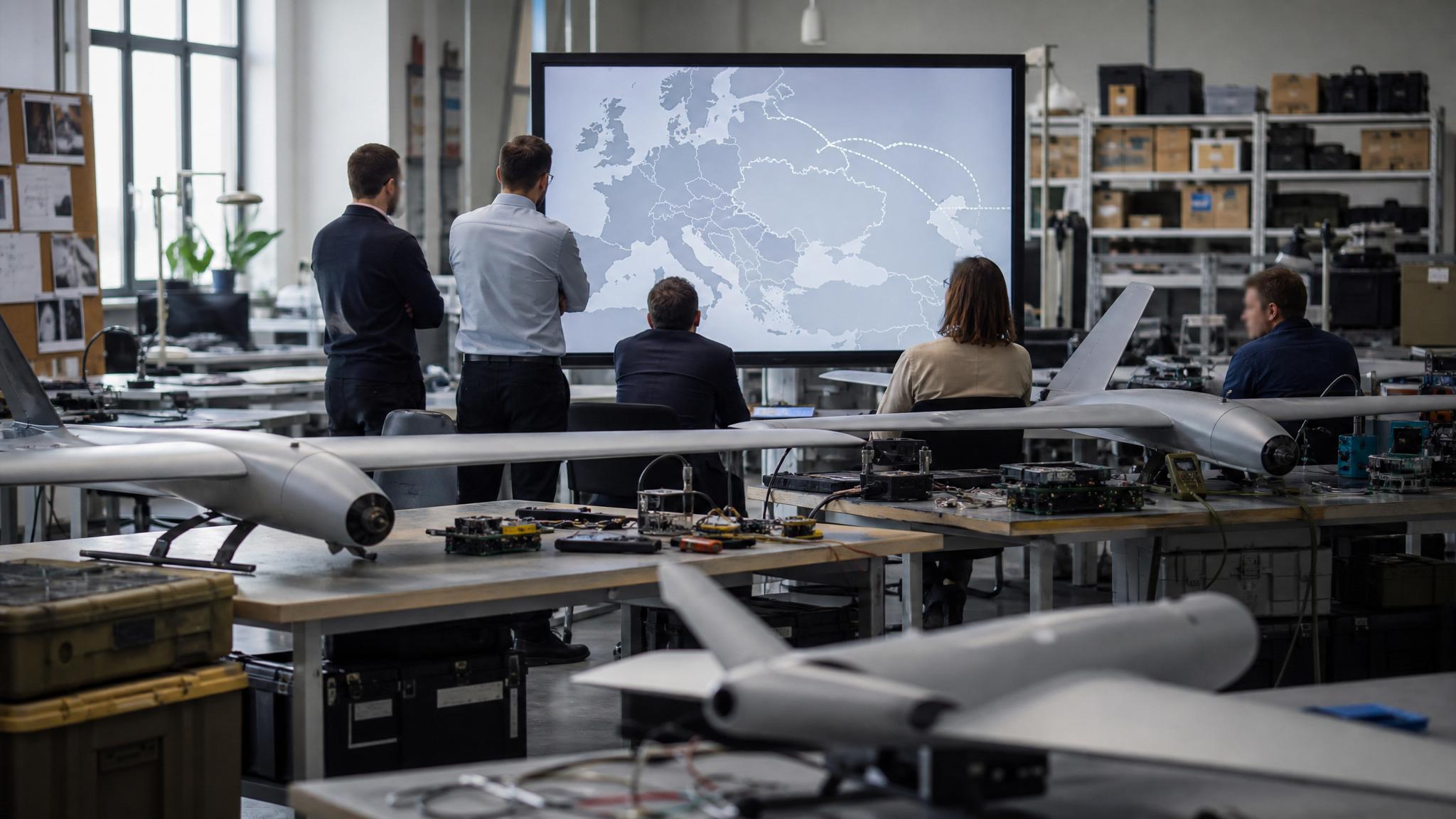
The amount of 1 billion euros is only a part of the larger 90 billion euro credit framework. Nevertheless, it is analytically more important than many larger announcements. When it comes to tanks, aircraft, or air defense systems, Europe almost inevitably works in cycles of years: specification, tendering, national approval, industrial quotas, delivery, training, maintenance. FPV drones and interceptor drones follow a different logic. Their effectiveness depends not only on quantity but also on software, sensors, jamming resistance, tactical feedback, and a very short learning loop between the front and the workshop.
That is precisely why the Drone Deal fits poorly with traditional European procurement instruments. The European Defense Fund finances research. SAFE provides loans. EDIP is supposed to strengthen the industrial base and joint procurement. All three are legitimate, but they are built for planned capacity building. The Ukrainian drone war cannot be planned in this sense. Every Russian jamming measure changes the design. Every new front tactic changes the demand. Anyone who takes six months for an administrative approval is, in the worst case, already financing outdated electronics.
Ukrainian Speed Meets European Control Culture
Ukraine's drone industry has emerged out of necessity, not industrial policy. It combines small manufacturers, military units, private donation channels, state procurement, and front-line testing. The result is not clean in the European sense, but it is capable of learning. European arms cooperation, on the other hand, is controlled, auditable, and politically secure. This is a strength in peacetime. In a war of attrition, it can become a weakness.
The institutional conflict is therefore not: Should Europe finance Ukrainian drones? The answer is obviously yes. The more difficult question is: Can Europe adopt Ukrainian production speed without neutralizing it through European procedures? If Brussels treats the Drone Deal like a normal EU program, a paradox arises: The Union buys agility and then transforms it into bureaucracy.
The EU-Ukraine Defence Industry Forum, which opened in Kyiv on July 13, shows that the Commission has at least recognized this problem. Joint ventures make sense when they combine Ukrainian front-line knowledge with European capital, electronics, manufacturing capacity, and certification. They are less meaningful if they only serve to distribute national industrial shares. In this regard, the Drone Deal is also a quiet criticism of older European major programs. FCAS, Eurodrone, and even some air defense initiatives show how quickly industrial division of labor becomes more important than military utility.
FPV Drones Are Not a Small Procurement Category
The term FPV drone sounds cheap, almost improvised. Strategically, it is not. FPV systems force armies to reassess their assumptions about protection, mass, and cost ratios. A vehicle that costs millions can be threatened by a system that costs only a fraction of that. Countermeasures, electronic warfare, and mobile air defense thus become consumables. However, the European procurement model is still focused on platforms: a tank, an aircraft, a ship, a system network.
This does not mean that tanks or aircraft become unnecessary. Such claims are usually analytical laziness. It does mean, however, that Europe needs a second industrial layer: fast, modular, software-driven, and with high fault tolerance. This layer cannot solely reside with the large system houses. It needs small and medium enterprises, Ukrainian developers, electronics supply chains, and military users who articulate change requests not in annual reports but in days.
The Sovereignty Problem Moves from Platform to Software
For Weber readers, the most important point is not the drone itself, but the control question. European debates about strategic autonomy often focus on final assembly and country of origin. That is no longer sufficient. In the case of drones, what matters is who controls the software, who analyzes the data, who can supply radio modules, who replaces chips, who understands jamming signatures, and who releases updates. A drone assembled in Europe with non-controllable software is not a sovereign capability. A drone developed in Ukraine with European funding, European electronics, and clear IP rules, on the other hand, can create more autonomy than a symbolically European prestige project.
The DGAP rightly argued this week that non-European and Ukrainian companies can strengthen Europe's defense if production, maintenance, intellectual property, and operational control are anchored in Europe. This condition is crucial. The Drone Deal must not become the next form of dependency, this time not on American missiles, but on opaque supply chains for chips, optics, and radio technology.
The Political Test Comes with Scaling
One billion euros can buy many drones, but it does not yet build a lasting industrial order. The next test is scaling. Who decides which systems are prioritized? Will Ukrainian units feed direct feedback into procurement decisions? Can EU states accept common standards even if their national manufacturers do not lead everywhere? And how quickly can counter-drone systems be procured when Russian attacks change their tactics?
Brussels will be tempted to measure the success of the deal by the funds disbursed. That would be the old mistake. The right measure is not whether 1 billion euros flows out, but whether a repeatable production cycle emerges from it: development, testing, front feedback, adaptation, mass production, spare parts supply. If this cycle works, the Drone Deal would be more important than its budget. If it does not work, it remains further evidence that Europe can mobilize money faster than military effect.
The EU-Ukraine Drone Deal is therefore not a marginal issue of Ukraine aid. It is an experiment on Europe's own defense model: Can a union built for rule adherence finance capabilities that thrive on permanent adaptation?
The European dilemma is thus precisely described. Without Brussels money, the Ukrainian drone industry cannot scale sufficiently. With too much Brussels procedure, it can lose its actual advantage. More money does not automatically solve this problem. But for the first time in a long time, the EU is financing not just a weapon system but a learning curve. Whether it can endure this learning curve is the real question of July 15.
On July 15, 2026, the European Union allocated 1 billion euros to support Ukrainian drone capabilities as part of a new defense industry partnership. This initiative aims to enhance drone and counter-drone technologies, reflecting a significant shift in European defense procurement practices. The deal emphasizes the integration of Ukrainian and European defense industries, addressing the urgent needs of Ukraine in the ongoing conflict.
- 1 billion euros allocated for Ukrainian drone capabilities
- EU and Ukraine signed a defense industry partnership
- The drone deal aims to enhance drone and counter-drone technologies
- The deal reflects a shift in European defense procurement practices
- The integration of Ukrainian and European defense industries is a key focus.