
Europe's Patriot Gap 2026 Forces Ukraine into the American Waiting Line
 Dr. Klaus Weber
Europe's Patriot Gap 2026 Forces Ukraine into the American Waiting Line
On May 28, Volodymyr Zelensky once again requested Patriot interceptors in Sweden. Not as another symbol of Western solidarity, but as the only Western series weapon that can intercept Russian ballistic missiles with a realistic probability of success. The operational finding is uncomfortable: Europe can promise Ukraine billions today, but it cannot reliably deliver the interceptors in 2026 that lie between a destroyed substation and a functioning capital.
The new urgency arises from two developments that are often discussed separately in Brussels. First, Russia has intensified its missile and drone campaign against Ukrainian cities. According to Ukrainian reports, Moscow used the Oreschnik again on May 24; Associated Press reported that Patriot interceptors are among the most urgent Ukrainian demands. Second, the war against Iran is tying up American air defense munitions. Zelensky warned on May 28 that American deliveries to Ukraine are dangerously lagging behind needs because U.S. stocks are being strained in the Middle East. This is not a logistical detail. It is a strategic hierarchy.
The Only Answer to Ballistic Missiles Does Not Lie in Europe
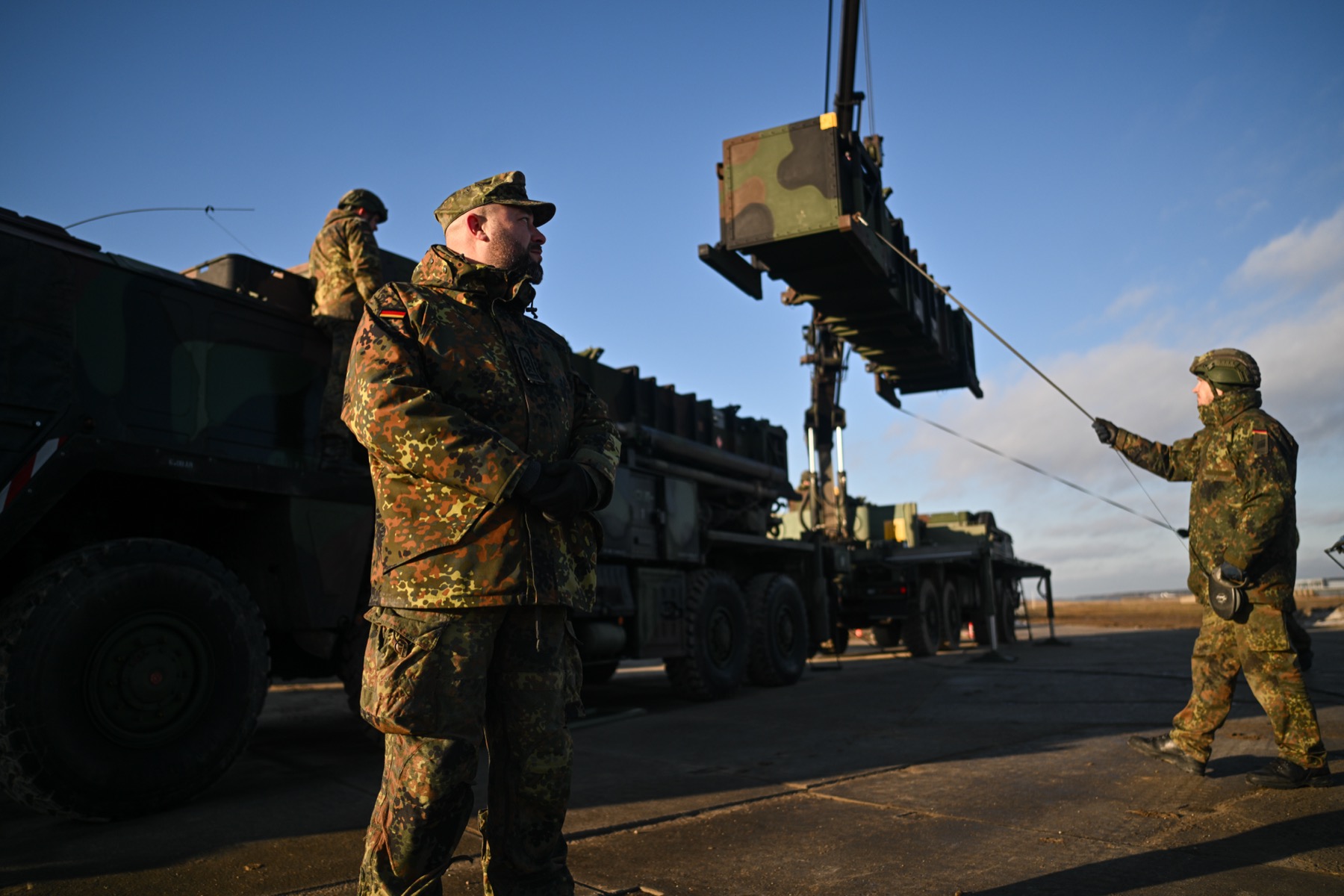
Patriot is not a perfect system. It is expensive, personnel-intensive, and due to its radar and fire control architecture, it cannot be distributed arbitrarily over a country the size of Ukraine. Nevertheless, it remains, especially with PAC-3 MSE and older PAC-2/GEM-T stocks, the core of Ukraine's defense against Iskander, Kinschal, and Oreschnik-like threats. IRIS-T SLM, NASAMS, and SAMP/T are valuable against cruise missiles, aircraft, and many drones; however, they do not replace the American Patriot layer against fast ballistic targets.
This is where the European contradiction lies. Germany is financing Patriot munitions, participating in contracts for GEM-T missiles, and has agreed with Diehl on additional IRIS-T capabilities for Ukraine. The EU refers to SAFE, EDIP, and joint procurement. But the scarcest resource is not money, but industrial control over a specific interceptor. Those who do not control their own production line in a crisis are waiting for priority decisions in Washington.
Brussels Billions Buy Time, but No Interceptors Today
The EU Council now estimates military support for the Ukrainian armed forces at 75.2 billion euros. SAFE is supposed to mobilize up to 150 billion euros as a loan framework for joint procurement; 15 out of 19 national SAFE plans include projects with Ukraine. Additionally, the 90 billion euro support loan finalized in April 2026 is expected to allow an indicative share of 60 billion euros for Ukrainian defense industrial capacities and procurement. On paper, this looks like European capability.
But the timing structure is wrong. A loan instrument can enable contracts, but it cannot create existing PAC-3 MSE from a stockpile. The European Defense Industry Program (EDIP) allocates 1.5 billion euros for 2026 and 2027; over 700 million euros are intended to strengthen the production of missiles, munitions, and counter-drone systems. Another 240 million euros are earmarked for joint procurement, and 260 million euros for the Ukraine Support Instrument. These amounts are sensible. But they are industrial policy seed funding, not operational air defense this summer.
This illustrates the typical confusion in European defense policy: funding is treated as capability. Capability only arises from series production, qualified supply chains, testing capacities, export approvals, munitions reserves, and an operational doctrine. Between a Brussels work program and a Ukrainian Patriot battery near Kyiv lies a timeframe that Russian missiles do not respect.
Germany is Central, but Not Sovereign
Berlin exemplifies this problem. The federal government has taken on more political risks since 2022 than many of its critics acknowledge. Patriot systems, IRIS-T SLM, Gepard munitions, self-propelled howitzers, and artillery munitions have shown real effects. The strategic partnership with Kyiv includes concrete armament points: GEM-T Patriot missiles, additional IRIS-T launchers, and closer industrial cooperation. This is not mere symbolic politics.
But Germany does not have a sovereign answer to the most important question: How many ballistic targets can Ukraine intercept in the next three months if Washington distributes its scarce stocks between Europe, the Middle East, and the Indo-Pacific? Berlin can pay, mediate, and accelerate. It cannot decide alone which American interceptors will become available. The special fund has closed many gaps in the Bundeswehr or at least ordered them. However, it has not created a German PAC-3 factory.
The debate about European strategic autonomy often sounds larger than its material basis. Autonomy does not mean that European states jointly purchase American weapons. Autonomy means that Europe has critical production lines, spare parts, software approvals, and munitions stocks in such a way that it does not become a supplicant in a U.S. priority crisis. With Patriot, Europe is far from that.
The Anti-Ballistic Coalition is Necessary and Too Late
Ukrainian and European discussions about a joint anti-ballistic defense architecture are strategically correct. A European replacement or complement for Patriot would not only help Kyiv; it would also be relevant for Warsaw, Bucharest, Helsinki, and Berlin. The war shows that Russian ballistic missiles are not just a Ukrainian problem, but a European infrastructure and deterrence problem.
However, such a system is not a procurement project for a budget cycle. It requires radar networks, high-acceleration interceptors, fire control software, compatibility with NATO air defense, industrial scaling, and political agreement on deployment. France, Italy, and Germany have valuable building blocks with SAMP/T and IRIS-T. However, they do not possess a European equivalent to the American Patriot stocks that would be immediately and massively available. The coalition is therefore not wrong. It just comes after the moment when its absence has already cost lives.
The Political Price of the Waiting Line
For Ukraine, this waiting line is operationally brutal. When interceptors are scarce, commanders must prioritize: capital or energy infrastructure, frontline logistics or industrial facilities, one ballistic missile or several cruise missiles. The much-cited Western support is then translated into everyday triage. Not every gap looks dramatic on a map; some only appear as a power outage, a destroyed train station, or a burned-out apartment building.
For Europe, the lesson is equally harsh. The EU can mobilize 75.2 billion euros and still fail at a single American bottleneck. It can create 150 billion euros in loan capacity with SAFE and still not deliver enough interceptors in 2026. It can launch EDIP without ending the strategic dependency in the ongoing war. More money is necessary. But it is no substitute for control over industrial bottlenecks.
European defense policy must therefore change its success criteria. It is not the amount of programs that matters, but whether they reduce foreign monopolies in critical capabilities. It is not the number of initiatives that counts, but whether they lead to magazines in five years that do not run empty in the first parallel war of the U.S. As long as Europe needs Patriot but cannot produce Patriot, its Ukraine policy remains dependent on American availability.
The paradox is thus clear: Europe must continue to buy American Patriot missiles in the short term precisely because it must move away from this dependency in the long term. Those who today forgo American systems on principle endanger Ukrainian cities. But those who only continue to buy out of convenience guarantee the next waiting line. Between these two mistakes lies the real task of European defense policy.
Sources
- Associated Press, May 28, 2026, Zelensky's renewed demand for Patriot interceptors: https://apnews.com/article/63efe7b5482de04a4fda9884f3bf7ebe
- Associated Press, May 24, 2026, Russian Oreschnik deployment against Kyiv: https://apnews.com/article/998aeaab5833ca397290d9ee2737b0e5
- EU Council, as of May 12, 2026, military support for Ukraine: https://www.consilium.europa.eu/en/policies/military-support-ukraine/
- European Commission, March 30, 2026, EDIP work program: https://defence-industry-space.ec.europa.eu/edip-commission-adopts-eu15-billion-work-programme-boost-european-and-ukrainian-defence-industry-2026-03-30_en
- German-Ukrainian Strategic Partnership, April 2026: https://www.bundesregierung.de/resource/blob/998440/2420612/634e4ab599c2a7f366f46ad84913d426/2026-04-14-erklaerung-deutsch-ukr-regierungskonsultationen-en-data.pdf?download=1
Ukrainian President Zelensky requested Patriot missiles from Sweden on May 28, 2026, due to increasing Russian missile threats. The EU has pledged 75.2 billion euros in military support, but European capabilities are insufficient to meet immediate needs. Germany is financing Patriot ammunition and enhancing IRIS-T capabilities, yet Ukraine remains dependent on U.S. supplies for effective defense against ballistic threats.
- Ukrainian President Zelensky requested Patriot missiles from Sweden on May 28, 2026.
- Russia has intensified its missile and drone campaign against Ukrainian cities.
- The EU has mobilized military support for Ukraine amounting to 75.2 billion euros.
- Germany is involved in financing Patriot ammunition and has agreements for additional IRIS-T capabilities.
- The report highlights the strategic dependence of Ukraine on U.S. military supplies.