
F-16 radar upgrade contract passes $2 billion with new Northrop award
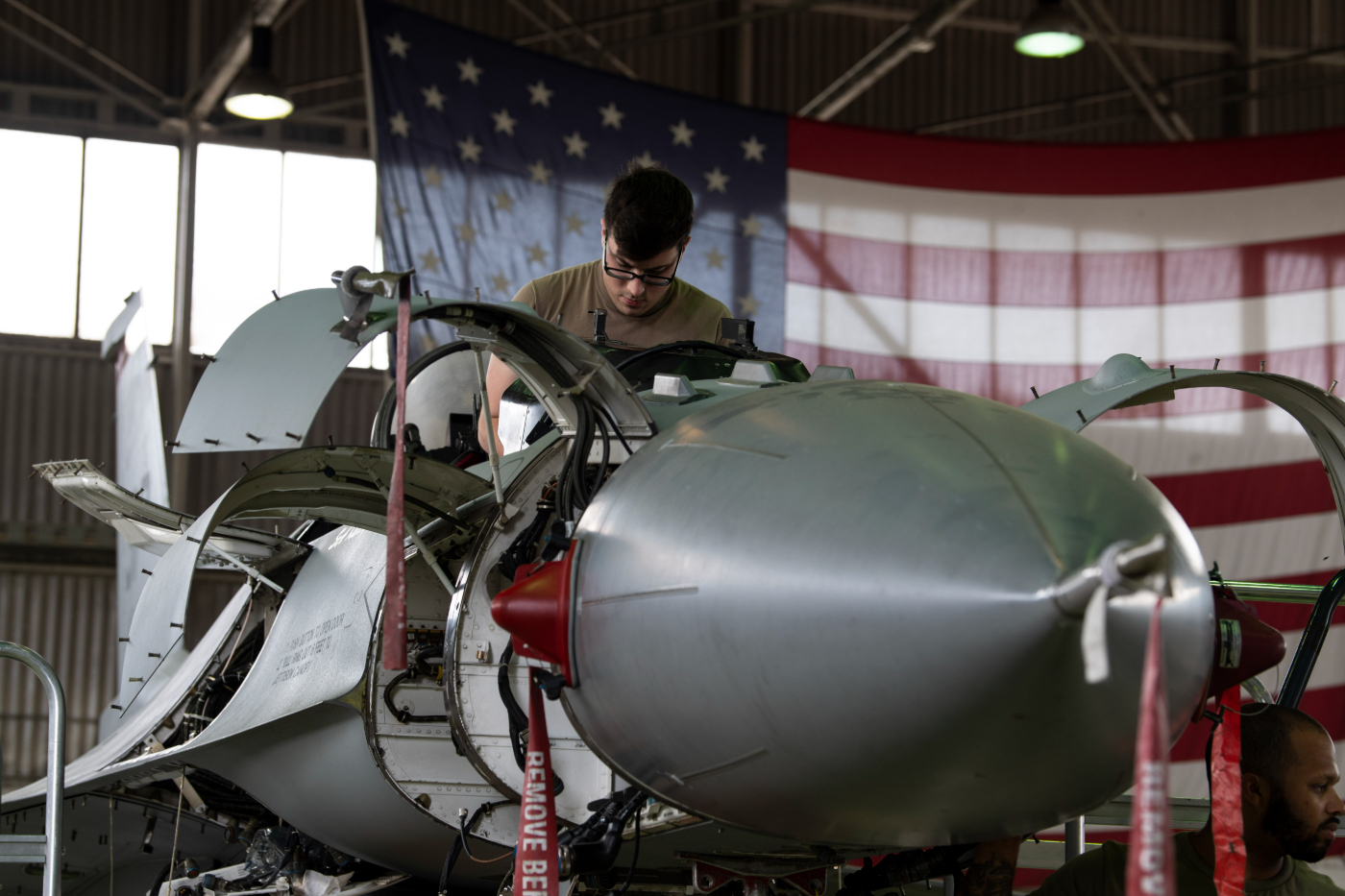
Northrop Grumman won another $79.6 million from the U.S. Air Force for the radar going into its F-16 fleet, pushing a contract that started at $244 million in 2017 past the $2 billion mark.
The award, announced Nov. 13 by the U.S. Department of War, is a modification “for Active Electronically Scanned Array radars of Air Force F-16 aircraft.” It raises the contract’s value “to $2,061,087,012 from $1,981,478,532,” the announcement said. Northrop Grumman will do the work in Linthicum Heights, Maryland.
All $79.6 million was committed at award, drawn from five separate pots. About $65.4 million is procurement money from fiscal 2025, 2026 and 2027. The other $14.2 million is research, development, test and evaluation funding. So roughly four dollars in five are for buying hardware, and the procurement share could cover more radars for the U.S. Air Force’s F-16 upgrade line.
That development figure has shown up before. The two research lines add up to $14,215,800, the exact amount of a modification to the same contract in March 2025 and of another one in June 2026.
The radar is the AN/APG-83, which Northrop Grumman sells as SABR, for Scalable Agile Beam Radar. It replaces the F-16’s APG-68, a radar that sweeps a dish back and forth mechanically. The APG-83 has no moving antenna. It steers its beam electronically across a fixed array, which lets it jump between targets almost instantly and track many at once while also mapping the ground.
Northrop Grumman says the design borrows from the radars it builds for the F-22 and F-35, and that it fits in the F-16’s nose without changes to the jet’s structure, power or cooling.
The contract began as an urgent homeland defense buy. In 2017, the U.S. Air Force ordered 72 radars for Air National Guard F-16s for $243.9 million. U.S. Northern Command had asked for them because it needed fighters that could track “small cross-section threats” such as cruise missiles, Air & Space Forces Magazine reported when those 72 jets were finished in 2022.
In December 2019, the U.S. Air Force added about $1 billion for up to 372 radars, with work then expected to run to May 2027. By April 2023 the contract stood at $1.51 billion. It reached $1.68 billion in March 2025 and $1.84 billion in June 2026.
The pace has picked up since. Between the June modification and this one, the contract grew by roughly $145 million.
Most of those radars are for the U.S. Air Force’s own late-model jets. The service plans to upgrade 608 Block 40 and Block 50 F-16s under a $6.3 billion effort that bundles up to 22 modifications, with the APG-83 as the largest single item. That target rose in steps from 330 aircraft, Key.Aero reported. The 480th Fighter Squadron at Spangdahlem Air Base, Germany, became the first active-duty squadron to get the radar in early 2022.
The 372-radar ceiling set in 2019 is well short of 608 aircraft. The U.S. Air Force hasn’t said in these announcements how many radars the contract now covers.
Production is well established. Northrop Grumman delivered its 1,000th APG-83 on May 19 from its Baltimore plant. That total includes radars for foreign F-16 upgrades and for new Block 70 and Block 72 jets, which carry the APG-83 as standard.
Work under the new modification “is expected to be completed Dec. 31, 2027,” according to the announcement.
Content preview only. Full article available at source. View Full Article
Northrop Grumman received a $79.6 million contract modification from the U.S. Air Force for radar upgrades to the F-16 fleet, raising the total contract value to over $2 billion. The AN/APG-83 radar, which replaces the older APG-68 model, will enhance the aircraft's capabilities. The work will be conducted in Linthicum Heights, Maryland, with completion expected by December 31, 2027.
- Northrop Grumman awarded $79.6 million for F-16 radar upgrades.
- Total contract value exceeds $2 billion since 2017.
- The AN/APG-83 radar replaces the older APG-68 model.
- The contract includes procurement for 608 F-16 aircraft upgrades.
- Work expected to be completed by December 31, 2027.