
F126 Cancellation Costs Rheinmetall 300 Million Euros — and the German Navy the Next Frigate Generation
 S.W
S.WF126 Cancellation Costs Rheinmetall 300 Million Euros — and the German Navy the Next Frigate Generation
Rheinmetall reported a revenue jump of nearly 70 percent to around 3.3 billion euros for the second quarter of 2026 at the end of July — all business areas contributed to the growth. Less than four weeks later, the Düsseldorf-based defense contractor revised its annual forecast downward: Instead of 14.0 to 14.5 billion euros, Rheinmetall now expects only 13.7 to 14.2 billion euros in revenue for 2026. The reason: The federal government canceled a long-delayed frigate program in June, for which Rheinmetall was considered a likely contractor.
The incident is more than just a corporate announcement. It illustrates the structural problem of German naval procurement — and the question of whether the much-touted turning point will ever reach the seas.
The Numbers Behind the Cancellation

The cancellation of the frigate program — according to industry sources, this refers to the F126 project or a subsequent tranche of it — burdens Rheinmetall's naval division with around 300 million euros. The company's order backlog drops from previously estimated 135 billion euros to now over 100 billion euros. The investment ratio is reduced from 16 to 8 to 9 percent of revenue.
Even though Rheinmetall left its margin targets and cash flow forecast unchanged and CEO Armin Papperger spoke of "record growth" — the stock market reacted with a decline of up to four percent. JPMorgan analysts warned that the downgrade could indicate slower growth in the years 2027 and 2028.
For a company that only acquired the naval division of Bremen's Lürssen shipyard in March 2026 and has since also examined the acquisition of Kiel's German Naval Yards — rival Thyssenkrupp Marine Systems withdrew its offer in July — the cancellation is a strategic setback. Papperger diplomatically stated: "Even in the naval business, we are looking ahead and are working diligently to fulfill our current maritime contracts as a reliable partner and to win new ones on the international stage."
The Procurement Paradox: Who Cuts, Loses
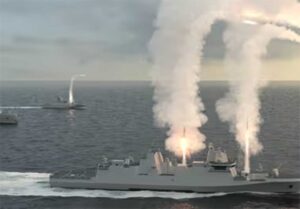
The F126 program — originally conceived as the Multi-Purpose Combat Ship 180 (MKS 180) — has stood for years as a symbol of the difficulties in German naval procurement. Four ships of the class were ordered in 2020 from a consortium led by the Dutch Damen shipyard, with Lürssen as the German construction partner. The delivery has been delayed multiple times.
That the federal government is now canceling the program for which the marine-industrial hope bearer Rheinmetall was built up with the Lürssen acquisition is not without a certain irony. The government orders, the industry invests in shipyards and personnel — and then the contract disappears without replacement. Money does not resolve institutional dysfunction.
For the German Navy, the situation is more serious than the corporate numbers suggest. The F123 Brandenburg class is nearing the end of its service life. The F124 Sachsen class — specialized in air defense — has become technically outdated. The F125 Baden-Württemberg class has operational capabilities but lacks both sonar and gun systems beyond the caliber of 27 millimeters — a design decision that has been criticized to this day. Without the next frigate generation, there will be a capability gap in the 2030s that neither the existing units nor the K130 class corvettes can fill.
Rheinmetall's Bet on the Navy — and What Remains of It
Rheinmetall has declared the navy a strategic growth area. The Lürssen acquisition in March 2026, the interest in German Naval Yards Kiel, and the GMF140 new development — a guided missile frigate that the company is positioning in the international market — testify to maritime ambition. The company, which sold its automotive division for around 350 million euros to the Munich investment firm Aequita in June 2026, is fully focused on defense. Papperger aims for 50 billion euros in annual revenue by 2030.
The F126 cancellation does not existentially impact this plan. Rheinmetall will find new contracts — in the United States, where American Rheinmetall recently won contracts for autonomous supply vehicles and hybrid UGVs for the U.S. Army, and in the international naval market. The operational question is different: Can a defense contractor expand its naval division when the home market does not offer a reliable perspective?
Europe's Marine-Industrial Fragmentation
The F126 cancellation is part of a series of European naval setbacks — albeit in a different way than the FCAS debacle. Where FCAS failed due to national industrial policy egos, F126 fails due to national planning unreliability. The result is the same: one less European program, one more capability gap.
While Germany cancels programs, others are building: France is producing FDI frigates (Frégate de Défense et d'Intervention) in series, Italy is manufacturing PPA and FREMM units, the UK is advancing Type 26 and Type 31, and the Netherlands and Belgium have ordered their future ASW frigates. In this environment, the cancellation signals not only a national capability gap but also weakens European naval credibility overall.
For NATO partners who rely on German naval presence in the North and Baltic Seas — particularly the Baltic states and Poland — the message is fatal: Germany's turning point produces tanks and ammunition, but no ships. The navy remains the neglected child of the security policy realignment.
"Canceling a frigate is cheaper than building one — as long as you only consider the budget item. Once the capability gap becomes real, the strategic costs are unaffordable. This is the fundamental problem of German procurement policy: It optimizes budget years, not decades."
— Dr. Klaus Weber is a Senior Fellow at the Center for Security Policy and specializes in European defense economics and naval procurement. The analysis is based on reports from Reuters/Defense News (Miranda Murray, Matthias Inverardi, August 6, 2026), corporate communications from Rheinmetall, and publicly available procurement documents from the Bundeswehr.
The German government canceled the F126 frigate program, resulting in a 300 million euro loss for Rheinmetall AG and raising concerns about the future capabilities of the German Navy. This decision reflects ongoing challenges in military procurement and highlights a potential capability gap for the Navy in the 2030s. Rheinmetall's order backlog has decreased significantly, impacting its financial outlook and growth plans.
- Rheinmetall faces a loss of 300 million euros due to the cancellation of the F126 frigate program.
- The German government has delayed and ultimately canceled the F126 frigate program, affecting Rheinmetall's revenue projections.
- The cancellation highlights ongoing issues in German military procurement and capability gaps for the German Navy.
- Rheinmetall's order backlog has decreased significantly, impacting its future growth plans.
- The report indicates a broader trend of European naval capability gaps as Germany cancels programs while other nations continue to build.