
Finnish military creates space operations center
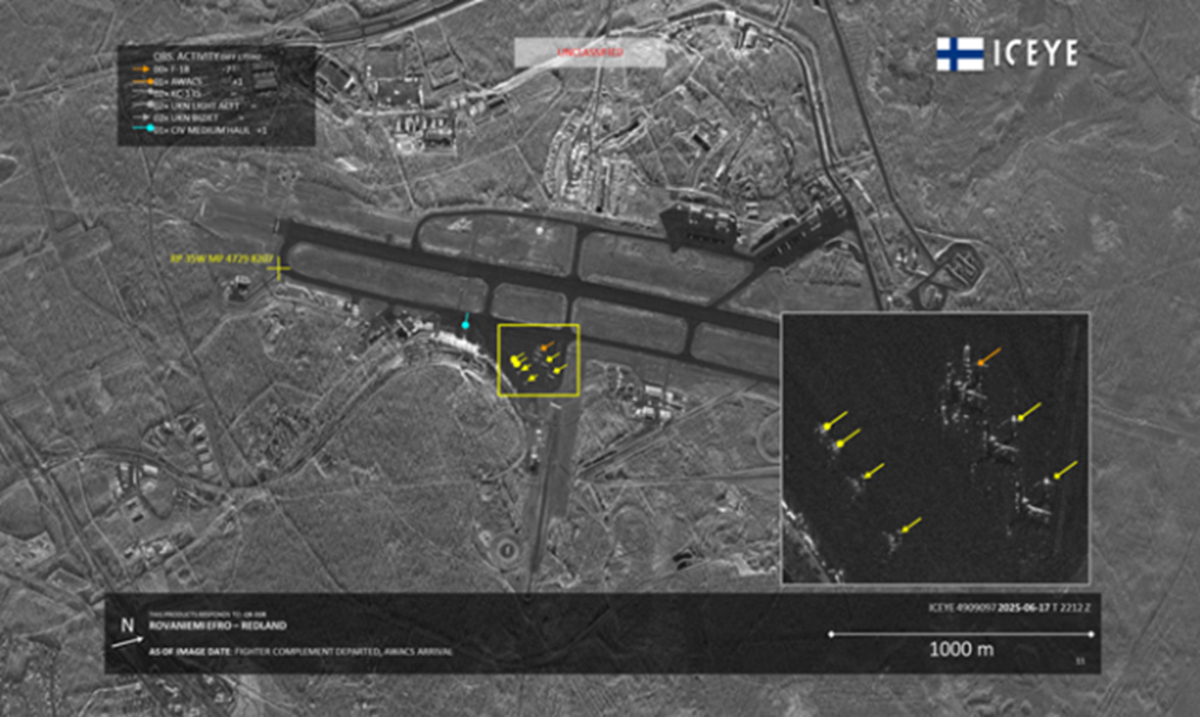
Finland will set up a military Space Operations Center on Jan. 1, 2027, to run the country’s space defense and take over the three radar imaging satellites the Finnish Defence Forces bought from ICEYE, the Finnish Air Force announced on Oct. 30.
Defense Minister Antti Häkkänen approved the new center, which will sit within Air Force headquarters at Tikkakoski, near Jyväskylä in central Finland. It will start with about 20 military and civilian specialists transferred from elsewhere in the Defence Forces, a number the Air Force expects to grow as Finland’s military space capabilities expand. The Air Force did not give a budget for the center.
The center will build a military picture of what is happening in space, coordinate space activity with NATO and partner countries, and plan and run the Defence Forces’ own space systems. It will work with the civilian space situational awareness center at the Finnish Meteorological Institute and with allies, combining national, allied, commercial and open-source data to issue warnings, threat assessments and analysis to military commanders.
“The importance of space has grown rapidly in recent years, both for civilian society and for warfare. Russia’s war of aggression in Ukraine has shown in concrete terms that space technology supports the operations of forces fighting on land, at sea and in the air, and that as an operating environment it is an essential part of modern multi-domain operations,” said Col. Jari Kumpuniemi of the Air Force headquarters.
Finland’s first military satellites form the core of the new center’s work. The Defence Forces signed a contract with ICEYE in September 2025 for a satellite remote sensing system, valued at about €158 million (about $176 million), including options to extend the satellites’ service life and expand the system. The Air Force has now confirmed it includes three satellites carrying synthetic aperture radar, or SAR, which were launched in 2025 and 2026. ICEYE has operated them under the contract until now, and the Defence Forces will take over operations on April 1, 2027.
SAR satellites bounce radar signals off the ground to build images, so they can see through clouds and at night, an advantage in Finland’s often overcast northern climate. The Air Force said the satellites give the Defence Forces an initial independent space-based intelligence and surveillance capability, and that their data can also be shared with other Finnish authorities and NATO allies.
ICEYE, based in Espoo, Finland, has sold satellites or ordered systems to several NATO members, including the United States, the Netherlands, Poland, Germany, Sweden and Portugal. Poland took control of its own ICEYE constellation less than a year after signing its contract, a similar model of buying satellites and then running them in-house that Finland is now following. The Finnish Defence Forces said they are also building cooperation with allies that operate SAR satellites.
Commercial radar satellites have also drawn Russian attention. A Russian military satellite maneuvered to within about 5 km (3 miles) of an ICEYE satellite in October and has held position near it, according to tracking data.
Content preview only. Full article available at source. View Full Article
Finland will establish a military Space Operations Center in Tikkakoski on January 1, 2027, to manage three radar imaging satellites acquired from ICEYE. The center will coordinate space activities with NATO and partner countries, starting with about 20 specialists. It aims to enhance Finland's military space capabilities and provide independent intelligence and surveillance through synthetic aperture radar technology.
- Finland will establish a military Space Operations Center on January 1, 2027.
- The center will manage three radar imaging satellites acquired from ICEYE.
- It will coordinate space activities with NATO and partner countries.
- The center will start with about 20 specialists and is expected to grow.
- The satellites will provide independent space-based intelligence and surveillance capabilities.