
U.S. Navy seeks “super intelligence” for future SSN(X) attack submarine
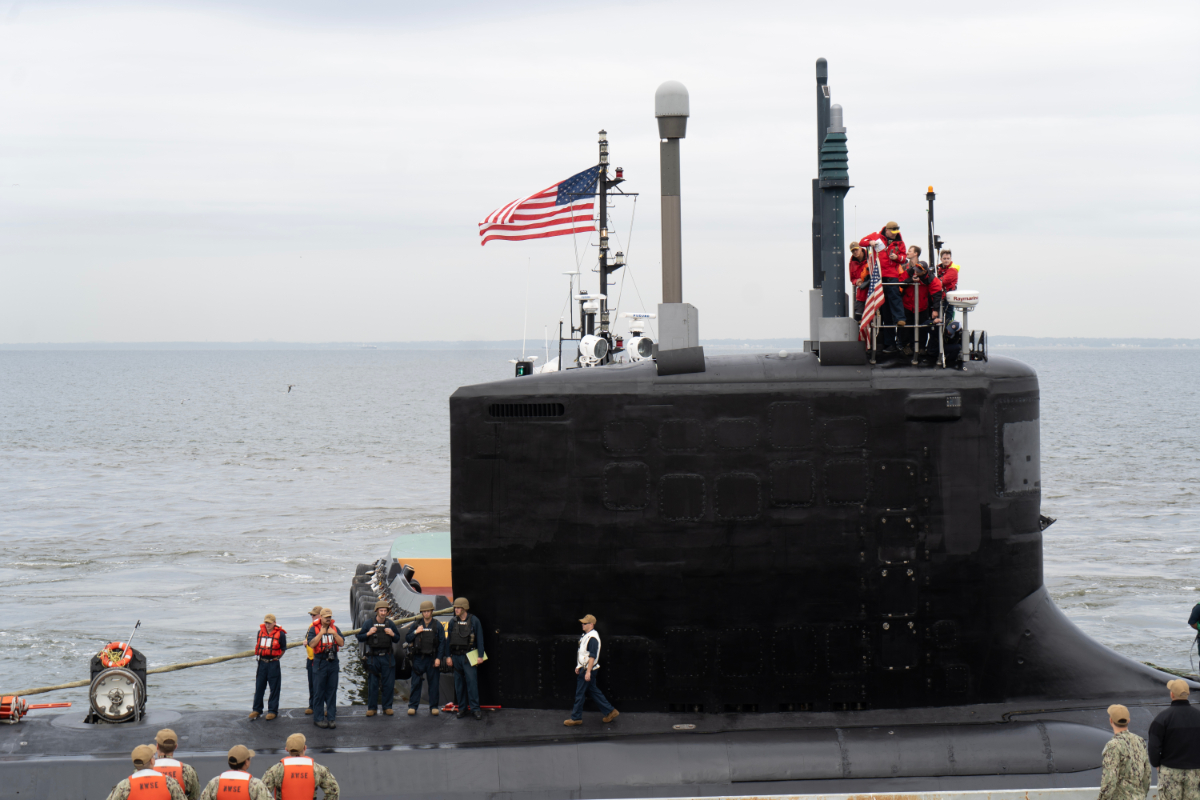
The U.S. Navy plans to ask industry for artificial intelligence tools to help lay out the interior of its next-generation attack submarine, SSN(X), and on Oct. 30 told companies to register their interest by Nov. 6. The submarine program office said a formal call for proposals could open as early as next week.
The notice comes from Naval Sea Systems Command’s Director, Submarine Programs, acting through the SSN(X) program office, PMS 351. It is a presolicitation: companies are asked for a short, non-proprietary expression of interest giving their capabilities and whether they are a traditional or non-traditional defense contractor. The notice gives no dollar value, number of awards or schedule beyond the response deadline.
“This forthcoming opportunity will solicit competitive industry concepts to leverage Super Intelligence to advance the design of a novel SSN(X) System Arrangement Concept Design and reduce technical risk associated with its integration within a hydrostatically balanced Whole-Ship Submarine Concept Design,” the notice says.
Super intelligence is the U.S. Navy’s new official term for artificial intelligence. In October, the service issued a memo ordering all commands to use “Super Intelligence” and “SI” in place of “Artificial Intelligence” and “AI” in official documents, following President Donald Trump’s Sept. 29 announcement retiring the older term. The SSN(X) notice is one of the first U.S. Navy acquisition documents to apply it.
The work itself centers on the submarine’s system arrangement: where reactor, propulsion, weapons, sensors, crew spaces and other equipment sit inside the hull. That layout drives the hull’s size, and every change shifts the boat’s weight and center of gravity. A submarine design has to stay hydrostatically balanced, meaning its weight and buoyancy match closely enough that the boat can hold depth and trim when submerged. The U.S. Navy wants competing concepts that use AI to explore arrangements quickly and check them against that whole-boat balance before engineers commit to a design.
The U.S. Navy will run the effort as an other transaction under 10 U.S.C. § 4022, a prototype authority that skips most standard procurement rules. To use it, the law generally requires at least one non-traditional defense contractor or nonprofit research institution to take a significant part in the project, an all-small-business or all-non-traditional team, or a one-third cost share from non-government participants. The notice points vendors to those conditions, and its question about each company’s status suggests the program office expects software firms from outside the submarine industrial base to bid.
Future SSN(X) attack submarine is the planned successor to the Virginia class. U.S. Navy officials have said they want it to combine the speed and payload of the Seawolf class, the quietness and sensors of the Virginia class, and the availability and service life of the Columbia-class ballistic missile submarine. In its fiscal 2025 budget, the U.S. Navy pushed procurement of the first boat from fiscal 2035 to fiscal 2040, citing limits on its overall budget. In January 2025, the Congressional Budget Office estimated the average SSN(X) at $8.7 billion per boat in fiscal 2024 dollars, against the U.S. Navy’s own estimate of $7.1 billion, based on a submerged displacement of about 10,100 tons.
Funding has moved in the other direction since. The U.S. Navy requested $622.8 million for SSN(X) research and development in fiscal 2026, including $256.8 million for next-generation attack submarine nuclear propulsion. Its fiscal 2027 request cut SSN(X) development funding by about $121 million to roughly $315 million, Naval News reported this month, as the program shifts to settling design requirements and an acquisition strategy.
Only two U.S. shipyards can build nuclear-powered submarines: General Dynamics Electric Boat in Groton, Connecticut, and Quonset Point, Rhode Island, and Huntington Ingalls Industries’ Newport News Shipbuilding in Virginia. In July, the U.S. Navy awarded the two yards $76.6 billion to build nine Virginia-class attack submarines and five Columbia-class ballistic missile submarines, work that runs through July 2038. The U.S. Navy has warned that the delay between finishing Columbia design work and starting SSN(X) design creates a gap for the submarine design workforce. The new notice does not say how AI-generated arrangement concepts would feed into work by the two shipbuilders.
Content preview only. Full article available at source. View Full Article
The U.S. Navy announced plans to solicit proposals for artificial intelligence tools to assist in designing the interior of the next-generation SSN(X) attack submarine. Companies are required to register their interest by November 6, 2023, with a formal call for proposals expected soon. This initiative aims to leverage AI to optimize the submarine's system arrangement while maintaining hydrostatic balance.
- U.S. Navy plans to solicit AI tools for SSN(X) submarine design.
- Deadline for companies to express interest is November 6, 2023.
- The SSN(X) is intended to be the successor to the Virginia class submarines.
- Funding for SSN(X) development has been adjusted in recent budget requests.
- Only two U.S. shipyards can build nuclear-powered submarines.