
Fire Point and Hensoldt Freyja aim to solve Europe's Patriot problem for 700,000 dollars by 2027.
 Dr. Klaus Weber
Fire Point and Hensoldt Freyja aim to solve Europe's Patriot problem for $700,000 by 2027
$700,000 per interception attempt is the figure by which Europe's air defense debate should now be measured. Not because Fire Point and Hensoldt have already proven that their Freyja system can reliably bring down a Russian Iskander from the sky in 2027. But because this number more accurately describes Europe's institutional failure than any summit declaration: For the continent's most urgent capability, there are too few missiles, too few production lines, and too many procurement logics that still stem from the peace dividend.
The Ukrainian company Fire Point, known for its FP-1 and FP-2 long-range drones as well as the Flamingo cruise missiles, has reportedly expanded its role according to Defense News and earlier Reuters reports. From a manufacturer of deep strikes against Russian refineries and arms factories, it is set to become a provider of ballistic missile defense. The new FP-7.X interceptor is the core of the Freyja system. Hensoldt is supplying radar and sensor systems, and further discussions involve Thales, Leonardo, and Kongsberg for target tracking and command architecture.
From the Ukrainian improvisation model to the European security architecture
Fire Point claims that its drones account for up to 60 percent of Ukrainian strikes against targets in Russia. This figure comes from statements by co-founder Denys Shtilerman at Eurosatory 2026 and is politically as important as it is technically. It shows that Ukraine is no longer just a recipient of Western systems. It has become a laboratory for scaled, inexpensive, and brutally field-tested armaments.
This is uncomfortable for Europe. The European debate on strategic autonomy has long been a discussion about programs, funds, and industrial location logic. EDF, PESCO, SAFE, national special funds: All these instruments generate paper, loans, and industrial claims. Ukraine produces products under fire. One does not replace the other. But the order has shifted. Those who speak about European air defense today can no longer pretend that innovation automatically lies in Paris, Munich, Rome, or Stockholm.
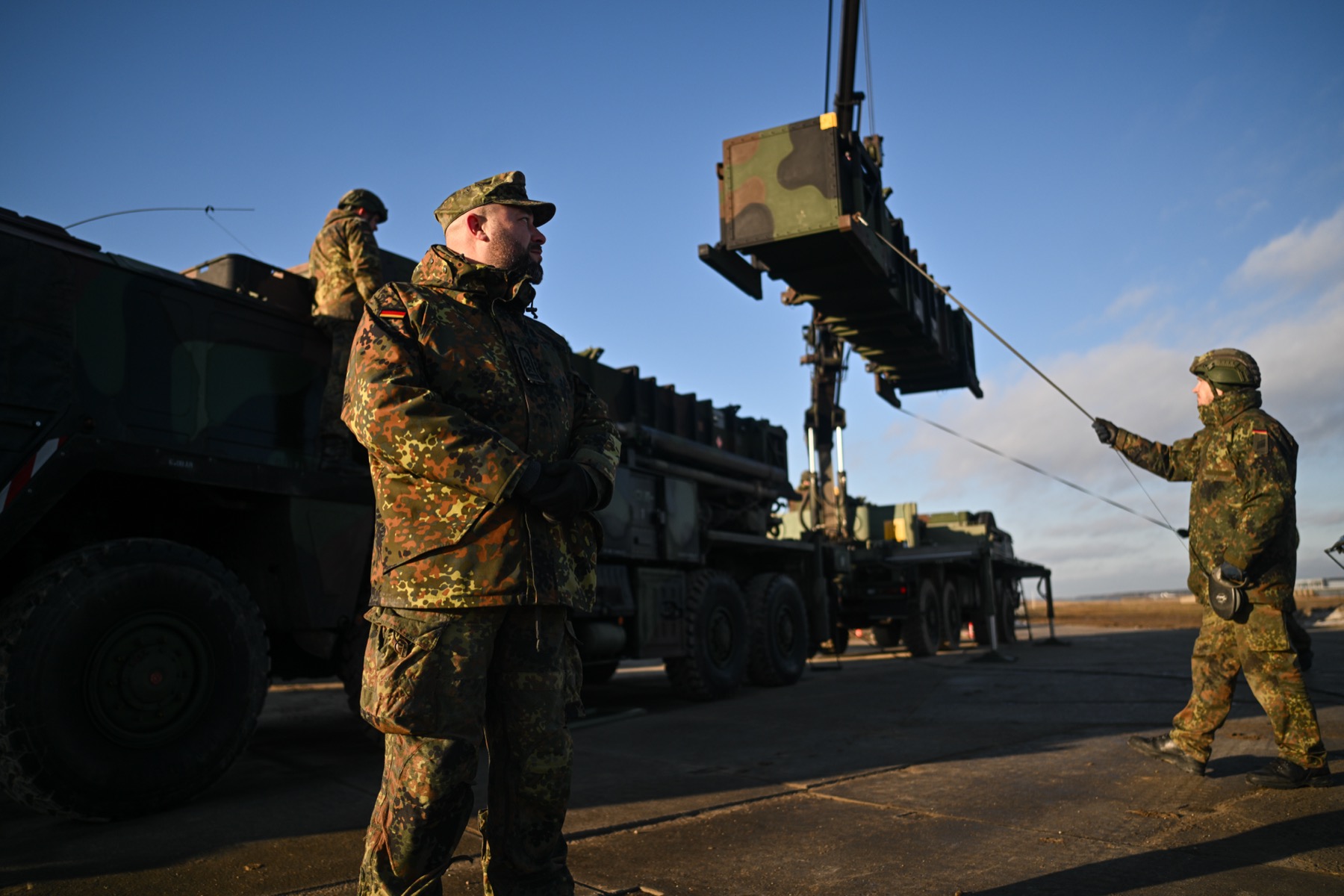
Freyja is intended to fill the gap that Patriot has made politically visible. A PAC-3 missile costs roughly $3.8 million, and often two or three interceptors are used against a ballistic target. Fire Point now speaks of about $700,000 per FP-7.X shot, an interception altitude of around 15 miles, and the goal of intercepting the first ballistic missile by the end of 2027. This is ambitious, perhaps too ambitious. But even if the hit rate were lower than that of Patriot, a cheaper interceptor changes the cost equation.
Germany provides sensors, but not automatically sovereignty
Hensoldt's role makes the case particularly interesting for Berlin. Germany possesses important partial capabilities with Hensoldt, Diehl, Rheinmetall, MBDA Germany, and other companies. What is often lacking is the ability to quickly translate these partial capabilities into a European usable overall system. Sensors are not the system. A missile is not the architecture. A memorandum is not yet a battery on the eastern flank.
This is precisely where Europe's institutional weakness lies. The USA does not just sell Patriot missiles. They sell an integrated system of radar, fire control, training, spare parts, industrial prioritization, and political commitment. Europe buys individual parts, celebrates national participation, and wonders why this does not lead to strategic autonomy. The difference between capability and capacity is particularly brutal in air defense: A capability can stand at a trade fair. Capacity only exists when a brigade can consume it monthly and the industry can replace it monthly.
The new project is therefore not a simple proof of European maturity. It is more of a test. Can a Ukrainian war producer, a German sensor specialist, and a network of European integrators build a system that does not suffocate under certification, export control, liability issues, and national procurement pride? Or will Freyja just be the next good idea that slowly evaporates in European interface protocols?
Patriot remains the benchmark, but also the problem
The comparison with Patriot is inevitable and at the same time dangerous. Patriot is not a single truck with missiles, but a developed ecosystem. It has weaknesses, it is expensive, and its availability is politically limited. But it works. The Ukrainian demand for more Patriot batteries does not stem from an aesthetic preference for American armaments, but from experience under fire.
Freyja cannot replace this system in the short term. However, it can create a second category: not the perfect defense against every high-value target, but an affordable, European-produced layer against certain ballistic threats. For Europe, this would be strategically more important than another press release about acceleration. Russian missiles force a munitions economy. If Moscow fires a relatively inexpensive missile and Europe responds with interceptors that are multiple times more expensive, Russia does not necessarily win militarily, but it gains fiscal time.
The numbers are incomplete and must be read carefully. Fire Point is also under corruption scrutiny in Ukraine, although no charges have been filed against the company so far. The claimed mass production of three interceptors per day starting in August must first be industrially and quality assured. And a controlled test flight is not yet a successful interception attempt against a maneuvering target. Weberian speaking: The prototype is a hypothesis, not a military capability.
Europe's real decision will be made before 2027
For this reason, Europe should take Freyja seriously. Not as a wonder weapon, but as an institutional stress test. If EU states only observe the project until it is perfect, they will order American systems again in 2027. If they politically overinflate it too early, they risk the next disappointed prestige program. The right path lies in between: clear test milestones, joint financing, open interfaces, early user states, and a procurement architecture that does not treat Ukrainian experience as an exotic special case.
SAFE loans and national special funds could here exceptionally be more than just accounting. But only if the money is tied to measurable production capacity: how many radar sets, how many seekers, how many interceptors per month, what spare parts reserve, what training cycles. Europe's problem is not that it talks too little about air defense. Europe's problem is that after every conversation, it reactivates national program logics.
Freyja will not end Europe's dependence on Patriot simply because a Ukrainian interceptor is cheaper. It could only reduce it if Europe integrates faster for the first time in years than Russia adjusts its attack profiles.
This is the real test point. More money without industrial discipline produces expensive scarcity. Cheap innovation without European integration produces interesting prototypes. Between these two errors lies the task that Berlin, Brussels, and Kyiv must now solve. Europe still needs Patriot. But if it can only buy Patriot in 2027, it will have observed everything from the war and learned very little.
Fire Point and Hensoldt are developing the Freyja air defense system to intercept ballistic missiles by 2027, with a projected cost of $700,000 per interceptor. This initiative aims to address Europe's air defense shortcomings, particularly against Russian threats. The project highlights the need for improved European defense integration and capability, as current systems like Patriot are costly and politically limited. Fire Point claims its drones have played a significant role in Ukrainian strikes against Russian targets, indicating a shift in Ukraine's role in defense technology.
- Fire Point and Hensoldt are developing the Freyja air defense system to intercept ballistic missiles by 2027.
- The cost per interceptor is projected to be around $700,000, significantly lower than existing systems.
- The system aims to address Europe's current air defense shortcomings against threats like Russian missiles.
- Fire Point claims its drones have been responsible for a significant percentage of Ukrainian strikes against Russian targets.
- The project is seen as a test of European defense integration and capability.