
Flash Review | Japan Plans to Introduce Unmanned Submarines, Revealing Militaristic Ambitions
Japan has taken a dangerous step in expanding its military capabilities. Several Japanese officials revealed on June 27 that the Japanese government has begun researching the introduction and deployment of unmanned submarines capable of anti-ship attacks, in order to strengthen its defense system on the Pacific side. Is Japan's move truly just about strengthening defense, or is there something more behind it?
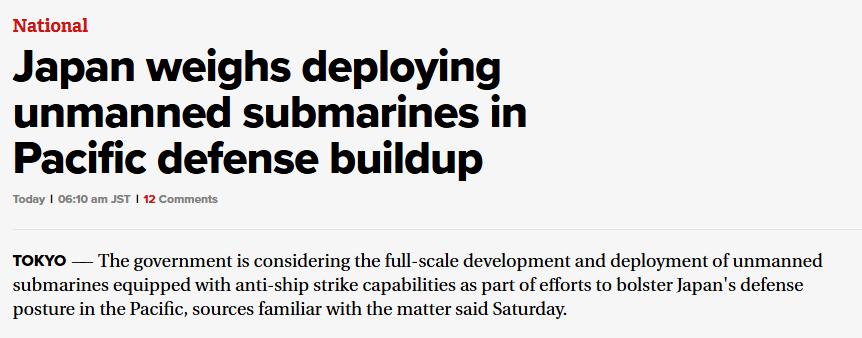
Screenshot from the "Today Japan" website
Military observer Wei Dongxu stated in an interview with the Global Information program "Flash Review" that Japan currently does not face any real security threats in the Pacific direction. Therefore, the Japanese side's excuse of developing large attack unmanned submarines under the pretext of "responding to defense needs in that direction" is completely unfounded.
Japan is currently continuously expanding its military forces, especially in strengthening its offensive capabilities. There are two purposes for developing large unmanned submarines aimed at the Pacific direction.
First, these large submarines can act as underwater spies, tracking other countries' surface ship formations and aircraft carrier groups, and it is even possible that they could spy on submarines conducting training missions in relevant maritime areas.
Second, they will also serve as tools for underwater surprise attacks and attack platforms, not only being large but also potentially carrying submarine-launched missiles or torpedoes, allowing them to strike maritime and underwater targets of the adversary. Therefore, these large unmanned submarines with offensive attributes represent Japan's attempt to plan attacks and surprise strikes underwater, which is worthy of vigilance and attention.
Reports indicate that the Japanese government envisions introducing unmanned submarines capable of carrying torpedoes and mines, with the goal of achieving long-range and prolonged operational capabilities.

Screenshot from the "Today Japan" website
Wei Dongxu believes that Japan's development of such large unmanned submarines is primarily aimed at strengthening underwater offensive capabilities, rather than meeting defense needs. From the current situation, Japan is attempting to bypass its pacifist constitution and break through the "defense-only" principle, further enhancing and strengthening its maritime attack capabilities.
These large unmanned submarines may be independently developed by Japan or jointly developed with the United States or its allies. Under the framework of the "AUKUS" second pillar, Japan, Australia, the United Kingdom, and the United States will jointly develop large unmanned submarines, so it is not ruled out that the Japan Self-Defense Forces may adopt a technology introduction approach, spending heavily to acquire large unmanned submarine technology from the United States and Australia, and then localizing it to meet the operational needs of the Japan Maritime Self-Defense Force, which has offensive attributes.
Initial models may primarily be used for underwater mine laying, quietly submerging to reach the coastal areas of other countries to conduct underwater offensive mine laying, placing mines at the doorstep of others to implement destruction and route blockage. Subsequently, these large unmanned submarines may become larger, with continuously improved performance, evolving into unmanned submarines equipped not only with advanced sonar equipment but also with torpedoes or submarine-launched anti-ship missiles, making the attack targets more diverse and the submarines more dangerous.
In addition to manned frigates and submarines, Japan will also coordinate the use of unmanned surface vessels equipped with missile launch systems. Wei Dongxu analyzes that the Japan Maritime Self-Defense Force is currently focusing on developing unmanned combat platforms. Due to Japan's late start and weak foundation in this field, having missed important opportunities, Japan is now attempting to accelerate technological development and practical deployment through cooperation with the United States and its allies. Furthermore, the development of unmanned combat platforms is also related to the current personnel issues Japan is facing.
Japan is continuously bypassing its "peace constitution," breaking through the "defense-only" principle, and exhibiting a warlike posture, which many Japanese citizens strongly oppose. As a result, the number of young people joining the Self-Defense Forces is not particularly high, leading to a shortage of personnel. The same applies to the Maritime Self-Defense Force. Japan is attempting to develop more unmanned combat platforms to address the issue of personnel shortages, while also aligning with its outward-oriented offensive military development, necessitating deep military integration with the United States. As the U.S. Navy is vigorously developing unmanned vessels and unmanned submarines, the Japan Maritime Self-Defense Force cannot afford to have shortcomings in relevant equipment during joint operations with the U.S. Navy.
Wei Dongxu stated that Japan's development of unmanned submarines and unmanned vessels, which have obvious offensive attributes, will undoubtedly have a negative impact on the regional military balance.
In the future, whether executing reconnaissance missions, spying tasks, or conducting military deterrence against other countries, these developments will undermine regional peace and stability, and may even affect shipping security in the Western Pacific region. Therefore, it is essential to remain vigilant and attentive to Japan's development of unmanned fleets or unmanned underwater combat platforms, observing the offensive capabilities of these platforms, the future deployment areas, and considering countermeasures and means of prevention and balance in advance.
Japan is researching and planning to deploy unmanned submarines with anti-ship capabilities to enhance its defense in the Pacific. This development, revealed on June 27, 2023, is viewed as a move towards offensive military capabilities rather than mere defense. The submarines are intended for reconnaissance and potential attacks, raising concerns about regional military balance and stability.
- Japan is developing unmanned submarines with anti-ship capabilities.
- The submarines may serve as underwater spies and attack platforms.
- Japan's actions are seen as a shift towards offensive military capabilities.
- The development is linked to Japan's collaboration with the U.S. and allies.
- Japan faces a shortage of military personnel, prompting a focus on unmanned platforms.