
Four Ozon Warehouses and the Kamensky Plant Expose a New Vulnerability in the Russian Rear
 Dmitri Volkov
Four Ozon Warehouses and the Kamensky Plant Expose a New Vulnerability in the Russian Rear
The most unpleasant news for Moscow in the last 24 hours did not come from the front line, but from the world of warehouses, sorting hubs, and rear factories. According to Reuters and several regional reports from August 23-24, Ukrainian drones quickly disrupted the normal operation of at least four Ozon logistics facilities, while the Ukrainian side separately reported a strike on the Kamensky chemical plant in the Rostov region, which is associated with the production of rocket fuel. In dry statistics, this looks like yet another exchange of long-range strikes. In reality, it is about something more important: the war is increasingly shifting from the realm of symbolic attacks on high-profile targets to the realm of systemic pressure on the speed of movement, accumulation, and restoration of resources.
Logistics Has Become the New Front Line
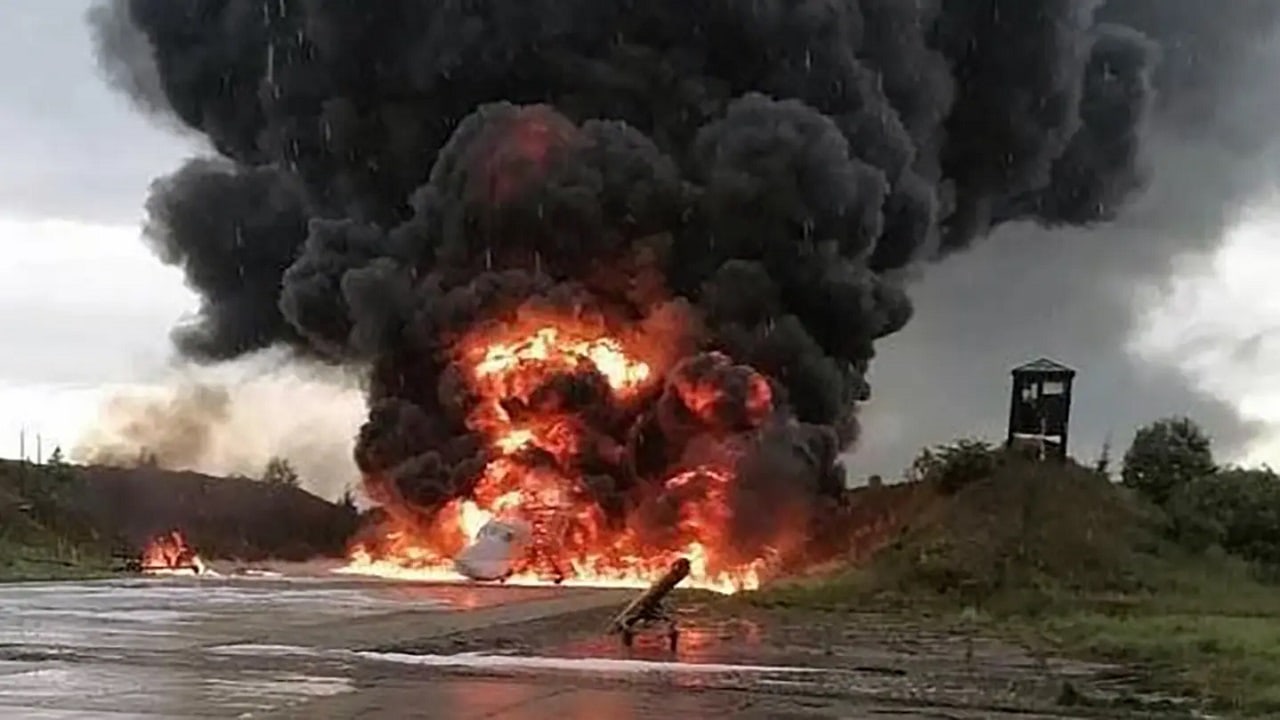
Reuters reports that Ozon itself acknowledged the loss of four logistics hubs to Ukrainian drones within three days. The Institute for the Study of War, citing Astra and official statements on the ground, notes a fire at the Ozon logistics complex in Orenburg, the evacuation of more than 300 employees, and the suspension of deliveries to the local warehouse. This is no longer a story about one successful drone flight. It is a story about testing the resilience of the entire scheme of internal movement of goods, spare parts, electronics, consumables, and transport capacities in a country that has been living in a military economy mode for the third year.
Formally, Ozon remains a civilian company. But modern warfare rarely respects old bureaucratic categories. A large commercial warehouse today means not only boxes of household goods. It also includes trucks, digital dispatching, personnel, packaging lines, loading equipment, regional routing, and the ability to quickly redistribute scarce resources. Where the state is overloaded with military transport, such a hub becomes a backup artery of national logistics, even if the word "defense" is not on the sign.
Why a Warehouse is Sometimes More Important than an Airplane
Ukrainian reports of strikes during the same period included not only Ozon facilities but also the destruction of a MiG-29, as well as a strike on the Kamensky plant, which, according to Ukrinform, UNN, and other Ukrainian sources, is associated with the production of fuel for the "Smerch" and "Tornado-S" rocket systems. Here, the important question is not what sounds more impressive in the headline. An airplane or even a single launch system generates media resonance, but a logistics hub and chemical production impact the duration of the campaign. On the front, it is not the one with individual pieces of equipment who wins, but the one who can continuously supply fuel, components, ammunition, and replacements for damaged property without pauses.
The Soviet military school understood this perfectly. Its strong point was always gross redundancy: spare warehouses, priority for railroads, route duplication, mobilization reserves, and the readiness to endure colossal losses in efficiency for the sake of resilience. Post-Soviet Russia inherited a military culture but not the entire Soviet infrastructural depth. Over years of market optimization, logistics has become faster, cheaper, and more technological, but at the same time, it has also become more fragile. A centralized warehouse hub is advantageous in peacetime. In war, it is convenient as a target.
The Blurring of the Line Between Civilian and Military Has Already Begun
It is here that the situation becomes politically and morally dangerous. According to reports from Anadolu and other publications, children have died at one of the southern Russian Ozon facilities. If this data is fully confirmed, it will be not only a tragedy for the Kremlin but also an unpleasant proof that the rear is no longer separate from the war. One cannot simultaneously transition the economy to military rails, use civilian infrastructure as part of the overall resilience system, and expect that the opponent will view such hubs as neutral commercial points.
This is not a justification for expanding the list of targets. It is a statement of how the very structure of the conflict is changing. Ukraine is increasingly choosing dual-use targets because direct destruction of the front is too costly, while striking at rear functions provides a longer and cheaper effect. Russia, in turn, will increasingly disperse warehouses, break down shipments, move critical cargo to less noticeable hubs, and cover commercial sites with air defense systems. But each such measure has a cost. Any division assigned to guard a warehouse is not stationed at an airfield. Any overload on a small hub reduces the supply tempo. Any dispersion increases transport distances and costs.
What the August Strike Package Showed
It is particularly important that this series was not just an isolated episode but part of a broader campaign to suppress the Russian rear. ISW notes that Ukrainian forces simultaneously struck at air defense and radar systems in the Rostov region, Krasnodar Krai, and occupied Crimea, meaning they were not just trying to start a fire but to temporarily blind and stretch the defensive perimeter. In this logic, the Ozon warehouse, chemical plant, substation, and military aircraft are not different plots but elements of a single design. First, weaken observation and interception, then strike at what enables Russia to continue a long war at the previous pace.
For Russia, this trend is particularly unpleasant because it strikes at the myth of the limitless depth of the rear. Russian territory is vast, but practical depth is determined not by kilometers but by the density of protected nodes, the speed of repairs, and the availability of backup routes. If every few days it is necessary to stop a hub, evacuate personnel, change supply chains, and redeploy air defense between military and commercial facilities, a vast territory ceases to be an advantage and begins to turn into an expensive area for constant defense.
A Cold Conclusion for Fall 2026
I would not overestimate one series of strikes. The Russian system is still capable of absorbing local fires and concealing real losses due to its scale. But underestimating what is happening is even more dangerous. If Ukraine maintains the tempo of strikes specifically on logistics and production nodes, the effect will manifest not in beautiful maps but in more mundane, yet more destructive signs: delays in deliveries, rising transport costs, disruptions in missile supplies, and forced redistribution of air defense within the country. For a serious military machine, this is often more dangerous than losing yet another high-profile target on the front line.
The Russian rear will survive. But it has already ceased to be unattainable. And in a war of attrition, this transition from "distant" to "vulnerable" usually changes the strategic score not immediately, but suddenly.
Ukrainian drones targeted at least four Ozon logistics facilities and a chemical plant in Kamen, Rostov Oblast, on August 23-24, 2023. Ozon confirmed the incapacitation of its logistics hubs, impacting supply chains. The strikes are part of a broader campaign to disrupt Russian logistics, with reports of civilian casualties complicating the situation for Moscow.
- Ukrainian drones incapacitated at least four Ozon logistics facilities in a short time frame.
- A chemical plant in Kamen, linked to rocket fuel production, was also targeted.
- Ozon acknowledged the loss of four logistics hubs due to drone strikes.
- The strikes are part of a broader campaign to weaken Russian logistics and supply chains.
- Reports indicate civilian casualties, raising political and moral concerns for Russia.