
FP-5 Flamingo Strikes Volgograd and Shows the Limits of Russian Defense in 2026
 Dmitri Volkov
FP-5 Flamingo Strikes Volgograd and Reveals the Limits of Russian Defense in 2026
660 Ukrainian drones, which the Russian Ministry of Defense reported intercepting in one night, already look like statistics of a new type of war. But a more important number is this: according to Volodymyr Zelensky, Russia launched about 1400 strike drones, nearly 1500 guided aerial bombs, and 19 missiles at Ukraine in a week. Against this backdrop, the Ukrainian statement about the defeat of a military facility in Volgograd by FP-5 Flamingo missiles does not appear as a separate episode, but rather as a response to the very economy of Russian firepower.
In the old Soviet logic, the deep rear was not just geography. It was part of a resilience system: factories, warehouses, railroads, repair bases, and air defense were supposed to form a unified contour. The war of 2026 is destroying this very contour. The strike on Volgograd is important not because one factory supposedly determines the fate of the front. That’s not how it works. It is important because Ukraine is increasingly shifting the war from the plane of “how many drones arrived at night” to the plane of “how much it costs Russia to maintain the pace of the next week.”
Why Volgograd is More Important than a Regular Strike Map
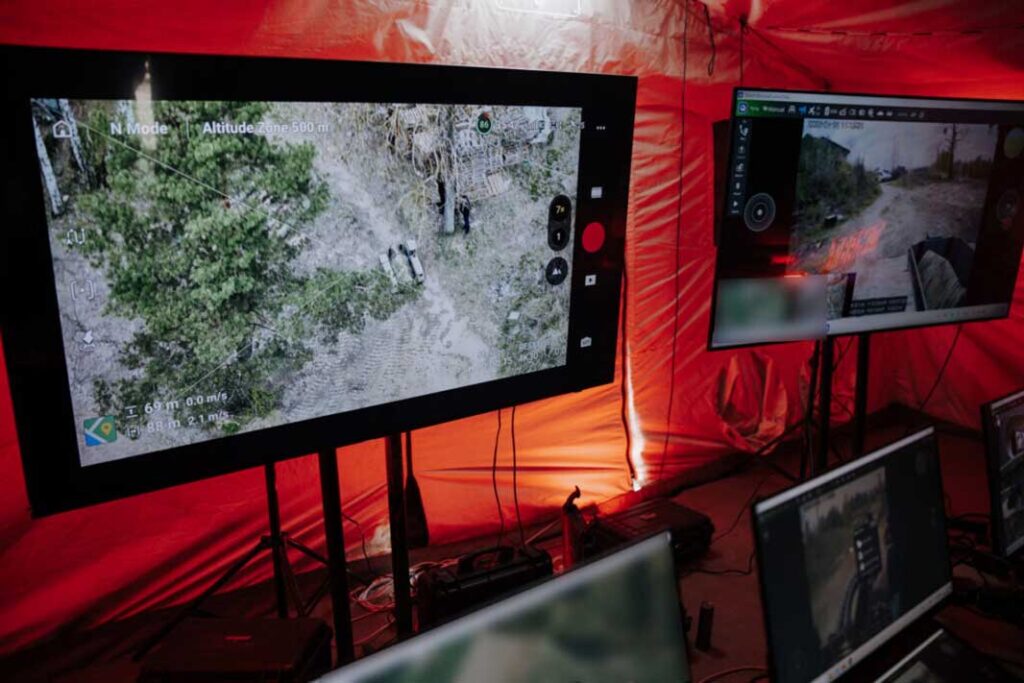
According to reports from Ukrainian and international sources on June 27, the target was a key military industrial site in the Volgograd region. In public Ukrainian formulations, it refers to a facility related to the artillery and missile production cycle. The name of the specific object requires caution: several sites in the industrial geography of Volgograd have historically worked on defense contracts, and the military purpose of a workshop does not always coincide with the name of the legal entity. But here, what matters is not the sign at the entrance, but the function. Such factories do not produce “wonder weapons,” but rather a serial routine: casings, components of launch systems, repair capacities, metallurgical and mechanical bases.
FP-5 Flamingo, if we believe the characteristics claimed by the Ukrainian side, belongs to a new generation of long-range systems: a range of several thousand kilometers and a heavy warhead make it not a replacement for ATACMS or Storm Shadow, but an attempt to create its own class of strategic industrial pressure. Here I deliberately write “if we believe.” The war has generated too many presentation figures. But even if the actual characteristics are lower than advertised, the very fact of strikes on Volgograd shows that the Ukrainian guidance, route planning, and reconnaissance support systems are already capable of operating against targets far beyond the border zone.
Russian Air Defense Faced Not Just One Missile, but Accounting
Russian official statistics on interceptions have long had a dual nature. On one hand, they do reflect the scale of the threat: if Moscow reports hundreds of downed devices, it means the Ukrainian barrage was very large. On the other hand, such figures become a convenient form of reassurance, because the public is shown “downed targets,” not the cost of nighttime defense, the expenditure of anti-aircraft missiles, the wear on radars, the load on crews, and the number of objects that still sustained damage. 660 reported interceptions in one night is not only a success for air defense. It is the bill that Ukraine presents to the Russian defense system.
In Soviet military literature, the term “tension of the control system” was often used. Today, it is more accurate to speak of the tension of the entire rear defense system. When drones are flying over 13 regions, including the Moscow region, Crimea, the waters of the Black and Azov Seas, the command is forced to allocate resources not by military importance, but by political sensitivity. Moscow demands protection, Crimea demands protection, oil depots demand protection, factories demand protection, airfields demand protection. It is impossible to protect everything. Sergey Aksyonov, the de facto head of the occupation administration in Crimea, admitted this almost military-honestly: absolute air defense does not exist. In Russia, such phrases are usually uttered only when denial has become pointless.
Ukraine Strikes Production, Russia Strikes Cities
On the Ukrainian side, the picture is also not romantic. While Kyiv demonstrates the ability to strike Volgograd, Russia uses about 1400 strike drones, around 1500 guided aerial bombs, and 19 missiles in a week. This arithmetic speaks of two different wars within one war. Russia uses mass: cheap drones, glide bombs with guidance modules, nighttime pressure on energy, farms, gas facilities, frontline cities, and residential infrastructure. Ukraine responds with precision and range, choosing targets that can increase the cost of Russia's next attack.
The difference is fundamental. The Russian way of war in 2026 increasingly resembles the late Soviet habit of compensating quality with quantity. If a guided bomb with a planning module is cheaper than a full-fledged cruise missile, it will be dropped by the hundreds. If Shahed and its Russian analogs can be produced in series, they will be sent in waves. But such a model requires a stable industrial backbone: explosives, engines, casings, electronics, transport, repairs, and labor shifts. The strike on Volgograd is therefore not a “symbolic response.” It is an attack on a node where quantity turns into munitions.
The main question now is not whether Russia can shoot down some of Ukraine's long-range systems. Of course, it can. The question is whether it can protect more and more objects without reducing the pace of its own fire production.
The Belarusian Factor Shows Moscow's Nervousness
Against this backdrop, reports of possible Russian pressure on Belarus do not appear to be a random diplomatic smokescreen. Zelensky stated that Minsk is developing border infrastructure and warehouses under Russian influence; the Kremlin and Lukashenko deny this. The likelihood of the Belarusian army directly entering the war remains low: Lukashenko remembers too well the price of 2022 and does not want to turn his army into expendable material. But the very topic is important as an indicator. If the Russian rear is becoming less secure, Moscow is looking for ways to expand the geography of threats to Ukraine — missile routes, airfields, warehouses, pressure on the northern direction.
This is a classic strategic attempt to exchange space for time. Russia wants to force Ukraine to keep air defense, reconnaissance, and ground cover forces not only in the east and south but also in the north. Ukraine, in turn, is trying to force Russia to stretch its air defense from Crimea to the Volga and from Tula to Novorossiysk. What results is not a front in the old sense, but a multi-layered map of mutual exhaustion. One layer is Ukrainian cities under bombs. The other is Russian industry under long-range strikes.
What FP-5 Flamingo Will Change
I would not make Flamingo into a Ukrainian “wunderwaffe.” The Russian military tradition knows well how belief in one decisive piece of technology ends. But the emergence of a national long-range system changes the political math. Kyiv is less dependent on whether Western capitals will allow another type of strike on Russian territory. Moscow, in turn, can no longer assume that the deep rear is protected only by Western diplomatic constraints. This does not negate Western supplies, but it reduces Russia's ability to manage escalation through fear of them.
For the Russian defense industry, the consequences will be gradual. One strike rarely breaks production. Several successful strikes force the dispersal of stocks, changes in schedules, the construction of shelters, the redeployment of air defense, the relocation of some processes, the introduction of nighttime restrictions, and complicating logistics. All of this increases costs. In a peacetime economy, such expenses would be called inefficiency. In a wartime economy, they will be called “measures to increase resilience.” The meaning is the same: every ton of steel, every radar, and every trainload starts to cost more.
The Russian system will withstand this blow. It is too large, inertial, and harsh on its own costs to collapse from one episode. But if the dynamics of June persist, by the fall of 2026, Moscow will face a more unpleasant problem: the war of attrition will begin to exhaust not only Ukrainian air defense and population but also Russia's ability to protect mass production. In this sense, Volgograd is not a finale or a turning point. It is a warning written in a language that the General Staff understands best: range, cost, repeatability.
Ukrainian forces struck a key military industrial site in Volgograd on June 27, 2026, using FP-5 Flamingo missiles, highlighting the limitations of Russian defense systems. This attack is part of a larger Ukrainian strategy to disrupt Russian military production capabilities, as Russia has reportedly deployed around 1400 strike drones and 1500 guided bombs in recent operations. The incident underscores the evolving nature of the conflict, with Ukraine increasingly targeting critical infrastructure.
- Ukrainian forces launched an attack on a military industrial site in Volgograd using FP-5 Flamingo missiles.
- Russia reported intercepting 660 drones in one night, indicating a large-scale Ukrainian drone operation.
- Over the past week, Russia deployed approximately 1400 strike drones and 1500 guided bombs against Ukraine.
- The attack on Volgograd signifies a shift in Ukraine's strategy to target Russian industrial capabilities.
- The situation reflects a broader trend of escalating military operations between Ukraine and Russia.