
France buys 17 Giraffe 1X radars and tests mobile drone defense until 2027
 Dr. Klaus Weber
France buys 17 Giraffe 1X radars and tests mobile drone defense by 2027
17 radars are not a revolution in air defense. But in France's new order of Saab Giraffe 1X lies a sober truth that is often overlooked in European defense debates: Those who want to combat drones, cruise missiles, and mortar rockets first need a reliable situational picture in the lower airspace. Without sensors, even expensive air defense systems remain blind, too slow, or too centralized.
On May 18, Saab and Scania France reported a contract with the French Direction générale de l'Armement. It includes 17 Giraffe 1X 3D radars, spare parts, training, and support. One radar is intended for testing and evaluation, while 16 systems are to be installed on the Scania V3P chassis developed by Scania France and the SPAD division in Angers. Deliveries are planned for 2026 to 2027. These numbers may seem small. Precisely for that reason, they are analytically interesting.
Why 17 radars mean more politically than their quantity
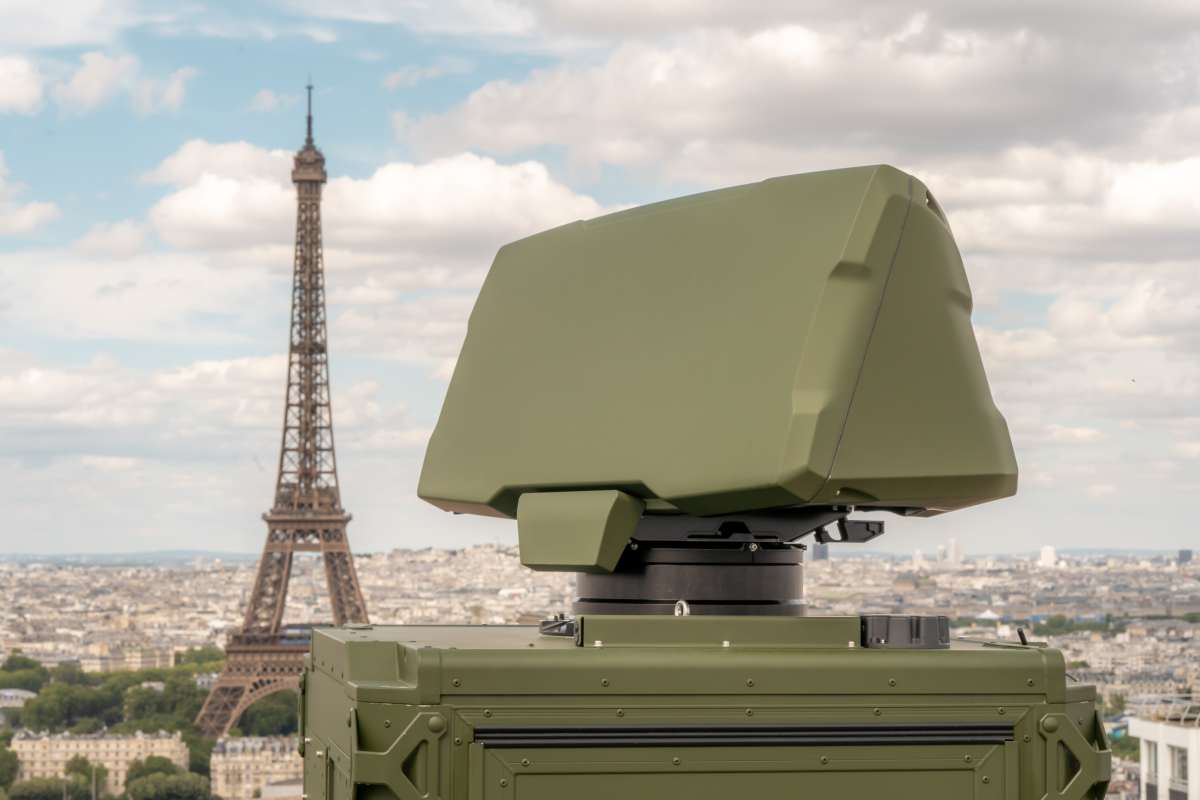
France has a strong aerospace and missile industry, from Rafale to SAMP/T to MBDA systems. Nevertheless, the Giraffe 1X contract reveals a gap below the classic high-value defense. The war in Ukraine has shown that the most dangerous airspace often does not begin with ballistic missiles, but with small drones, loitering munitions, improvised FPV systems, and low-flying cruise missiles. These targets do not demand a glamorous strategy. They demand many sensors, short reaction times, and robust data connections.
The Giraffe 1X fits precisely into this level. Saab describes the system as a compact, lightweight 3D multi-mission radar for Ground Based Air Defence, Very Short Range Air Defence, Counter-UAS, and C-RAM warning. According to the manufacturer, the entire system weighs less than 150 kilograms, scans the search area every second, and can track small UAVs in cluttered environments. More important than the individual number is the architecture: Such a radar is not intended as a national shield, but as a distributed eye close to maneuvering forces, depots, airfields, or temporary deployment sites.
The French decision is also an institutional decision
That the 16 operational radars will be mounted on a Scania V3P chassis is not a logistical detail. It shows that Paris is not just buying a sensor module, but a mobile tactical package. The SPAD integration in Angers gives the order a French industrial component, while the core technology comes from Sweden. This is classic European defense cooperation on a small scale: less symbolic than FCAS, but faster, more concrete, and operationally tangible.
This is precisely where the contrast lies with many large European programs. FCAS, MGCS, or joint air defense initiatives do not fail due to the insight that cooperation is necessary, but due to leadership claims, division of labor, export policy, and national industrial policy. In the Giraffe 1X order, governance is simpler: one Swedish sensor, one French-integrated vehicle, one national procurement authority, a manageable delivery timeframe. Europe is not always incapable of defense cooperation. It is often incapable of cooperation once prestige, system leadership, and decades-long industrial shares are on the table.
Sensors are the underestimated currency of drone defense
The European debate on air defense has been heavily missile-focused since 2022. Patriot, IRIS-T SLM, SAMP/T, NASAMS, and Skynex dominate the political language. This is understandable but incomplete. Drone defense does not begin with shooting down, but with detection, classification, and prioritization. A small quadcopter, a Shahed-like loitering UAV, and a cruise missile generate different tactical and economic decisions. Those who recognize them too late waste expensive ammunition or accept hits.
Here, France's procurement is instructive. 17 Giraffe 1X do not replace medium or long-range systems. They densify the lower sensor layer. This is a capability that European armed forces have long treated as a secondary task because air superiority and expeditionary operations have shaped the view. In Mali, Iraq, or the Levant, a mix of reconnaissance, air power, and protected base infrastructure was often sufficient. In a European high-intensity war, this assumption is no longer tenable. Every brigade, every airfield, and every ammunition depot becomes a target for cheap, numerous, and hard-to-predict air threats.
France modernizes, but does not solve the quantity problem
Nevertheless, the order remains limited. 16 radars installed on vehicles can cover priority areas, but they do not create comprehensive national or expeditionary drone defense. France must decide whether these systems primarily serve the army, base defense, critical infrastructure, or mixed task forces. This is where the institutional question begins: Who owns the situational picture, who distributes the data, and who decides which target to engage with what effect?
The French model is traditionally highly centralized and technologically demanding. For drone defense, this can become a problem. Small threats require a shorter command chain than classic air defense. If every target has to go through too many hierarchical levels, the system loses the seconds that a short-range radar is supposed to gain. Therefore, procuring a software-based, updatable sensor is only the first step. The second step is more uncomfortable: France must reorganize its tactical air defense so that sensor data reaches the right shooters, jammers, or command posts in real-time.
A small procurement with European lessons
For Europe as a whole, the order shows three things. First: The Nordic defense industry remains a central capability provider in sensor technology and ground-based air defense, even for large states like France. Second: Strategic autonomy does not mean producing everything nationally; it means consciously managing critical dependencies. Third: The next European air defense gap will not only arise in missile stocks but in the integration of many small sensors into a resilient tactical network.
One can overrate the contract if it is sold as a French breakthrough. But one underestimates it if it is read only as a small order. France buys 17 radars because modern air warfare no longer consists solely of aircraft and missiles. It consists of thousands of small signatures, short decision windows, and the banal question of whether a unit can even see in time what is flying towards it.
The European defense question here is not whether 17 Giraffe 1X are enough. It is whether Europe has finally understood that air defense is primarily a sensor and data architecture. More interceptor missiles do not solve this problem if the target is recognized too late, incorrectly, or not at all.
Source situation
- Saab, press release from May 18, 2026, regarding the order for 17 Giraffe 1X radars on French tactical vehicles.
- Defence Industry Europe, report from May 18, 2026, on Saab, Scania France, and the DGA procurement.
- Saab product data Giraffe 1X on weight, 3D search performance, Counter-UAS, C-RAM, and VSHORAD operational roles.
France is procuring 17 Giraffe 1X radars to enhance its mobile drone defense capabilities, with deliveries planned for 2026-2027. The radars will be mounted on Scania V3P vehicles, reflecting a strategic shift towards improved detection of small aerial threats. This procurement aims to address gaps in air defense and integrate new sensor technologies into the French Armed Forces' operational framework.
- France is purchasing 17 Giraffe 1X radars for mobile drone defense.
- The radars will be integrated onto Scania V3P vehicles.
- Deliveries are scheduled between 2026 and 2027.
- The procurement aims to enhance detection capabilities against small aerial threats.
- The contract reflects a shift in European defense strategy towards sensor integration.