
France's 7th Armored Brigade Dismantles the Leclerc into 2-Module and Tests Europe's Response to Drones 2026
 S.W
S.WFrance's 7th Armored Brigade Dismantles the Leclerc into 2-Person Modules and Tests Europe's Response to Drones 2026
The Leclerc Becomes a Building Block
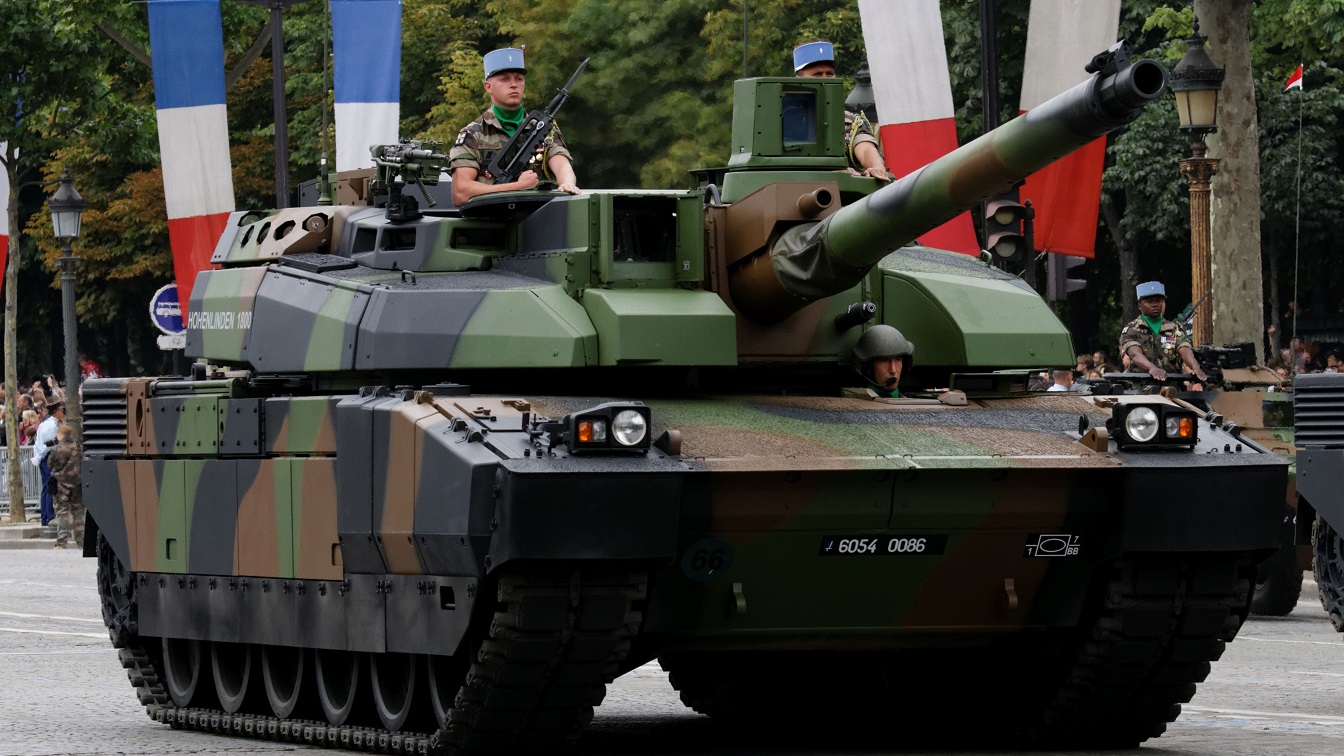
A French general described on September 15 a detail that is larger than a new combat formation. The 7th Armored Brigade is testing the deployment of its heavy cavalry units not as closed four-vehicle groups, but by breaking them down into smaller, combinable units. Currently, two Leclerc tanks and two VBLs are considered a viable "building block." A single tank with a VBL proved too small to act tactically coherently. This is not a cosmetic adjustment of French doctrine. It is an attempt to reduce the value of a target to the point where its discovery does not automatically justify its loss.
General Maxime Do Tran articulated the logic unusually openly: The less significant a unit appears, the less worthwhile an attack becomes for the opponent. In drone warfare, this does not promise invisibility. Battlefield transparency remains; what is to be changed are the cost-benefit calculations of the attacker and the survival chances after discovery (Defense News, September 15, 2026).
What the Leclerc Can and Cannot Do
Despite its age, the Leclerc remains a powerful main weapon system. It has a three-person crew, an automatic loading system, and the 120mm smoothbore gun CN120-26. The tank, weighing around 56 tons, is powered by an approximately 1,500 horsepower engine and can reach about 70 km/h on the road. Its strength lies in the combination of fire control, mobility, and high responsiveness, not in a magical immunity to modern reconnaissance.
This is where the political significance of the French attempt lies. A Leclerc is an expensive and scarce platform; however, a single small drone operation can cause far greater damage. Therefore, the tank must not only be better protected but also organized differently. The brigade is considering autonomous sub-leaders, distributed command posts, data connections, and its own drones above the vehicles. The classic four-vehicle formation remains sensible for concentrated firepower. However, it must no longer be the only response to every situation.
From the Orion Maneuver to NATO Capability
The idea did not emerge in a vacuum. During the French large-scale exercise Orion 2026, units already tested operations with half formations. The practical hurdle was less the technology than the leadership: Non-commissioned officers had to understand the commander's orders and develop initiative without the lieutenant. This is the real cost of modularity. Those who dismantle units must delegate decision-making authority downwards. Otherwise, you end up with isolated vehicles instead of mobile building blocks.
The 7th Brigade is also part of France's capability to lead a multinational NATO force; elements of the brigade were deployed in Romania, where France leads a multinational battle group. This is relevant for the alliance because dispersed formations not only improve French survivability. They also change the requirements for joint command networks, electronic warfare, logistics, and air defense. A tank that successfully disperses must still be able to concentrate again at the right moment. Otherwise, protection against drones becomes a loss of assertiveness.
The Industry Slowly Follows the Doctrine
France is trying to bridge this gap with an interim solution. KNDS presented a potential Capint tank in June that could combine French unmanned turret and weapon technology with a Leopard-2 chassis. Initially, a stronger 120mm gun is planned, possibly later a 140mm variant, active protection systems, countermeasures against drones, and robotic companions. A demonstrator could emerge around 2030; first series vehicles are expected to be feasible by the mid-2030s according to industry estimates at that time (Defense News, June 16, 2026).
This reveals Europe's well-known timing problem. The troops are adapting their tactics today, while the Main Ground Combat System is not expected until the 2040s. Therefore, the Leclerc must survive with existing means before a new system delivers its promised capabilities. More money alone does not resolve this contradiction. The European Defense Agency estimated EU defense spending at €418 billion for 2025 and projected €454 billion for 2026. What matters is whether this results in readily available sensors, jammers, spare parts, and trained leaders in the short term.
Europe's Uncomfortable Lesson
The French "Lego" approach is neither proof of the end of the main battle tank nor a panacea. It is an acknowledgment that heavy platforms can only survive in the age of permanent reconnaissance as part of a distributed system. The tank remains necessary to exploit a breakthrough; however, its gun is no longer necessarily the most important means of generating effect. Artillery, loitering munitions, electronic warfare, and reconnaissance drones increasingly determine whether the Leclerc even reaches its target.
For NATO and the EU, this presents an institutional challenge. Joint procurement must not end with chassis and calibers but must include the interfaces between manned and unmanned systems, data standards, and logistics. France's attempt also shows a political limit: National doctrines can be changed more quickly than European programs. Europe can dismantle its tanks into "building blocks." Whether it can also organize its industrial responsibilities as flexibly remains the much more difficult question.
Sources
- Defense News and Reuters, “France experiments with smaller tank units to evade drone attacks,” September 15, 2026.
- Defense News, “KNDS proposes mixed French-German tank to replace France’s Leclerc,” June 16, 2026.
- Defense News, “France puts mobile corps command to the test in major war scenario,” April 15, 2026.
- European Defense Agency, “EU defence spending €418 billion in 2025, projected to €454 billion in 2026,” July 16, 2026.
- French Ministry of Defense, News of the Armée de Terre, 2026.
The 7th Armored Brigade of the French Army is testing new modular combat formations to enhance operational effectiveness against drone threats. On September 15, 2026, the brigade demonstrated the use of two Leclerc tanks and two VBLs in smaller, more flexible units. This approach aims to reduce the tactical footprint and improve survivability in modern combat scenarios. The brigade's adaptations are part of France's broader strategy to maintain NATO capabilities and address evolving threats.
- The 7th Armored Brigade is testing smaller, modular combat units instead of traditional formations.
- The Leclerc tank remains a key asset despite its age, with significant capabilities.
- France is adapting its military tactics to counter drone warfare effectively.
- The brigade is part of a multinational NATO force, enhancing operational flexibility.
- The French defense industry is developing new armored vehicles to meet modern warfare needs.