
France’s newest global air mission covers three continents
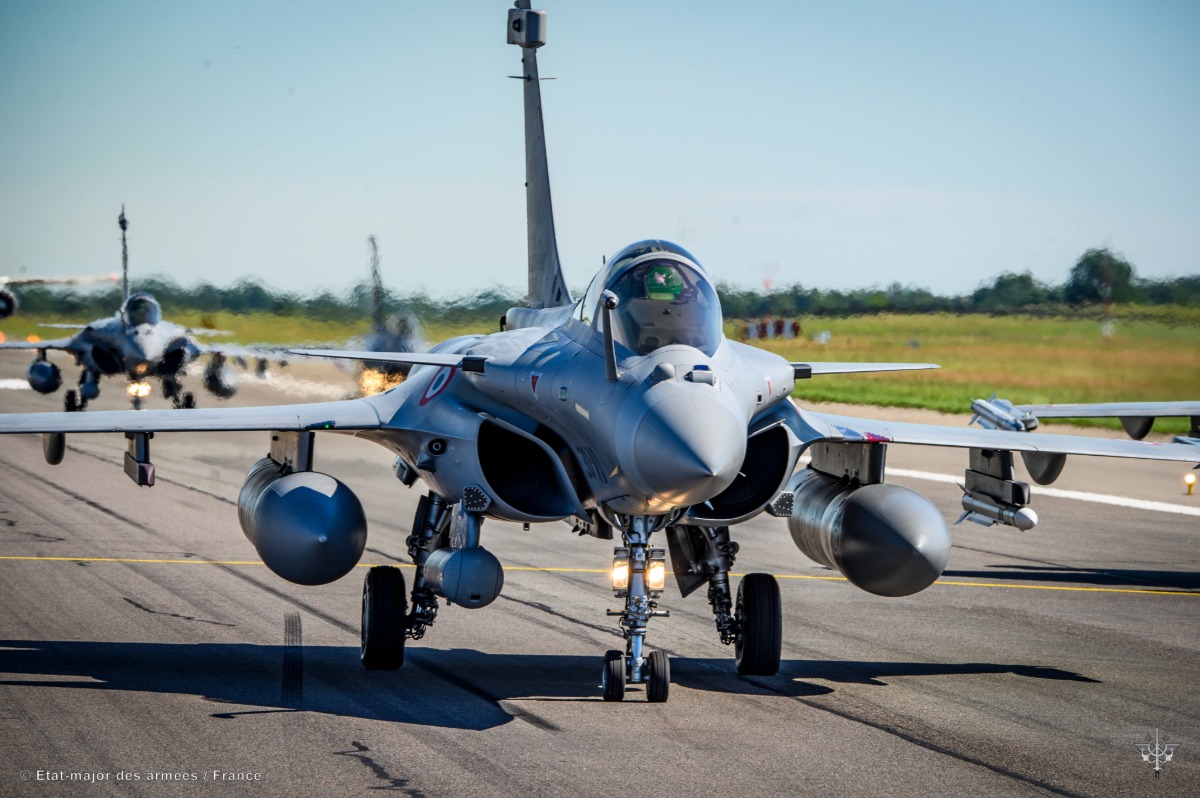
France’s Air and Space Force announced that its sixth major long-range air power deployment, code-named PEGASE 26, will launch in early September 2026, sending four Rafale fighter jets built to the latest F4 operational standard across three strategic regions the French military considers critical to its global posture: the Arctic, the Indo-Pacific, and the Middle East.
The mission will involve four Rafale multirole fighters, three A330 MRTT refueling and transport aircraft known as Phénix, and two A400M Atlas heavy transport planes, all supporting roughly 300 French airmen over a 38-day operation. That combination of aircraft types matters because each plays a distinct role in letting France project combat power across distances the country could never cover with fighter jets alone. The Rafale delivers the fast, long-range strike capability at the center of the mission, the A330 MRTT tankers extend that reach by refueling the fighters mid-flight and doubling as cargo and troop transports, and the A400M provides what French officials describe as resilient, autonomous logistics support, carrying spare parts, ground equipment, and support personnel needed to keep the whole detachment operating independently far from any French home base.
PEGASE, named after the winged horse of Greek mythology, began in 2018 as a way for France to demonstrate it could deploy combat airpower to the Indo-Pacific region and back without relying on foreign bases or support infrastructure along the way. That first edition involved just 90 airmen and 40 tons of equipment, a modest footprint compared to how the mission has grown since. The 2023 iteration became the largest and most ambitious version to date, deploying 19 aircraft, 320 airmen, and 55 tons of freight across 11 stopovers spanning the United Arab Emirates, Singapore, Malaysia, Indonesia, Qatar, Djibouti, South Korea, and Japan, according to reporting from The Diplomat, a milestone French officials framed at the time as proof of the country’s standing as a legitimate Indo-Pacific power given its 10 million square kilometer exclusive economic zone in the region, the second largest in the world after the United States.
The 2025 edition, dubbed Pégase Grand Nord, redirected the deployment entirely toward Sweden instead of the Indo-Pacific, a shift The Aviationist attributed to France taking on a larger role reinforcing NATO’s eastern flank against Russia as American strategic support to Europe diminished under the Trump administration. PEGASE 26 effectively merges both priorities into a single mission, opening with a stop in Greenland specifically to validate a new air route toward North America and to continue training French crews in the high-latitude, polar conditions that have become increasingly relevant as competition over Arctic access intensifies among NATO members and Russia alike.
From Greenland, the detachment moves to Alaska for a joint training sequence with American forces, where the Rafale fighters will join the rest of the formation before the group crosses the Pacific Ocean with stops in Japan, South Korea, and Indonesia, part of what France describes as an effort to showcase the variety and durability of its military partnerships across the region. The detachment then splits, with part of the force continuing to India, where France maintains what officials call a historic and dynamic defense relationship reinforced by the joint exercise TARANG SHAKTI, while the remaining aircraft head to French forces stationed in the southern Indian Ocean zone, a deployment meant to demonstrate France’s ability to temporarily reinforce its overseas military bases on short notice.
The mission’s third phase brings the detachment to the Middle East, a region French officials have repeatedly described as a priority area of engagement, with a stopover in Qatar preceding French participation in AMUN 26, a joint exercise with Egypt’s military, before the aircraft finally return to France. Throughout the deployment, the Commandement de la Défense Aérienne et des Opérations Aériennes, France’s air defense and air operations command based at Lyon Mont-Verdun, will plan and direct the mission from what French officials describe as the nerve center of the country’s air operations, coordinating a detachment operating thousands of kilometers from home across radically different climates and threat environments simultaneously.
France has framed missions like PEGASE as proof of an operational capability few air forces in the world can genuinely replicate, the ability to send combat aircraft into virtually any region on short notice, operating either independently or alongside coalition partners, and sustain that presence through extended, multi-week deployments rather than brief, symbolic flyovers.
Content preview only. Full article available at source. View Full Article
France's Air and Space Force will launch PEGASE 26 in September 2026, deploying four Rafale fighter jets and supporting 300 airmen across the Arctic, Indo-Pacific, and Middle East. The operation will last 38 days and involve A330 MRTT and A400M Atlas aircraft for logistics. This mission aims to demonstrate France's military capabilities and strengthen partnerships in these strategic regions.
- France's Air and Space Force will deploy four Rafale fighter jets in September 2026.
- The mission will cover the Arctic, Indo-Pacific, and Middle East regions.
- Approximately 300 airmen will support the operation over 38 days.
- The deployment includes A330 MRTT and A400M Atlas aircraft for logistics.
- The mission aims to showcase France's military capabilities and partnerships.