
Franco-German defense cooperation under strain as Macron, Merz meet
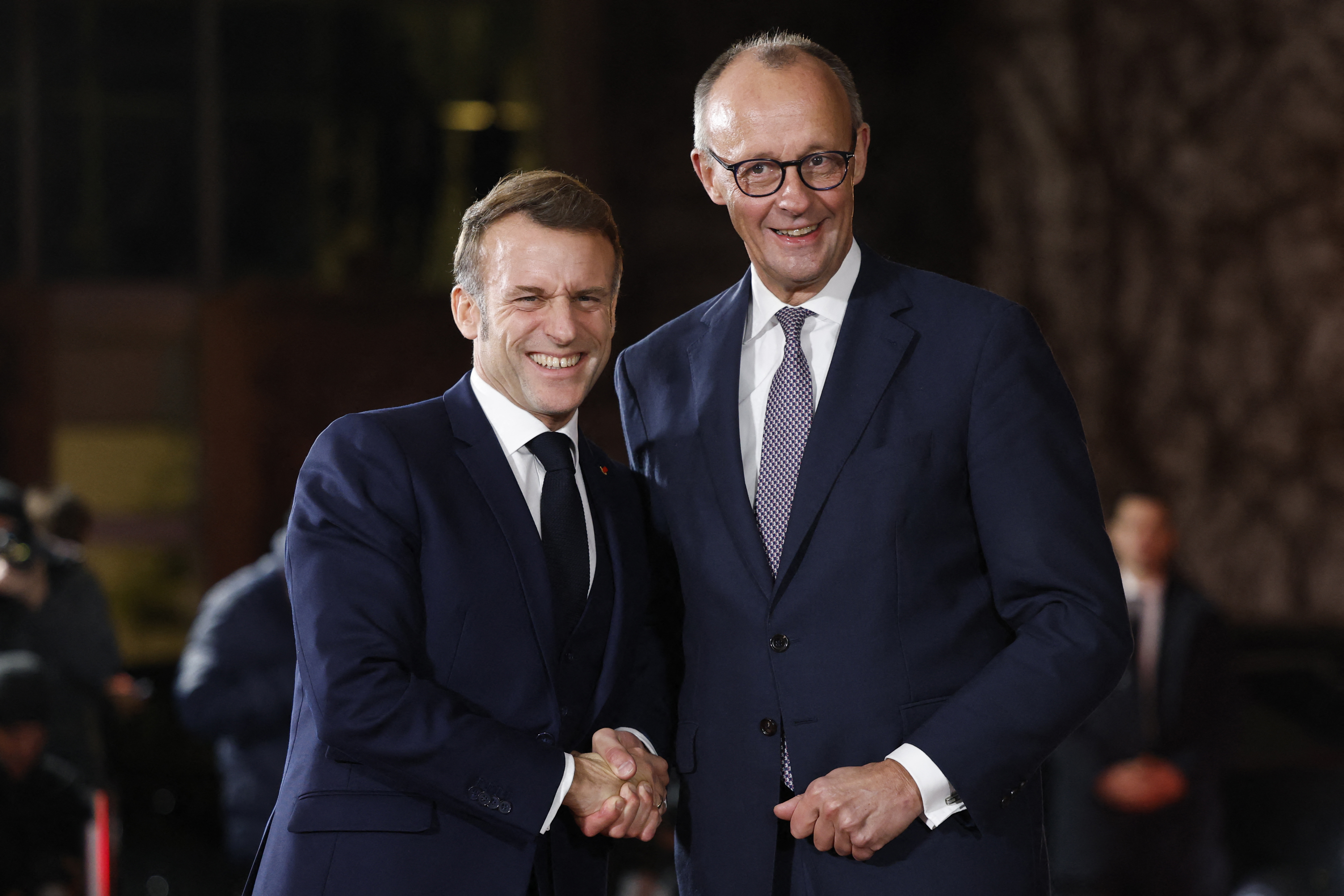
France and Germany will discuss deepening cooperation on nuclear deterrence, missile defense, long-range strike capabilities and space at a joint ministerial retreat, the Elysee said, seeking to show that the EU’s two largest defense powers can still work together despite differences over major armament programs.
The meetings come weeks after industrial rivalries forced Paris and Berlin to scrap the landmark Future Combat Air System (FCAS) fighter jet program at a time the U.S. is pressuring Europe to rearm itself.
Delays to a Franco-German next-generation tank project, setbacks to the multinational Eurodrone program meant to build a drone competitor to the U.S. Reaper and growing competition within Europe in the space sector have all underscored Europe’s challenges scaling up its defense ambitions.
Two joint declarations are expected following the Franco-German Defence and Security Council (CFADS) and a broader joint ministerial meeting near Cologne on Thursday and Friday.
A French official acknowledged that the discussions were “not a path where everything is necessarily aligned,” but said Franco-German defense industry cooperation was bigger than the failed FCAS project.
A German official said agreement was expected on how elements of the FCAS project would continue to be developed. Both countries have pledged to focus on data links between warplanes and related software known as a “combat cloud”.
The two sides will also discuss Macron’s proposal for “forward (nuclear) deterrence,” unveiled in March, under which European allies could participate in French nuclear deterrence exercises and temporarily host French nuclear assets on their territory.
Berlin now expects to agree that German troops will take part in a French nuclear exercise in the autumn, the German official said.
Defense Sovereignty
Underlying the Franco-German defense relationship are differences over how dependent Europe should be on U.S. weapons technology at a time the continent is questioning President Donald Trump’s reliability as a security partner.
The Elysee said the talks would also centre on conventional military capabilities, citing early warning systems, long-range strike capabilities and air and missile defense.
France has long advocated greater reliance on European technologies for missile defense.
“On ballistic missile defense, we have always argued to Germany the importance of what is sovereign,” the Elysee official said.
Space cooperation will also be on the table, another area where competition has recently complicated bilateral ties.
The Elysee said France and Germany would reaffirm support for IRIS², the European Union’s planned secure satellite communications constellation, despite Berlin simultaneously pursuing its own military satellite constellation project.
Paris sees the program as a cornerstone of Europe’s efforts to secure sovereign communications infrastructure and reduce dependence on foreign providers.
France and Germany are set to meet in Cologne to discuss enhancing defense cooperation, focusing on nuclear deterrence and missile defense. The meeting follows the cancellation of the Future Combat Air System program and aims to reaffirm joint military capabilities. Germany anticipates agreement on its troops participating in a French nuclear exercise this autumn, highlighting ongoing collaboration despite recent challenges in defense projects.
- France and Germany are meeting to discuss defense cooperation.
- Topics include nuclear deterrence and missile defense.
- The Future Combat Air System (FCAS) program was recently scrapped due to industrial rivalries.
- Germany expects to agree on participation in a French nuclear exercise this autumn.
- Both countries will focus on enhancing data links between warplanes.