
Friendly Fire Over Kuwait: When Coalition Air Defense Shoots Down Its Own Jets
 Ahmed Al-Rashid
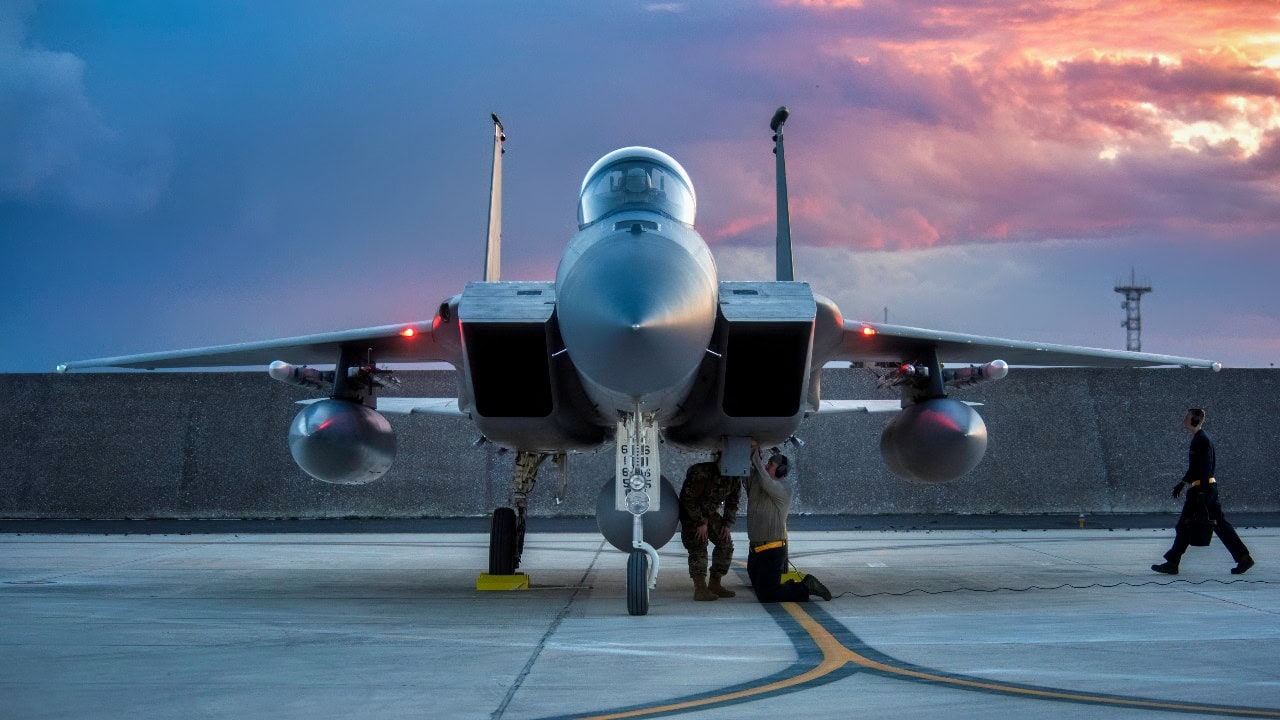 U.S. Air Force F-15 Strike Eagles — the same type as those lost over Kuwait on March 2, 2026. (Photo: U.S. Air Force)
At 07:03 local time on March 2, 2026, three U.S. Air Force F-15E Strike Eagles were destroyed over Kuwaiti airspace — not by Iranian missiles, not by hostile drones, but by the air defense batteries of America's own coalition partner. All six aircrew ejected safely and were recovered in stable condition. The aircraft were not.
CENTCOM's confirmation was terse but unambiguous: "The U.S. Air Force fighter jets were mistakenly shot down by Kuwaiti air defenses." In a conflict already marked by escalating complexity — Iranian drone strikes on RAF Akrotiri in Cyprus, Hezbollah rocket barrages triggering Israeli air, land, and sea strikes on Beirut — this incident stands out not merely as a tactical disaster but as a systemic warning about the fragility of coalition warfare in the modern battlespace.
The IFF Problem: Technology That Should Have Prevented This
Identification Friend or Foe (IFF) systems have been a cornerstone of military aviation since World War II, when the RAF deployed the first radar-based transponder networks to distinguish Spitfires from Messerschmitts. Eight decades later, the F-15E carries the AN/APX-119 advanced IFF transponder, one of the most sophisticated in any air force inventory. Kuwaiti Patriot batteries and Hawk surface-to-air missile systems are equipped with compatible interrogators designed precisely to query and confirm friendly aircraft.
That the system failed on March 2 points to something more troubling than equipment malfunction. In a theater where American, British, Gulf Cooperation Council, and Israeli aircraft are sharing contested airspace simultaneously — where flight corridors shift by the hour and emergency tasking reroutes aircraft with minutes of notice — IFF alone cannot carry the cognitive load of deconfliction. The transponder answers the question "what are you?" It cannot answer "should you be here, right now, on this heading, without prior coordination?"
Military aviation experts have long warned that Mode 5 IFF — NATO's current generation — was designed for Cold War bilateral threat environments, not the layered, multi-vector, multi-nation airspace management challenges of a dynamic Middle Eastern theater. When Kuwaiti air defense operators faced an unannounced fast-mover ingressing from a direction associated with recent Iranian drone activity, the conditions for a catastrophic misidentification were already in place.
Command and Control Breakdown: The Real Failure
No IFF system substitutes for functioning command-and-control architecture. The critical question investigators will be asking is not whether the Kuwaiti Patriot battery's interrogator worked — it is whether the aircrew's sortie was properly filed and communicated through the Combined Air Operations Center (CAOC) at Al Udeid Air Base in Qatar, and whether that information reached Kuwaiti air defense sector control in time.
In high-tempo operations, particularly when missions are re-tasked at short notice — as is common during active strike packages against time-sensitive targets in Iran — the standard ATO (Air Tasking Order) cycle can lag behind reality. Aircraft depart on updated tracks that haven't been pushed to all partner-nation ground elements. The result is a lethal information gap between the aircraft in the sky and the missile system tracking it on radar.
This appears to be the anatomy of the March 2 incident. The F-15Es were operating in a theater where Iranian drone and cruise missile activity had placed every Kuwaiti air defense unit on heightened alert. Trigger thresholds were compressed. Decision timelines were shortened. And somewhere in the chain between CENTCOM, CAOC, and Kuwaiti sector control, the coordination failed.
The Diplomatic Minefield
Kuwait occupies a uniquely delicate position in U.S. Middle East strategy. Camp Arifjan hosts thousands of American troops. Ali Al Salem Air Base is a forward staging point for air operations across the Gulf. The relationship is not merely strategic — it is existential for Kuwaiti security, and Kuwaiti leaders know it.
That reality cuts both ways in the aftermath of March 2. The Al Sabah government will be under intense domestic pressure from a public already wary of Kuwait's entanglement in what was initially framed as a limited U.S. operation against Iranian nuclear infrastructure. Losing three American aircraft to Kuwaiti missiles — aircraft that were, in effect, guests of Kuwait's sovereignty — transforms the incident from a military accident into a political crisis requiring management at the highest levels.
Washington's response will need to be carefully calibrated. Public pressure on Kuwait risks destabilizing a host-nation relationship that cannot be easily replicated. But silence reads as weakness and signals to other partners that accountability is optional. The likely outcome is a joint investigation, quiet diplomatic assurances, and an accelerated review of shared airspace protocols — none of which brings back three $87-million aircraft or the operational tempo lost at a critical moment in the campaign.
History Rhymes: Friendly Fire in Coalition Wars
The Kuwait incident is horrifying but not historically unprecedented. During Operation Desert Storm in 1991, friendly fire accounted for 35 of the 148 American combat deaths — nearly 24 percent. Two British Tornado GR1s were destroyed by American Patriot missiles in March 1991 in incidents eerily similar to what occurred on March 2, 2026. The investigation that followed found almost identical root causes: compressed decision timelines, inadequate cross-national communication, and IFF procedures that assumed a clarity of battlespace that didn't exist.
In Operation Iraqi Freedom, the 2003 shoot-down of a British Tornado GR4 by a U.S. Patriot battery killed both crew members and prompted a sweeping joint review of coalition air defense procedures. The lessons learned — improved datalink integration, mandatory positive identification protocols, dedicated liaison officers embedded in partner-nation air defense sites — were implemented across NATO and GCC frameworks.
That those reforms apparently proved insufficient in the current conflict suggests that the pace of operational scaling outran the institutional reforms. When a theater expands rapidly — as this one has, from a discrete strike on Iranian nuclear sites to a multi-front conflict spanning Kuwait, Cyprus, Lebanon, and the Red Sea — coordination architectures built for steady-state operations fracture under pressure.
A Widening War: The Signals No One Wanted to Read
The Kuwait friendly-fire incident did not occur in isolation. It is one data point in a rapidly expanding conflict geometry. On the same operational timeline, Iranian UAVs struck RAF Akrotiri in Cyprus — a British sovereign base area, an article 5 NATO trigger zone — marking the first direct Iranian kinetic attack on European soil in the modern era. Simultaneously, Hezbollah opened a northern front against Israel, launching rocket barrages that drew a massive Israeli air, naval, and ground response against Beirut. The Iran operation, sold to the public as a surgical strike, has become a regional war.
In this environment, the friendly fire over Kuwait is both a symptom and an accelerant. It exposes the command friction inherent in a coalition operating under sustained pressure across multiple simultaneous fronts. It will consume diplomatic bandwidth at exactly the moment when strategic clarity is most needed. And it hands Iran's information warfare apparatus a potent narrative: that the coalition is so degraded, so disorganized, that it is shooting down its own aircraft.
The death toll from U.S. operations against Iran now stands at six — a figure that includes two previously unconfirmed remains recovered in the same 24-hour window as the Kuwait incident. Six American personnel killed. Three aircraft destroyed by an ally. The conflict has already exceeded every initial parameter for scope, duration, and cost.
What Comes Next
In the immediate term, U.S. and Kuwaiti military authorities will implement emergency airspace protocols — mandatory voice confirmation requirements, expanded radar identification zones, reduced engagement authority for automated systems. These are the predictable, necessary short-term responses.
The harder questions are structural. How does a coalition operating across a theater this vast, with this many sovereign air defense networks, maintain the coordination discipline to prevent the next incident? How does CENTCOM balance the operational security requirements of fast-moving strike packages with the transparency that partner-nation air defenses need to avoid catastrophic misidentification?
And at the political level: how does the Biden administration — or any administration — sustain coalition cohesion when the coalition is now visibly, publicly, killing itself?
The pilots are alive. That is the only unambiguous good news from March 2, 2026. The aircraft are gone. The trust, in some measure, is also gone. And the war is larger than anyone in Washington planned for.
Ahmed Al-Rashid is a Middle East military analyst at hiwars.com, specializing in Gulf security architecture and coalition operations. Sources: CENTCOM official statement, Aviation Week & Space Technology, historical data from DoD friendly fire review panels (1991, 2003).
Three U.S. Air Force F-15E Strike Eagles were shot down by Kuwaiti air defenses over Kuwait at 07:03 local time on March 2, 2026. All six aircrew ejected safely and were recovered, but the incident raises serious concerns about the effectiveness of identification systems and command coordination in coalition operations. This event underscores the complexities and risks of multi-national military engagements in the region.
- Three U.S. Air Force F-15E Strike Eagles were shot down by Kuwaiti air defenses on March 2, 2026.
- All six aircrew ejected safely and were recovered in stable condition.
- The incident highlights failures in command and control and IFF systems during coalition operations.