
G7 Licenses for Patriot and Air Defense 2026 Highlight Europe's Production Gap
 Dr. Klaus Weber
G7 Licenses for Patriot and Air Defense 2026 Highlight Europe's Production Gap
On June 17, 2026, the G7 states in Évian did not agree on a new European weapon, but on something more sober: they want to review licenses that would allow Ukrainian, European, and especially American rights-bound manufacturers to produce air defense systems, interceptor missiles, and possibly also long-range weapons. It is precisely this sobriety that makes the news significant. Europe has money, political statements, and increasingly more target quotas. What is missing are missiles in sufficient quantities.
German Chancellor Friedrich Merz articulated the problem unusually openly. Everyone is currently producing too little, he implied; this gap could be reduced through licenses for companies with existing production capacity in Europe and Ukraine. This is not a technical detail. It is the belated recognition that the European support architecture for Ukraine has so far relied too much on stockpiles, American approvals, and ad-hoc national packages.
The License is Not a Missile
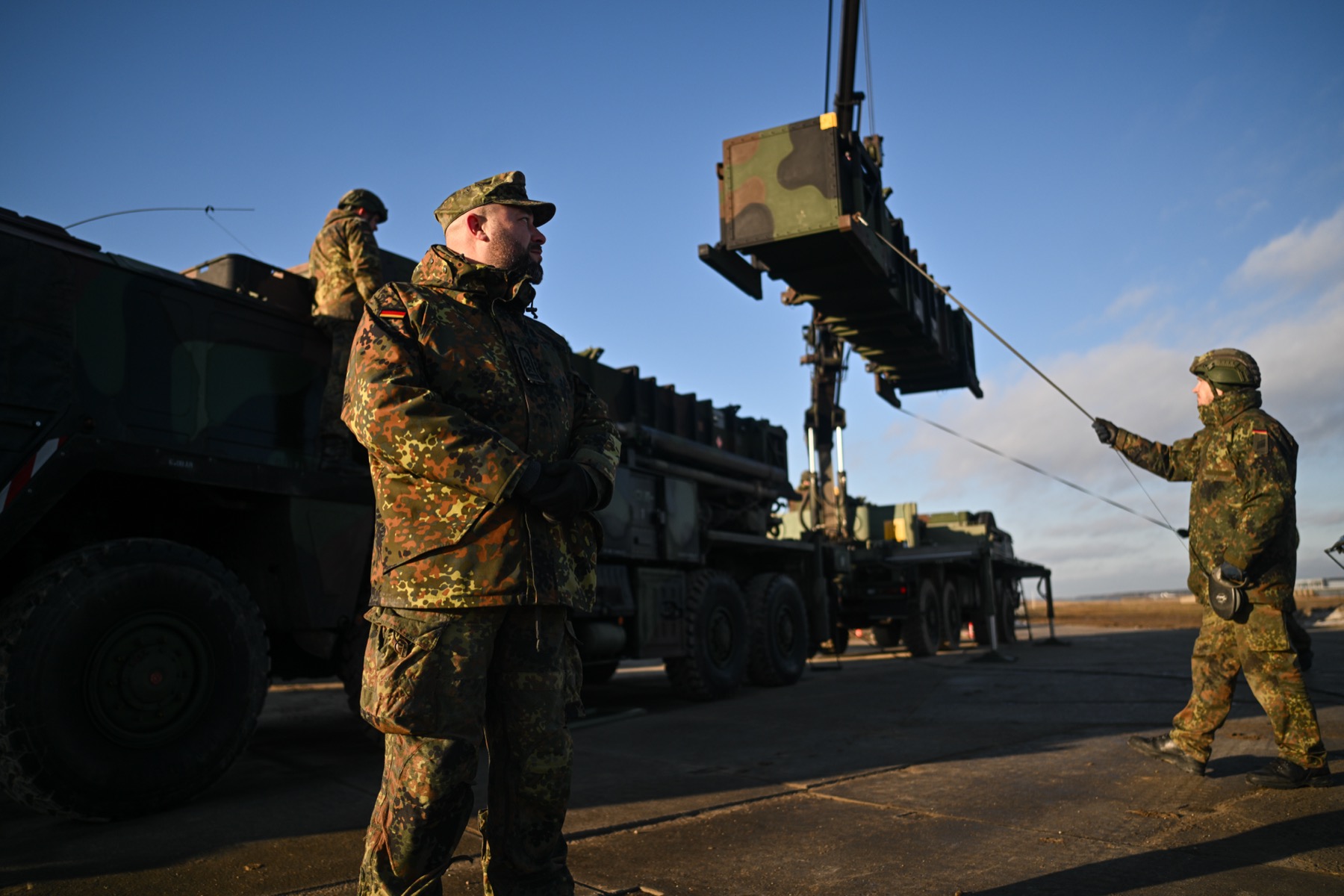
A production license does not automatically solve three problems. First, it does not replace a supply chain. Patriot interceptor missiles, modern seekers, solid-fuel motors, guidance components, and certified testing infrastructure do not come into existence through a political declaration. Second, control over intellectual property, export approvals, and software versions remains with the rights holder, unless the license is exceptionally broad. Third, every additional line requires skilled workers, pre-products, and acceptance standards. In air defense, industrialization is not app development.
That is precisely why the G7 formulation is a step forward. It shifts the debate from procurement to production. Since 2022, Europe has too often asked who can still deliver a system. The right question now is who can produce new interceptors monthly and who decides on their transfer. For Ukraine, this question is existential because Russian ballistic missiles and cruise missiles systematically put pressure on Western supply cycles.
Patriot Most Clearly Shows the Dependency
The Patriot complex is the best example for this. Ukraine needs systems and interceptor missiles primarily against ballistic threats. European states possess Patriot batteries, operate them within NATO structures, and have some industrial participation in components. But the political and technical core control still lies in the United States. If Washington conserves stocks or prioritizes other theaters of war, Europe cannot simply create the same effect through higher budget allocations.
This is the uncomfortable lesson from the turning point. Germany can decide on special funds, meet NATO quotas, and use SAFE funds for joint procurement. But if the crucial ammunition is not produced in Europe under European disposal rights, defense capability remains dependent on American timing. Therefore, the license debate is not a fringe topic of the arms industry, but a test of sovereignty.
SAFE Fits the Problem, but Not Fully the Solution
The EU Commission describes SAFE as the first pillar of Readiness 2030 and aims to mobilize up to 150 billion euros in loans through the program, embedded in a larger reArm-Europe goal of more than 800 billion euros. SAFE allows joint procurement with Ukraine and requires that no more than 35 percent of the components come from countries outside the EU, EEA-EFTA, or Ukraine for certain projects. On paper, this is exactly the right direction: less fragmentation, more European value creation, involvement of Ukraine.
But SAFE finances demand. Licenses regulate rights. Production only occurs where both come together and additional industrial capacity is available. This difference is central. A member state can take out a favorable EU loan and still order a system whose critical components, software, or interceptor missiles are controlled outside Europe by export law. Conversely, a license can remain politically worthless if no European factory has enough motors, electronics, and qualified labor available.
Ukraine Provides the Countermodel
In a remarkable sense, Ukraine is not just a recipient but an industrial teacher. European think tanks have pointed out for months that Ukraine has achieved a speed through short feedback loops between the front, developers, and production that classic European procurement offices hardly know. Drones, electronic warfare, and modular systems are changed in weeks, not in multi-year armament cycles.
This logic cannot be transferred one-to-one to Patriot interceptor missiles. Ballistic missile defense is technically more demanding, more regulated, and security-critical. But the organizational lesson remains valid: Europe needs not only larger budgets but shorter paths between operational needs, industrial adaptation, and political approval. If license production in Ukraine and Europe is treated only as an additional chapter of national procurement programs, the effect dissipates.
NATO Numbers Conceal the Bottleneck
NATO has dramatically increased the political framework. Since the Hague Resolution, the Allies are to allocate 5 percent of GDP for defense and security-related expenditures annually by 2035, of which at least 3.5 percent for core defense. In 2025, for the first time, all Allies met the previous 2 percent target; European Allies and Canada increased their defense spending by 20 percent compared to 2024. These are relevant figures. But they measure input, not immediate firepower.
The G7 license initiative makes visible why this distinction is more than academic. A 20 percent increase in spending can flow into salaries, infrastructure, ammunition, spare parts, or expensive platforms. For Ukraine, something narrower counts in the coming months: additional interceptors, additional launchers, additional production rights. Whoever does not control this chain can pay more and still deliver too late.
What Évian Left Open
The most cautious assessment is also the most realistic. According to reports from Évian, there are discussions, political willingness, and a G7 formulation that explicitly considers license production. However, there is still no publicly named manufacturer, no binding timeline, and no clear list of systems. It is precisely here that it will be decided whether this is a breakthrough or just a diplomatic bridge.
For Germany, the task is particularly clear. Berlin can use this initiative to connect European air defense production with Ukrainian war experience and American rights. Or it can transfer it into the familiar German routine: working groups, review orders, questions of responsibility. The first variant would not end Europe's dependency but would measurably reduce it. The second would confirm what Moscow has long calculated: Europe can talk about strategic autonomy faster than it can produce interceptor missiles.
Sources
- The Guardian, June 18, 2026, G7 License Initiative for Ukrainian Air Defense and Long-Range Capabilities.
- European Pravda, June 17, 2026, Reports on G7 Licenses for Production in Ukraine.
- Euromaidan Press via Bloomberg, June 18, 2026, Talks on US Licenses without Confirmed Timeline or Manufacturer.
- NATO, Defence expenditures and NATO 5 percent commitment, Data on 5 percent, 3.5 percent core defense, and 20 percent spending increase 2025.
- European Commission, SAFE Security Action for Europe, Rules on Ukraine Participation, Loans, and 35 Percent Component Limit.
- Centre for European Reform, Rearming Europe for Deterrence, June 2026, Analysis on Modular Systems and European Procurement Issues.
On June 17, 2026, G7 nations agreed to review licenses for the production of air defense systems and missiles in Europe and Ukraine during a meeting in Évian. This decision highlights Europe's production gap in military equipment, as emphasized by German Chancellor Friedrich Merz. The initiative aims to enhance production capabilities and reduce reliance on U.S. supplies, with Ukraine serving as a model for rapid military production adjustments.
- G7 nations agreed to review licenses for air defense production in Europe and Ukraine.
- The production gap in Europe for missiles and air defense systems was highlighted.
- Germany's Chancellor emphasized the need for increased production capacity.
- The G7 initiative aims to shift focus from procurement to production of military equipment.
- Ukraine is seen as a model for rapid military production adjustments.