

Genghis Khan Made Military History and Changed Humanity Forever
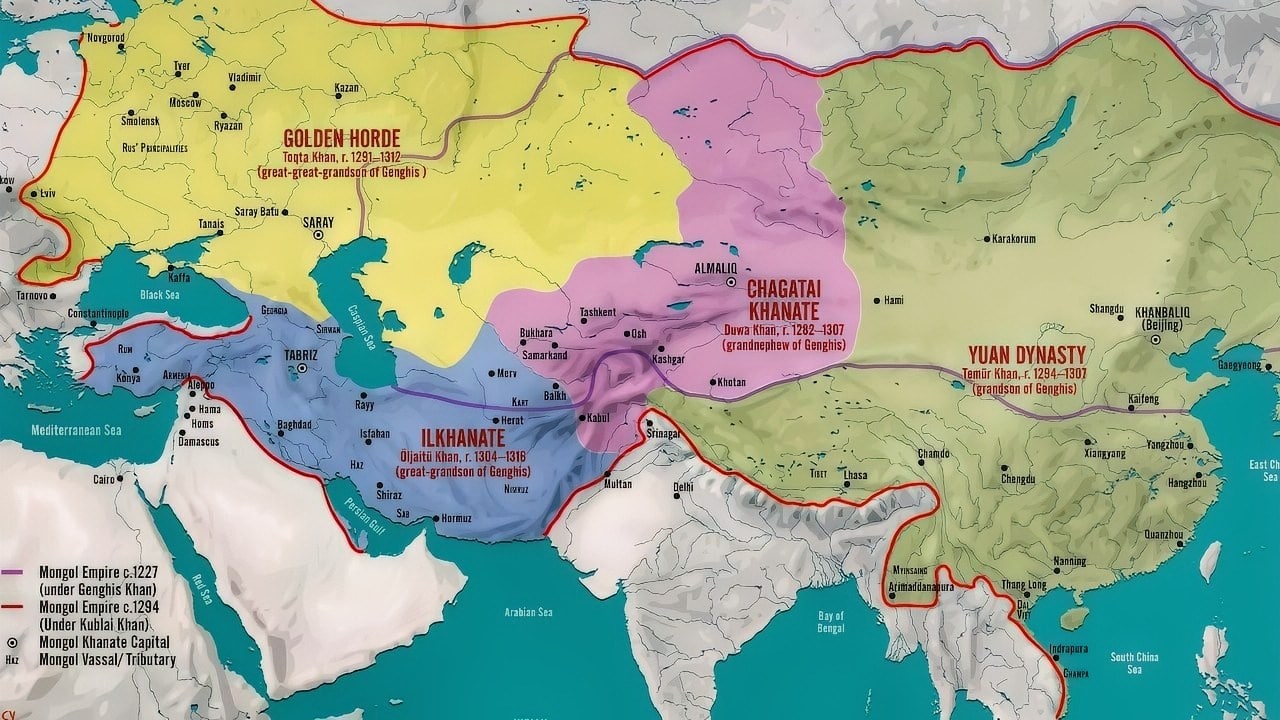
Genghis Khan Map of Conquest. Image Credit: Creative Commons.
Military History Quote of the Day: “There is no good in anything until it is finished.” – Genghis Khan
Genghis Khan was one of history’s great conquerors. Living in the 12th and 13th centuries, Khan established what was then the largest land empire in history, comprising 11 to 12 million square miles.
According to a History Channel account, Genghis Khan was born around 1162 on the border of modern Mongolia and Siberia, and his birth name was Temujin.
At that time, the History Channel says, citing “The Secret History of the Mongols,” dozens of nomadic tribes on the Central Asian steppe were constantly fighting and stealing from each other, and life for Temujin was violent and unpredictable.” His father had kidnapped his mother for a forced marriage, and his father was later poisoned to death when Temujin was just ten years old.
For his part, young Temujin went on to kill his older half-brother.
They abandoned him, and he was later captured and enslaved, but he escaped.
After he married, his wife was kidnapped, but he launched a rescue mission to rescue her.
And after that rescue, “he soon began making alliances, building a reputation as a warrior and attracting a growing number of followers.”
Uniting the Mongols
While the Mongols had been engaged in clan warfare, Temujin first succeeded in uniting them, even across religious lines.
In 1206, the History Channel said, Temujin “called a meeting of representatives from every part of the territory and established a nation similar in size to modern Mongolia.” At that point, he controlled territory that let him rule about a million people.
Around this time, he took the name “Genghis Khan,” which translated to “Universal Ruler.”
Having consolidated the Mongols, Khan instituted reforms, including banning the enslavement of Mongols and the selling of women; he also made theft of livestock punishable by death.
Not all of his reforms were punitive, however; he sought to establish a writing system, allowed religious freedom, and granted diplomatic immunity to foreign ambassadors.
Time For Conquest
According to the History Channel, Genghis Khan launched his first military campaign against the Xi Xia kingdom in northwestern China.
It began with raids, followed by a “major initiative” in 1209.
“The army consisted almost entirely of cavalrymen, who were expert riders and deadly with a bow and arrows,” the History Channel said. “At Yinchuan, the Mongols deployed a false withdrawal—one of their signature tactics—and then initiated a siege. Though their attempt to flood the city failed, the Xi Xia ruler submitted and presented tribute.”
Then they attacked a different Chinese dynasty: the Jin Dynasty of northern China. Khan’s armies besieged the territory for three years, which drove people into the city and caused food shortages, which caused the Jin Dynasty to kill many of its own peasants.
The Mongols later sacked what is now Beijing in 1214.
The next campaign came in 1219, when Khan’s armies launched a war in the Khwarezm Empire, in what is now Afghanistan, Turkmenistan, Uzbekistan, and Iran.
“Despite once again being outnumbered, the Mongol horde swept through one Khwarezm city after another, including Bukhara, Samarkand, and Urgench.
Skilled workers such as carpenters and jewelers were usually saved, while aristocrats and resisting soldiers were killed,” the History Channel account said.
The Last Battles
By 1225, Genghis Khan controlled territory from the Sea of Japan to the Caspian Sea.
He then launched another invasion of the Xi Xia kingdom, which, according to the History Channel account, “had refused to contribute troops to the Khwarezm invasion.”
But it wasn’t an enemy who would bring about Khan’s demise, but a horse.
“In early 1227, a horse threw Genghis Khan to the ground, causing internal injuries. He pressed on with the campaign, but his health never recovered,” the account said. Genghis Khan died in 1227, amid that campaign.
However, his empire would outlive him, with his descendants Ogodei and Khubilai also engaging in prolific conquests.
Genghis Khan’s descendants continued to rule over land into the 20th century.
The Quote
One of the famous quotes attributed to Khan is “There is no good in anything until it is finished,” although it is sometimes presented as “there is no value in anything until it is finished.”
He likely meant it in reference to war and conquest, although it’s also been applied over the years to everything from politics to business.
And, clearly, his family would surely continue on many of his dreams of conquest, conquering more of the world than anyone could have ever dreamed. Talk about ‘finishing’.
About the Author: Stephen Silver
Stephen Silver is an award-winning journalist, essayist, and film critic, and contributor to the Philadelphia Inquirer, the Jewish Telegraphic Agency, Broad Street Review, and Splice Today. The co-founder of the Philadelphia Film Critics Circle, Stephen lives in suburban Philadelphia with his wife and two sons. For over a decade, Stephen has authored thousands of articles that focus on politics, national security, technology, and the economy. Follow him on X (formerly Twitter) at @StephenSilver, and subscribe to his Substack newsletter.