
Germany's €8.5 Billion IRIS-T Deal Changes Ukraine Aid
 Alexandra Reeves
Germany's €8.5 Billion IRIS-T Deal Changes Ukraine Aid
Berlin has finally started treating Ukraine’s war as an industrial problem, not a warehouse-clearance exercise. Germany and Ukraine signed defence and economic agreements worth more than €8.5 billion in October, including roughly €1.3 billion in German support and about €1 billion in military aid. The headline is large. The more important detail is where the money goes: IRIS-T air defence, missiles, and the production of interceptor drones inside Ukraine.
That is a meaningful change in Germany’s posture. It does not create a European air-defence system overnight, and it certainly does not solve Ukraine’s ammunition problem. But it moves Berlin closer to the policy Europe has avoided for four years: building with Ukraine rather than merely delivering to Ukraine.
IRIS-T Is the Immediate Answer
The urgent requirement is obvious. Ukraine is being forced to defend cities, power facilities, logistics hubs, and troop concentrations against a layered Russian campaign. Ukrainian officials have reported that more than 1,900 attack drones, 1,700 glide bombs, and 25 missiles were used in a single week, with more than 800 of the drones reportedly jet-powered. Those figures are Ukrainian claims, and they should be treated accordingly. The operational trend, however, is not in doubt: Russia is adding speed, volume, and mixed attack packages to make every interception decision more expensive.
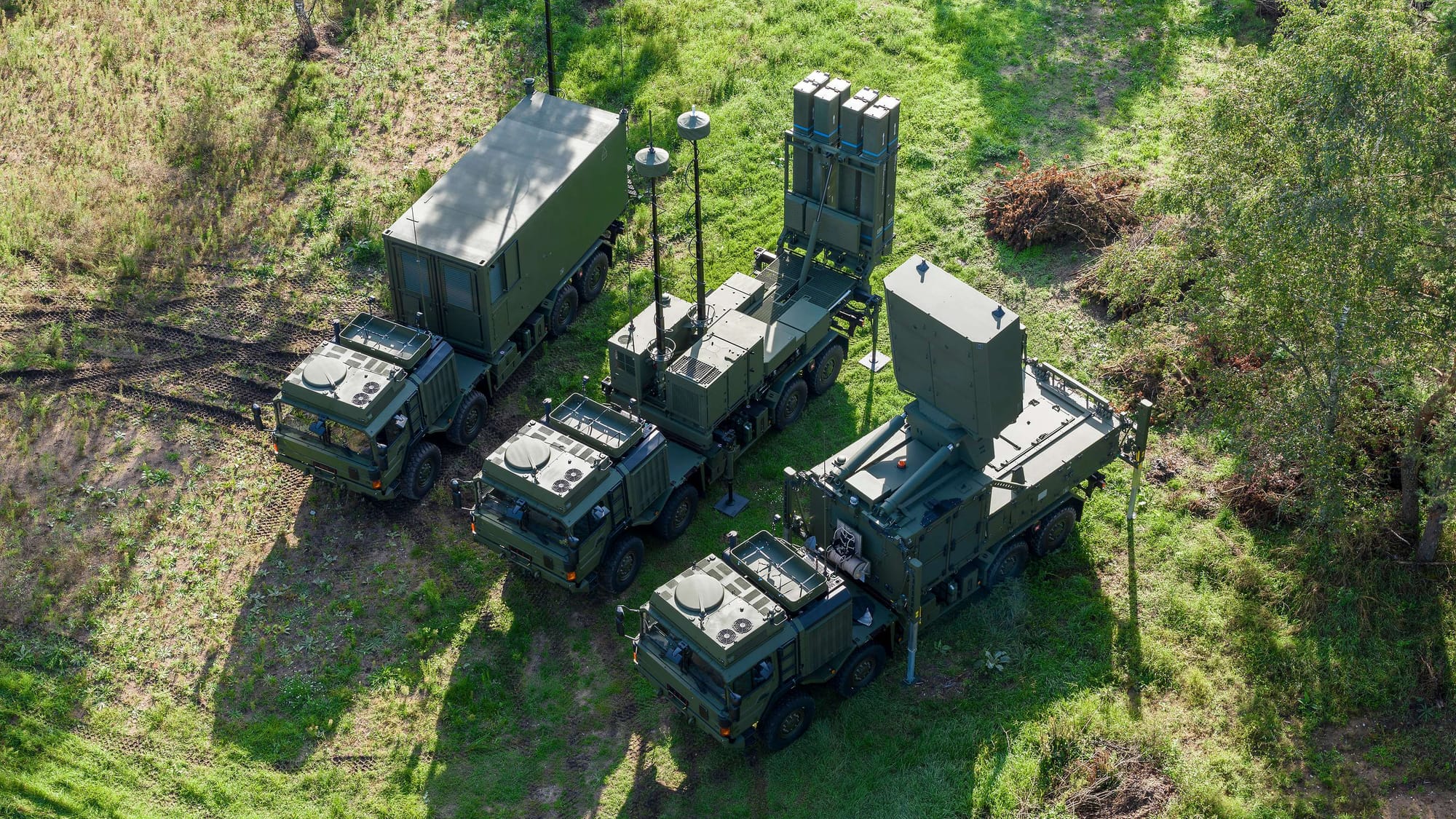
IRIS-T SLM is not a miracle weapon. It is a medium-range, ground-launched system built around the IRIS-T missile, with an active radar seeker, high manoeuvrability, and networked fire-control architecture. Its value is that it can engage aircraft, cruise missiles, and some drone threats while operating as part of a wider air-defence network. Ukraine has already used German-supplied IRIS-T batteries in combat, so this is an expansion of a known capability rather than a political promise about a future prototype.
That distinction matters. In a war of industrial endurance, a system that can be maintained, supplied, and crewed today beats a more impressive system that arrives after the threat has changed.
The More Interesting Move Is Production in Ukraine
The interceptor-drone element is strategically more revealing than another announcement of aid. Berlin is financing the production of drones designed to defeat fast Russian attack drones, with German and Ukrainian companies expected to share development and manufacturing. German officials have also referred to the rapid delivery of around 1,000 newly developed interceptor systems, while Ukrainian industry is positioned to produce at much larger scale.
This is an attempt to repair the cost exchange at the heart of the air war. Sending a million-euro missile against a cheap one-way drone may be necessary, but it is not sustainable when the attacker can launch hundreds in a night. An interceptor drone will not be free, and it will not replace IRIS-T or Patriot. It can, however, give commanders another rung on the ladder: cheaper systems for lower-value targets, reserved surface-to-air missiles for the weapons that genuinely threaten a city or a power station.
Ukraine contributes something Europe cannot manufacture in a conference room: combat feedback. Ukrainian units can test software, sensors, datalinks, and tactics under real attack conditions. German firms contribute financing, production discipline, and access to a larger industrial market. The arrangement could shorten the cycle from battlefield problem to deployable solution. Europe’s conventional procurement system usually takes years to do what Ukraine has learned to do in weeks.
Germany Is Buying Strategic Relevance
There is a domestic political calculation here. A package that includes contracts, factories, and German industrial work is easier to defend in Berlin than a transfer of equipment with no visible return. That does not make the policy cynical. It makes it politically durable. Ukraine needs support that survives coalition politics, budget arguments, and voter fatigue.
But Berlin should not confuse bilateral momentum with European autonomy. IRIS-T is a German contribution inside an ecosystem that still depends on American intelligence, satellite communications, air-defence integration, and broader NATO logistics. Ukraine’s own production lines remain vulnerable to Russian strikes. A factory in Ukraine is valuable precisely because it can shorten supply chains, but it is also a target.
The security arrangements around these facilities therefore matter as much as the contracts. Germany and its European partners need to help protect production sites, harden energy supplies, secure component imports, and create redundant manufacturing capacity outside Ukraine. Otherwise, Europe will congratulate itself on a new industrial model while Russia targets the first factory that makes it real.
The Test Comes After the Ceremony
The agreements are a sound direction, but they are not yet a capability. A signed figure is not a delivered fire unit. A production announcement is not a stocked magazine. And a promise to buy interceptor drones is not the same as proving that they can detect, identify, and defeat the newest Russian jet-powered systems in bad weather and under electronic attack.
The next milestones should be concrete: how many IRIS-T launchers and missiles reach Ukrainian units, when the first interceptor-drone batches enter operational service, how quickly damaged systems return to the fight, and whether the German-Ukrainian supply chain can survive disruption. NATO should also study the arrangement as a model for other allies, especially Poland, the Baltic states, and Romania, rather than treating it as a special bilateral exception.
Germany’s course is correct because it links immediate defence to long-term production. It is insufficient because one country cannot build Europe’s air shield alone. The uncomfortable conclusion is that Berlin has recognised the right lesson from Ukraine, but Europe still has not decided whether it wants to learn it at scale.
Sources
- The Kyiv Independent, Germany announces aid including interceptor drones and air-defence missiles
- Kyiv Post, reporting on the €8.5 billion Germany–Ukraine defence agreements, October 2026.
- European Commission, EU military support to Ukraine.
- Diehl Defence, technical information on the IRIS-T SLM.
Germany signed defense agreements with Ukraine in October 2026, totaling over €8.5 billion, which includes military aid for IRIS-T air defense systems and the production of interceptor drones in Ukraine. This shift marks a significant change in Germany's approach to supporting Ukraine, focusing on building defense capabilities rather than merely providing equipment. The agreements aim to enhance Ukraine's defense against Russian attacks and foster industrial cooperation between the two nations.
- Germany signed defense agreements with Ukraine worth over €8.5 billion.
- The agreements include military aid for IRIS-T air defense systems and interceptor drones.
- Germany is financing the production of drones in Ukraine to counter Russian attacks.
- Ukrainian officials reported significant drone and missile usage by Russia.
- The agreements aim to enhance Ukraine's defense capabilities and industrial cooperation.