
German missile-carrier drone completes first flight
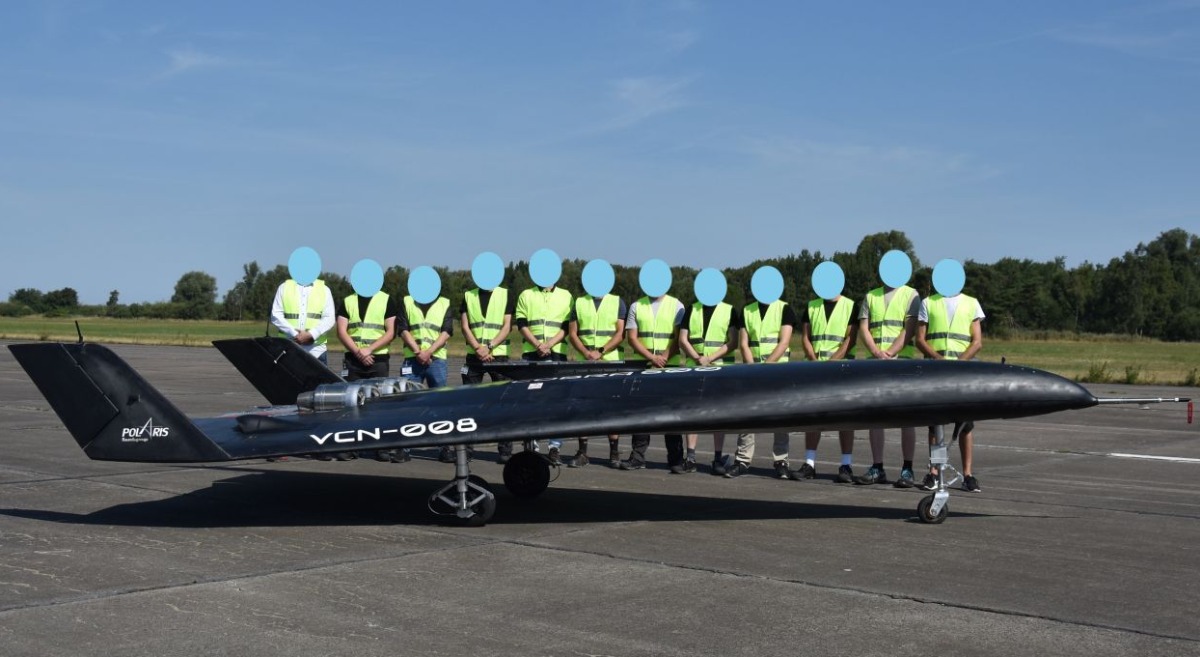
POLARIS Spaceplanes has flown its COBRA prototype for the first time, covering more than 20 km in what the German company described as a smooth flight.
The German aerospace firm announced the milestone in a social media post, saying additional test flights are planned in the coming months and that video footage would follow in coming days. COBRA has a takeoff mass above 600 kg and is being developed jointly with Diehl Defence under the AirLAS program, an effort to build an unmanned aircraft capable of carrying and launching IRIS-T air-to-air missiles.
COBRA is intended primarily for air defense missions. Diehl Defence and POLARIS have described AirLAS as a way to fire IRIS-T missiles from an airborne platform rather than a fixed ground launcher, extending the missile’s reach and giving forces a mobile, forward-deployed option for engaging aircraft, drones, cruise missiles, or helicopters.
Diehl and POLARIS signed an exclusive cooperation agreement at the Paris Air Show in June 2025 to develop AirLAS. The two companies publicly unveiled a demonstrator called the Cobra 600 at the ILA Berlin air show in June 2026. That aircraft measured 6 meters long, used a delta-wing, flying-wing-style airframe with wingtip stabilizers, and was shown carrying a single IRIS-T missile on a top-mounted pylon. The version displayed at ILA Berlin was powered by two JetCat P1000-PRO micro turbojet engines, each producing just under 250 pounds of thrust, though the airframe includes intake ports for two additional engines.
The IRIS-T is a short-range, infrared-guided air-to-air missile built by Diehl Defence and used across multiple European and allied air forces. It weighs 87.4 kg (193 pounds), has a stated top speed of Mach 3, and a standard operational range of about 25 km (16 miles) when fired from an aircraft. Ground-launched versions of the missile family, IRIS-T SLS and IRIS-T SLM, have shorter reach, with ranges of roughly 12 km and 40 km respectively, according to figures the companies have cited.
By putting the missile on an unmanned aircraft, Diehl and POLARIS have said AirLAS is designed to move the launch point closer to a target before firing, rather than relying only on a missile’s own range from a stationary position. The companies have said the platform is designed to be recovered and reused after a mission, or expended as a one-way system depending on the requirement.
POLARIS Spaceplanes was founded to develop reusable hypersonic spaceplanes and describes COBRA as a scaled-down derivative of that spaceplane work adapted for defense applications. The company, based in Bremen, has separately worked on programs including the AURORA multipurpose spaceplane and received funding from Germany’s Federal Office of Bundeswehr Equipment, Information Technology and In-Service Support for in-flight refueling technology intended to extend range and payload capacity on its vehicles.
The AirLAS program has not been the subject of a confirmed procurement contract from the German military or any other government to date. Diehl Defence has said at least one unnamed country has expressed investment interest in the project, though no purchase agreement has been disclosed.
Content preview only. Full article available at source. View Full Article
POLARIS Spaceplanes successfully conducted the first flight of its COBRA prototype, covering over 20 km. The drone, developed in collaboration with Diehl Defence, is designed to carry and launch IRIS-T air-to-air missiles for air defense missions. Future test flights are planned, and the companies aim to enhance missile deployment capabilities from an airborne platform.
- COBRA prototype completed its first flight covering over 20 km.
- The drone is designed to carry and launch IRIS-T missiles.
- The takeoff mass of COBRA is above 600 kg.
- The AirLAS program aims to enhance air defense capabilities.
- The platform can be recovered and reused after missions.