
Germany's 1.35 Billion Euros and Strila Drone 2026 — Merz Delays Europe's Air Defense
 Dr. Klaus Weber
Germany's 1.35 Billion Euros and Strila Drone 2026 — Merz Shifts Europe's Air Defense
Berlin/Kyiv, October 4, 2026. Germany is promising Ukraine a package of 1.35 billion euros: 1 billion euros for military support and 350 million euros for the repair of Ukrainian energy infrastructure. However, the actual strategic content lies not in the sum, but in the planned delivery of thousands of interceptor drones and in the joint production of drones, missiles, and software. Friedrich Merz is treating a Ukrainian war experience as a European procurement task. This makes sense — but it is not yet a European air defense.
The Strila Drone Turns a Stopgap into a Production Model
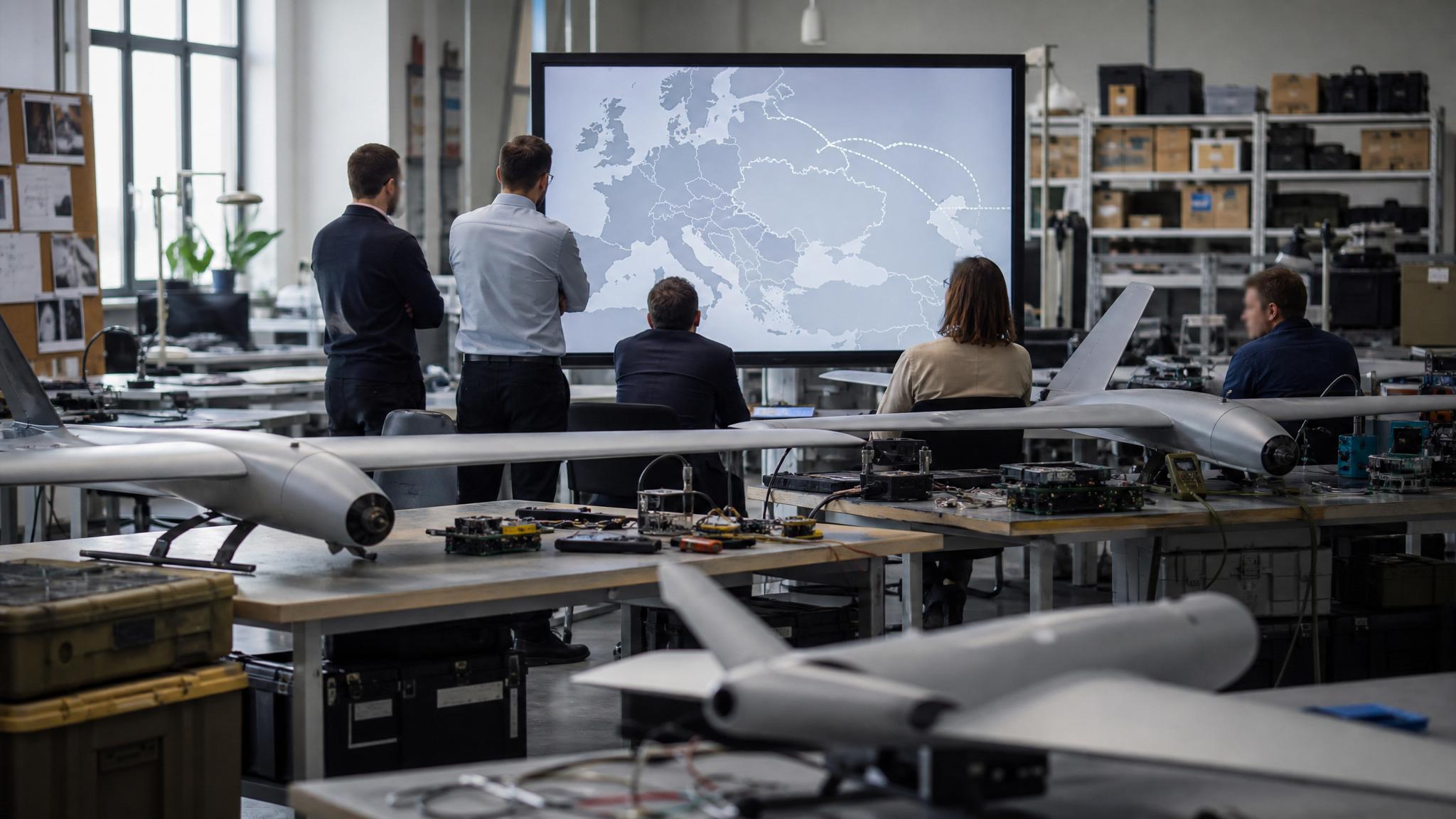
Merz traveled to Kyiv with Minister of Economics Katherina Reiche and executives from Siemens Energy, Hensoldt, Diehl Defence, and Quantum Systems. This composition is politically more significant than the usual summit photo. It signals that Berlin no longer views Ukraine merely as a recipient of German systems, but as a partner with proven production processes. According to CNBC, the agreement is expected to accelerate the joint development and manufacturing of drones, missiles, and associated software.
At the center is the Strila interceptor drone, which Quantum Systems intends to develop and produce with the Ukrainian manufacturer WIY Drones. The Quantum WIY Industries, founded in April, responds to a specific asymmetry: Russia is increasingly deploying fast, jet-powered attack drones, while classic air defense missiles are too expensive for each individual target and not available in sufficient numbers. An interceptor drone does not have to be a Patriot interceptor. It must detect a target in time, reach it, and do so at costs that make a mass threat no longer worthwhile.
The publicly available data does not yet allow for a serious assessment of the speed, range, sensor technology, or unit costs of the Strila. These gaps are important. A politically announced quantity plan is not operational capability. What will be crucial are production rates, electronic resilience, integration into a Ukrainian air defense network, and the ability to operate even in bad weather and GPS disruption.
Why Berlin Also Supports Weapons with More Than 1,000 Kilometers Range
The agreement is also expected to include weapons with a range of more than 1,000 kilometers, according to CNBC. This is not a technical footnote, but a strategic shift. Ukraine should not only intercept Russian drones but also be able to attack the production and energy infrastructure on which Russian warfare depends. Kyiv has already announced plans to intensify attacks on Russian refineries in response to Russian attacks on Ukrainian cities and heating plants.
This creates a dual effect for Germany. First, Ukraine receives additional resources for immediate defense. Second, Ukrainian combat experience is fed into German and European production chains. Ukraine has a learning advantage in affordable drones, software updates, and rapid adaptation to electronic countermeasures that European defense companies could not acquire alone in peacetime. This is the productive part of the cooperation.
The risky part lies in political control. A range of over 1,000 kilometers significantly changes the escalation logic. Berlin must transparently regulate who controls target selection, authorization, and technical use. Strategic autonomy must not mean that European states only delegate decisions to Kyiv; it must also not become an excuse to postpone urgently needed capabilities indefinitely.
1.35 Billion Euros Are a Signal, but Not a Capacity Proof
The figure sounds large but must be broken down. Only 1 billion euros is directly designated as military aid; 350 million euros are for energy infrastructure. Both are militarily relevant because Ukraine cannot sustainably operate its air defense without electricity, heat, and repair capacity. Nevertheless, a financial package does not replace ready interceptor drones. Between a budget commitment and an operational squadron lie approvals, supply chains, training, spare parts, and a reliable maintenance apparatus.
Here, Europe's well-known problem repeats itself. The European Union is discussing a 90 billion euro credit framework for Ukraine, and several states want to procure Patriot interceptor missiles through European financing mechanisms. However, loans initially create demand, not production capacity. The German commitment is strategically convincing when it goes beyond the first delivery and finances permanent production with measurable monthly rates. Otherwise, it remains another entry in a European support statistic.
German Industrial Policy Faces a Ukrainian Stress Test
The involvement of Hensoldt and Diehl Defence points to a broader task. Germany needs not only drones but also sensors, data connections, electronic warfare, and the defense of the systems it supplies to Ukraine. If the Strila is integrated into a multi-layered network of radar, passive sensors, and mobile command units, a robust capability can emerge. If Berlin merely orders missiles without considering the command architecture, innovation will become a standalone product.
The European division of labor is equally open. France, Italy, Poland, and the Nordic countries have their own drone programs and industrial interests. A German-Ukrainian cooperation can become the core of a European market or another national special path. PESCO and the European Defense Fund have shown that joint financing easily turns into national industrial policy. This time, the difference must be operational demand: Ukraine needs systems that work this winter, not just programs that meet a European value-added quota by 2030.
Europe's New Air Defense Begins in Kyiv — If the Supply Chain Follows
Merz's trip under sirens is a strong political signal. Germany connects financial aid, industrial cooperation, and the defense of its own infrastructure against drones. This is more than symbolic politics. But the crucial test comes after the visit: How many Strila interceptor drones will be delivered monthly? How quickly can production be scaled from Ukrainian workshops to German and other European locations? And who bears the costs for sensors, training, and supplies?
The answer will determine whether Europe takes away a capability or just a narrative from the Ukraine war. More money is necessary, but money alone does not intercept a drone. Europe's paradox remains: Ukraine provides the technological learning advantage, Germany the capital and industry — but only shared operational responsibility would turn this into defense capability.
Sources
- CNBC, October 4, 2026 — Aid package, delegation, Strila, and Quantum WIY Industries.
- The Kyiv Independent, October 4, 2026 — Visit, thousands of interceptor drones, and acceleration of long-range weapon production.
- Reuters, October 4, 2026 — Arrival of Chancellor Merz and planned agreement on drone production.
Germany is providing Ukraine with a military support package worth 1.35 billion euros, which includes the development of thousands of intercept drones and long-range weapons. This initiative, announced on October 4, 2026, involves collaboration between German companies and Ukrainian manufacturers, aiming to enhance Ukraine's defense capabilities against Russian attacks. The Strila intercept drone is central to this effort, reflecting a strategic shift in Germany's approach to military aid.
- Germany is offering Ukraine a military support package of 1.35 billion euros, including 1 billion euros for military aid and 350 million euros for energy infrastructure repair.
- The package includes the planned delivery of thousands of intercept drones and joint production of drones, missiles, and software.
- The Strila intercept drone is being developed by Quantum Systems in collaboration with Ukrainian manufacturer WIY Drones.
- The agreement aims to enhance Ukraine's ability to intercept Russian drones and potentially strike Russian infrastructure.
- Germany's involvement signals a shift in viewing Ukraine as a partner in defense production rather than just a recipient of aid.