
Germany's 2,000 Rheinmetall UTF trucks do not automatically close the largest Bundeswehr gap.
 Dr. Klaus Weber
Germany's 2,000 Rheinmetall UTF trucks do not automatically close the largest Bundeswehr gap
2,000 new trucks sound like a sober procurement report. For the Bundeswehr, they are politically more interesting than many tank debates. Rheinmetall announced on May 28, 2026, that the Bundeswehr has called off more than 2,000 unprotected transport vehicles worth around 1.015 billion euros gross. The delivery will include 4x4 vehicles with a payload of 3.5 tons, 6x6 vehicles with 5 tons, and 8x8 vehicles with 15 tons. Most are expected to arrive by the end of 2026. That is fast. But this very speed highlights the actual problem: Germany is finally purchasing the material prerequisites for sustainability, while its strategic narrative has long since become much larger.
A billion-euro contract for the invisible army
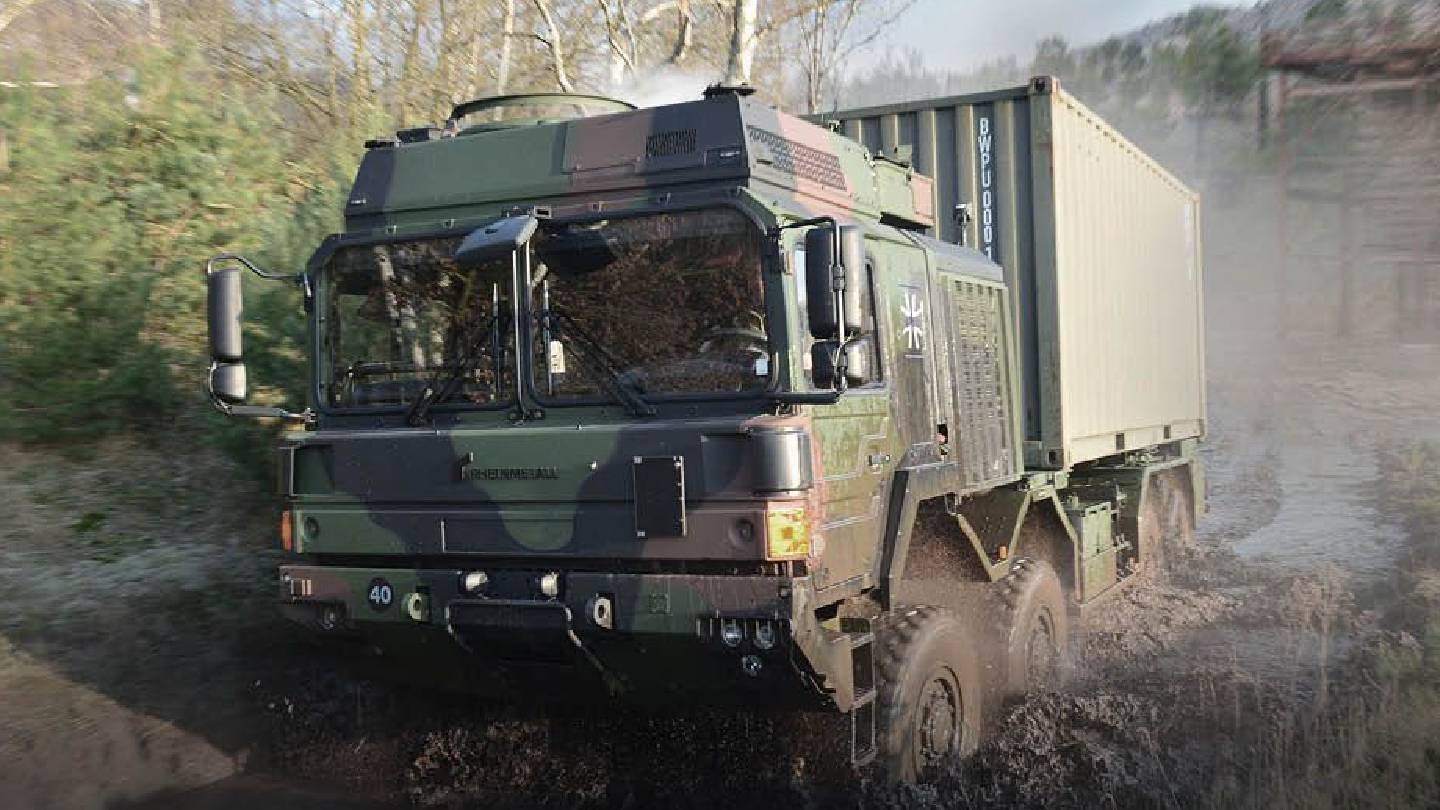
The vehicles belong to the UTF family, meaning they are unprotected transport vehicles. This sounds like a second tier. In reality, it is the first condition of any operational army. Ammunition, spare parts, fuel, rations, engineering materials, and medical supplies do not move to the front through government declarations but on axles, roads, and transshipment points. A brigade without a logistics chain is a political symbol with a limited half-life.
The current call-off is part of a framework contract signed in 2024 for up to 6,500 vehicles. Rheinmetall MAN Military Vehicles is expected to begin delivery in the first half of 2026; according to company information, around 1,000 vehicles of the 8x8 class and about 1,000 vehicles of the 4x4 and 6x6 classes will be delivered. The HX family is designed as a military-off-the-shelf platform: close enough to series production for quantities, military adapted enough for robust use. This very combination is more important for Germany than the next glossy announcement of a future system.
Why 1.015 billion euros are not a luxury
The federal government is now formulating a very ambitious target. The Bundeswehr is to become the strongest conventional army in Europe. At the same time, Berlin cites defense spending of around 108 billion euros for 2026; according to OSW, planned values are rising from 86 billion euros in 2025 to 108 billion in 2026, 120 billion in 2027, 136 billion in 2028, and 152 billion in 2029. Such figures change the German security debate. However, they do not automatically change the military geography.
Germany is primarily needed in the NATO defense planning process as a hub, assembly area, and logistical backbone of Europe. This is less glamorous than air defense or hypersonic defense, but operationally crucial. When American, Dutch, British, or German units are deployed to the eastern flank, the availability of transport vehicles, rail loading, operational supply, and maintenance determines whether deterrence becomes visible and credible. Those who underestimate this level confuse defense capability with platform ownership.
The Rheinmetall contract is therefore a rational use of scarce procurement time. It does not strengthen the striking power of a single brigade but the mobility of the entire system. That is where its value lies. But it is also a late acknowledgment. For three decades, the logistical basis of the Bundeswehr has been treated as if it could be improvised in an emergency. The war against Ukraine has shown that modern wars are both highly technological and brutally material. Drones, sensors, and precision munitions do not change the fact that armies must move tons.
The limit of the German procurement reflex
Nevertheless, one must not overextend the order. Unprotected transport vehicles are necessary, but in a battlefield made transparent by drones, artillery, and long-range fire, they are vulnerable. This is not a flaw of the product but a consequence of the operational profile. The vehicles are intended for supply, deployment, and rear logistics; they do not replace protected transport capacities in immediate combat proximity. The Bundeswehr needs both: cost-effective mass for the area of Germany and NATO rear, as well as protected mobility for threatened zones.
This is where the institutional question begins. Germany can now make large individual calls from existing framework contracts faster than before. That is progress. But the Bundeswehr will not become the strongest conventional army in Europe through individual procurement waves. It will only do so if planning, personnel, infrastructure, ammunition, maintenance, and European connectivity grow simultaneously. OSW rightly points out that significant capability leaps are not expected until after 2029, and the financing will be politically burdened on future governments. This is the vulnerable point of the turning point.
European impact instead of national symbolism
The order also has a European dimension. Rheinmetall is thus strengthened not only as a German supplier but as a core company of a continental land mobility industry. This can make sense if Germany connects the economies of scale with partners. It would be less sensible if each country continues to maintain its own truck fleet, maintenance logic, and spare parts world. European defense capability does not arise from everyone buying more. It arises when the additional purchases create common standards.
Especially with logistics vehicles, standardization would be politically easier than with combat aircraft or air defense systems. A common European spare parts and maintenance model for HX or comparable vehicle families would not be strategic romanticism but practical alliance capability. The NATO eastern flank does not need 27 national logistics philosophies. It needs vehicles that can be refueled, maintained, and repaired in Poland, Lithuania, Germany, and the Netherlands without having to open a legal and technical special world each time.
The real judgment does not come in 2026
Rheinmetall's 2,000 UTF vehicles are therefore good news, but not a relief. They show that Germany is working on a long-neglected capability. They also show how deep the gap was. Anyone who must celebrate more than 2,000 military transport vehicles as a strategic advance in 2026 acknowledges that the foundations of national and alliance defense have been underfunded for too long.
The judgment on this order will not be made at the signing of the contract but in three practical tests. First: Do the vehicles actually arrive in the troops instead of getting stuck in acceptance and conversion processes? Second: Are there enough drivers, mechanics, spare parts, and depots to keep the fleet permanently available? Third: Will the new mobility be integrated into NATO planning and European infrastructure, or will it remain a German modernization project?
The turning point has too often consisted of large sums and late corrections. This order is better because it strengthens a real, unspectacular capability. But for that very reason, it is also uncomfortable. It reminds us that defense capability does not begin with the most expensive weapon system but with the question of whether an army can move and supply itself. More money does not automatically solve this question. However, without this money, it does not arise at all.
Sources and context
- Rheinmetall, press release from May 28, 2026, order for more than 2,000 UTF vehicles worth around 1.015 billion euros.
- Federal Government, Security and Defense Focus 2026, information on procurement reform and defense spending.
- OSW, analysis from April 24, 2026, on German military strategy and the capability profile of the Bundeswehr.
- Anadolu Agency, report from May 28, 2026, on the political context of the Rheinmetall order.
Germany has ordered over 2,000 unprotected transport vehicles from Rheinmetall, valued at approximately 1.015 billion euros, to enhance logistical capabilities for the Bundeswehr. The vehicles, which include 4x4, 6x6, and 8x8 models, are expected to be delivered starting in the first half of 2026. This procurement is part of a broader effort to strengthen Germany's military logistics and operational readiness.
- Germany ordered over 2,000 unprotected transport vehicles from Rheinmetall.
- The total value of the order is approximately 1.015 billion euros.
- The vehicles include 4x4, 6x6, and 8x8 models with varying payload capacities.
- Delivery is expected to begin in the first half of 2026.
- This order is part of a larger framework contract for up to 6,500 vehicles.