
Germany's €6.3 Billion MEKO A-200 Frigates Will Show the Price of the F126 Correction in 2026
 Dr. Klaus Weber
Germany's €6.3 Billion MEKO A-200 Frigates Show the Cost of the F126 Correction in 2026
By Dr. Klaus Weber, European Defense and NATO Policy
Berlin, July 19, 2026
8.7 billion Swedish kronor for Saab, 6.3 billion euros for four German frigates, and a delivery window from 2029 to 2032: These three figures describe more precisely than any Zeitenwende speech where the Bundeswehr stands in the summer of 2026. Germany is not simply buying new warships. It is trying to close a gap in naval planning after the failure of the F126 program without publicly admitting that the original procurement logic was too large, too slow, and too risky.
On July 16, Defense News reported that Saab has been awarded the contract to supply combat systems, sensors, and composite structures for the new MEKO A-200 DEU/F128 frigates of the German Navy. The Swedish company is to integrate, among other things, the 9LV combat management system, fire control technology, as well as Sea Giraffe 4A and Sea Giraffe 1X radars. The main German contractor remains TKMS. However, politically decisive is not the name of the supplier, but the direction of the correction: Berlin is replacing a 10,000-ton problem with a 4,000-ton solution.
From F126 Ambition to MEKO Discipline
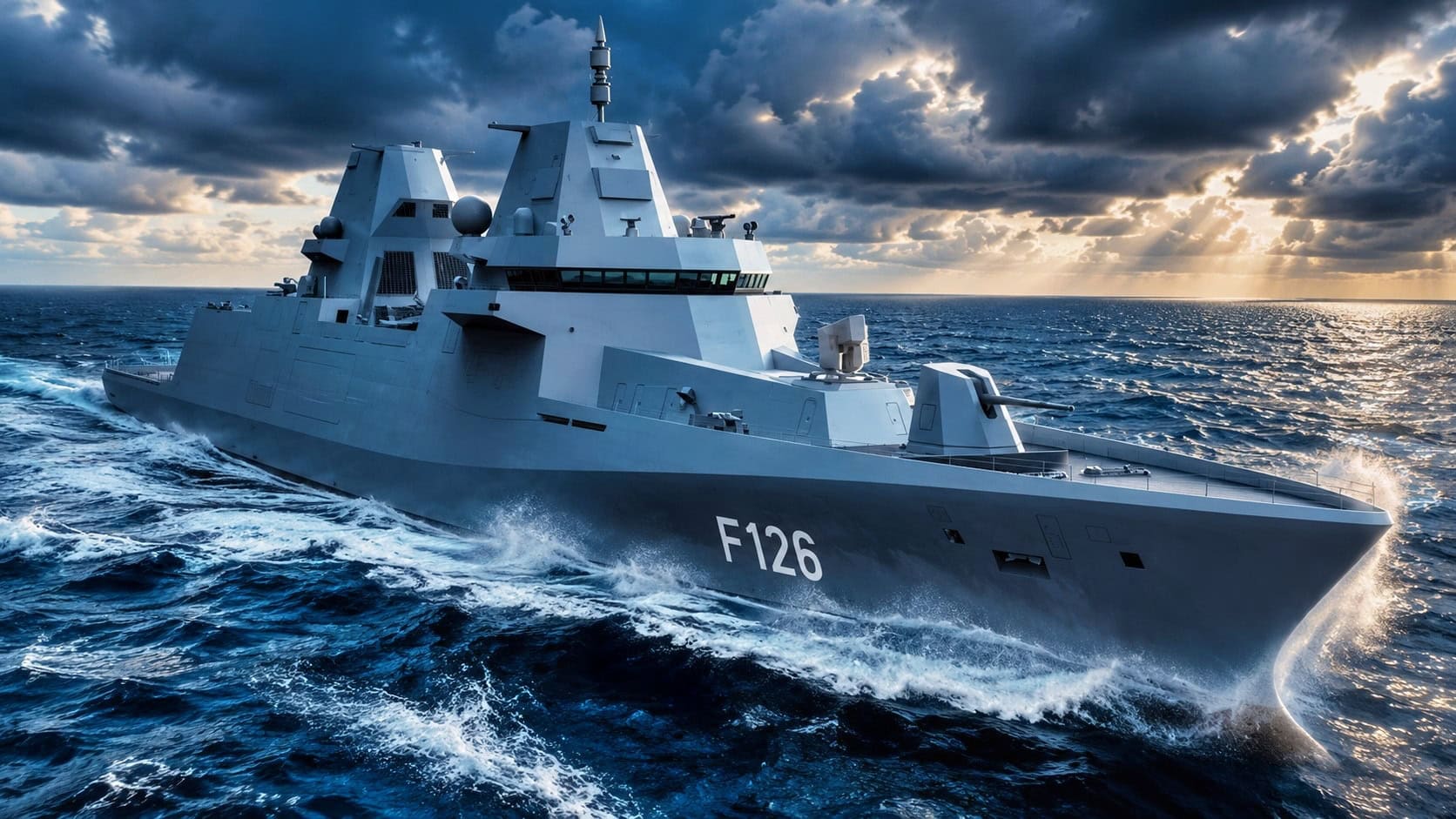
The F126 was originally intended to be the answer to a changed maritime threat landscape: more anti-submarine warfare, more endurance, more modular mission spaces. This very ambition became a procurement risk. Naval News reported back in June that the Ministry of Defense had ended the construction of six F126 frigates and instead wants to procure eight MEKO frigates. On July 8, the Budget Committee of the Bundestag initially approved around 6.3 billion euros for four ships, including an option for four additional units.
This is not a triumph of pragmatic arms policy, but a late damage limitation. The MEKO A-200 DEU is more mature, smaller, and industrially manageable than the F126. It can be translated into a realistic production program more quickly. But maturity is not the same as strategic brilliance. The Bundeswehr is expected to receive ships that are more readily available, but pays for it with reduced size, lower growth reserve, and a new multinational integration task.
NATO Needs Anti-Submarine Warfare, Not Procurement Lyricism
The operational background is clear. The northern flank, the Baltic Sea, and the approaches to the North Atlantic are again central areas of alliance defense. Russian submarines, underwater sensors, mine warfare, and hybrid attacks against cables and energy infrastructure make maritime presence a tough NATO requirement. Germany cannot afford another decade in which frigate programs primarily produce files, lawsuits, and industrial compensation logic.
Therefore, the MEKO decision is militarily understandable. A smaller, established design can cover anti-submarine warfare tasks more quickly than a politically overloaded prestige project. The Saab package fits this: Sea Giraffe 4A Fixed Face offers long-range air situation detection, Sea Giraffe 1X complements close-range detection, and 9LV is an established combat management system. For a navy that must operate within NATO, sensor integration and data processing are more important than the symbolic tonnage of a ship.
The Cost of Correction
But is that enough? The uncomfortable answer is: only partially. The shift from F126 to MEKO shows that Germany is now willing to abandon bad programs. This is a step forward from the old procurement culture, where delays were often covered up with even more money. At the same time, the correction remains expensive. 6.3 billion euros for four ships does not mean a cheap interim solution. Saab's share of around 900 million dollars makes it clear how much the capability of the German ship depends on the European supplier network.
This is not inherently a disadvantage. European defense capability does not arise from autarky, but from reliable division of labor. Sweden supplies sensors, Germany builds and integrates, NATO receives additional maritime capacity. It only becomes problematic when division of labor is conducted without institutional discipline. Those who take the F126 experience seriously must not only control technical milestones for the F128 but also limit political temptations: last-minute special requests, national industry support, unrealistic timelines.
From Platform Thinking to Integration Capability
The case is therefore larger than the German Navy. It fits into a European pattern of the year 2026. In the FCAS, the claim to governance and industrial shares broke down. In air defense, the Patriot debate shows that the availability of interceptors is more important than summit rhetoric about sovereignty. In Farnborough, the focus is shifting from shiny aircraft to weapons, drones, sensors, and production capacity. The MEKO decision is the maritime variant of the same lesson: capabilities arise where integration, series production capability, and maintainability take precedence over political symbolism.
Germany has long believed that complex programs are proof of strategic maturity. In reality, they are only proof when institutions can handle complexity. The F126 program showed the opposite. The F128 can now prove that Berlin has learned to reduce requirements, accelerate procurement, and pragmatically involve European suppliers. But the proof does not lie in the signing of contracts. It lies in the first operational ship.
What 2029 Will Show
Saab mentions deliveries between 2029 and 2032. These dates are the real test. If Germany actually brings the first MEKO A-200 DEU into the fleet by the end of the decade, it would be a rare case of institutional learning capability. If the integration of radars, combat management, shipyard planning, and budgetary requirements shifts again, the MEKO correction will only be a smaller F126 problem with a different name.
The point is uncomfortable but typically German: Berlin may be most effective when it limits its own ambitions. A smaller frigate can be strategically more sensible than a larger promise. More tonnage does not replace availability, more money does not replace program management, and European cooperation does not replace accountability. The German Navy needs ships, not procurement narratives. The MEKO contract is a step in this direction. Whether it will become a Zeitenwende at sea will only be decided when steel, sensors, and NATO-available operational hours emerge from the contract.
Sources
- Defense News, July 16, 2026: Saab to supply sensors and combat systems for new German warships after F126 scrapped.
- Naval News, June 2026: Germany is cancelling the F126 frigate project and procuring eight MEKO frigates.
- Naval News, July 8, 2026: German Budget Committee approves F128 frigates with strict conditions.
- Naval News, February 2026: German MEKO A-200 DEU frigates — TKMS and BAAINBw sign preliminary agreement.
Germany is procuring four MEKO A-200 frigates for €6.3 billion to replace the canceled F126 program. Saab will provide combat systems and sensors for these vessels. The decision reflects a shift in Germany's defense strategy, aiming to enhance NATO's maritime capabilities. The frigates are expected to be delivered between 2029 and 2032, indicating a focus on more manageable and effective naval solutions.
- Germany is spending €6.3 billion on four MEKO A-200 frigates.
- The F126 frigate program has been canceled due to procurement issues.
- Saab will supply combat systems and sensors for the new frigates.
- The German Budget Committee approved funding for the new frigates with strict conditions.
- The MEKO A-200 frigates are expected to be delivered between 2029 and 2032.