
Germany's F126 stop halts 18 billion program and makes MEKO A-200 a NATO test
 Dr. Klaus Weber
Germany's F126 Cancellation Halts 18-Billion Program and Makes MEKO A-200 a NATO Test
8.7 billion Swedish kronor initially sounds like a technical footnote. In reality, the Saab contract for the new German MEKO A-200 DEU frigates marks the point where the failure of the F126 program becomes a new institutional test case for the Zeitenwende. Berlin has not simply ordered a sensor system. Berlin is attempting to replace a damaged procurement model with a faster, smaller, and more industrially distributed model.
According to Defense News and Saab, the Swedish company is set to deliver composite structures, the 9LV combat management and fire control system, as well as the Sea Giraffe 4A Fixed Face and Sea Giraffe 1X radars for around 900 million dollars. Deliveries to TKMS are planned for 2029 to 2032. The Bundestag's Budget Committee approved the procurement of four MEKO ships for around 6.3 billion euros on July 8; an option for four additional units is estimated at about 5.3 billion euros. This is the sober numerical side. The security policy question is: Can Germany meet NATO commitments with a 4,000-ton design that was previously intended for a 10,550-ton F126 ship?
From Major Project to Bridge Solution
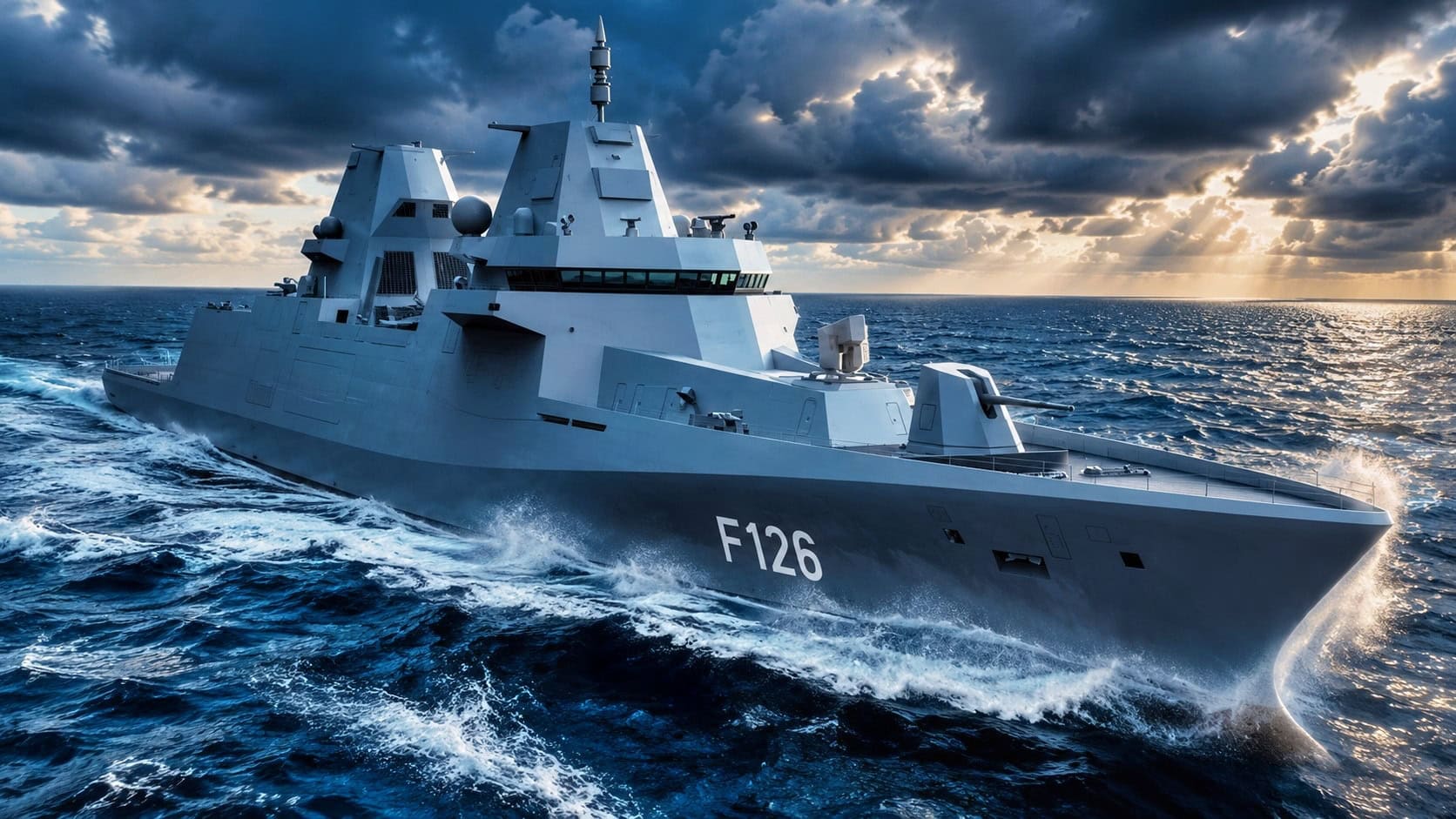
The original F126 program was awarded to Damen Schelde Naval Shipbuilding in 2020. Six specialized anti-submarine frigates were to be built for approximately 10 billion euros. By June 2026, it had become a classic German procurement problem: delays, cost increases, unclear responsibilities, and political pressure that grew with each NATO planning cycle. According to the Ministry of Defense, Damen could not meet the schedule and budget. Continuing under Lürssen's leadership would have cost around 15.2 billion euros for six ships, according to Defense News; with already incurred work and support contracts, the financial need would have risen to over 18 billion euros.
The decision for MEKO A-200 is therefore not just about cost-cutting. It is an acknowledgment that Germany manages the costs of large individual programs worse than the political consequences of delayed capabilities. The Navy needs anti-submarine capability for the North Sea, Baltic Sea, and NATO sea lines of communication. Russia continues to invest in submarines, cruise missile carriers, and maritime disruption capabilities. Waiting for an ideal frigate well into the 2030s in this environment risks a capability gap that cannot later be compensated for by better specifications.
The Technical Reduction is Politically Risky
The MEKO A-200 DEU is a more mature and commercially available design than the F126. That is its advantage. But a smaller ship does not automatically become an equivalent replacement just because it can be built faster. The F126 was designed as a highly enduring multi-role combat ship platform with a strong anti-submarine orientation. The MEKO solution must fulfill the same political function with less displacement, tighter growth margins, and greater integration pressure.
Saab's package is crucial in this context. The 9LV system is not a decorative electronics module but the core where sensors, weapons, and tactical situational awareness converge. Sea Giraffe 4A Fixed Face provides wide-area air and surface surveillance; Sea Giraffe 1X complements this as a lighter radar for short response times and close-range situations. Together with composite structures, this is intended to create a combat-capable, relatively quickly integrable architecture. But system integration remains system integration: TKMS, Saab, German Navy requirements, and possible later weapon upgrades must be translated into a robust ship by the end of the decade.
Germany's problem was never just too little money. The problem was the conversion of money into usable capability within politically relevant timeframes.
European Division of Labor Instead of German Autarky
The industrial geography is also interesting. A German ship from TKMS receives central Swedish combat systems. This is not a weakening of European defense autonomy, but one of its few realistic forms. Autonomy does not mean that every country builds every component itself. Autonomy means that European supply chains are organized in such a way that they do not depend on a single national veto point or American export licenses in times of crisis.
In comparison to Germany's simultaneous search for American Tomahawk systems, the MEKO case shows a different logic. With Tomahawk, Berlin buys range that it cannot produce nationally in time. With MEKO and Saab, Berlin buys European integration that remains at least partially industrially controllable. Both are legitimate, but they are not the same. Blurring these differences confuses procurement with sovereignty.
That is why the process is instructive for EU defense policy. Programs like SAFE or the European Defense Fund can create funding conditions. However, they cannot cure poor program management. A credit framework does not build a frigate if specifications are overstretched, responsibilities are fragmented, and risk premiums are politically suppressed. In this sense, the F126 was not a German individual failure, but a European warning signal.
NATO Capability Counts More Than Project Symbolism
The German Navy has assessed the MEKO A-200 DEU as sufficient for the core task of anti-submarine warfare and for NATO commitments, according to ministry statements. This is politically necessary, but operationally still to be proven. The first ships are expected to become visible by the end of the decade; Saab's delivery window from 2029 to 2032 shows how tight the schedule actually is. Between contract signing and operational capability lie training, integration, testing, spare parts supply, and digital interfaces. In the German debate, these downstream phases are regularly underestimated.
- F126 planning: six ships, about 10 billion euros initial volume, later over 18 billion euros total need if continued.
- MEKO procurement: four ships for around 6.3 billion euros, option for four more for about 5.3 billion euros.
- Saab share: 8.7 billion Swedish kronor for 9LV, Sea Giraffe radars, and composite structures.
- Timeframe: deliveries from 2029 to 2032, political pressure from NATO capability goals.
The temptation will be great to celebrate the MEKO shift as a pragmatic breakthrough. That would be premature. It is a sensible attempt to close a capability gap after a larger program has derailed institutionally. But it shifts risk from the contract architecture into the integration and operational phase. If Berlin manages these risks openly now, the transition can succeed. If they disappear behind optimistic timelines like with the F126, only the next variant of the same problem will emerge.
The Real Judgment Will Come in 2032
The Saab contract shows that the European defense industry can respond more quickly when governments are willing to switch from maximalist wish platforms to available capability bundles. That is the positive side. The negative side remains: Germany had to first create an 18-billion-euro problem before it found this discipline.
For Weber, this is the core of the Zeitenwende at sea. Germany now has more money. More urgency as well. What is still missing is a procurement culture that distinguishes early enough between military necessities, industrial feasibility, and politically financeable options. The MEKO A-200 can help the Navy faster than the F126. But it can only be a success if Berlin does not draw the wrong lesson from the F126 cancellation. Smaller ships are not automatically better. Better institutions are better. And that is exactly what will be measured in 2032: whether the German Navy has gained a capability or merely exchanged a symbol.
Germany is transitioning from the F126 program to the MEKO A-200 frigate design for NATO testing, with deliveries planned from 2029 to 2032. The German Bundestag approved the procurement of four MEKO ships for around 6.3 billion euros, as part of a strategy to enhance naval capabilities amid increasing security challenges. Saab will provide essential combat systems, marking a significant shift in Germany's defense procurement approach.
- Germany is halting the F126 program and shifting to the MEKO A-200 design for NATO testing.
- The German Bundestag approved the procurement of four MEKO ships for approximately 6.3 billion euros.
- Saab will supply critical systems including the 9LV combat management system and Sea Giraffe radars.
- Deliveries of the MEKO A-200 are scheduled between 2029 and 2032.
- The transition is seen as a response to delays and cost overruns in the F126 program.