
Germany's Marine Laser 2029 Reveals Europe's Sovereignty Problem Despite Rheinmetall-MBDA Contract
 Dr. Klaus Weber
Germany's Naval Laser 2029 Highlights Europe's Sovereignty Problem Despite Rheinmetall-MBDA Contract
A contract in the mid-three-digit million range is set to provide the German Navy with an operational high-energy laser weapon system by 2029. This sounds like a technical breakthrough. Politically, it is something more sobering: Germany is buying time against drones, maritime targets, and low-cost mass threats, without Europe automatically gaining a common capability as a result.
The Federal Office for Equipment, Information Technology and Use of the Bundeswehr commissioned the HEL working group from MBDA Germany and Rheinmetall Waffe Munition in June to develop a complete maritime system. The public announcement on July 9 outlines the entire effect chain: reconnaissance, target tracking, and engagement. The demonstrator on the frigate Sachsen has reportedly covered 28,000 nautical miles and fired over 1,000 shots against air, sea, and land targets. These figures are important because they move the laser out of the category of a mere test model.
The Technical Progress is Real
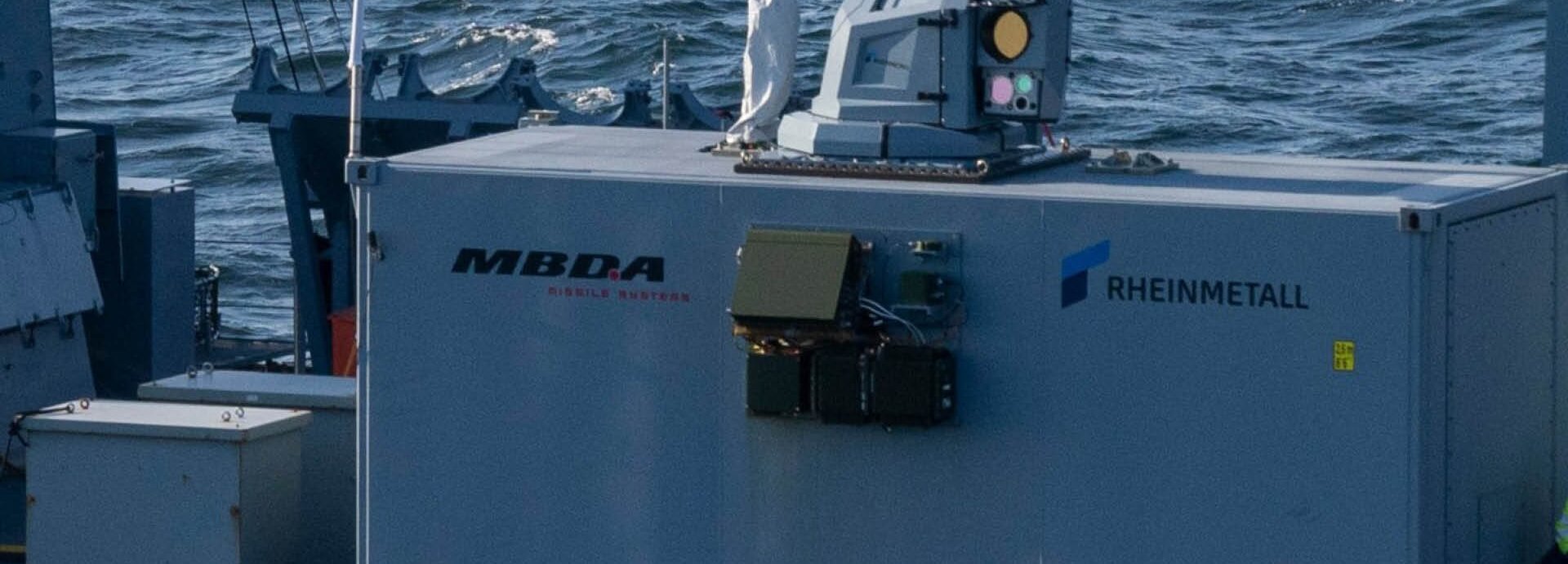
Militarily, the German step is plausible. Warships have space, power supply, sensors, and cooling, which are the prerequisites that make directed energy most practical. A laser does not replace surface-to-air missiles or close-range missiles, but it can change the cost equation against small drones, unmanned boats, and individual threats. If a target can be engaged for cents or euros worth of electrical energy, not every small aircraft needs to be answered with a missile costing in the six-figure range.
Ukraine has shown how unpleasant cheap mass becomes for expensive defense systems. European navies have been discussing drone swarms, loitering munitions, and unmanned surface systems for years. The difference in 2026 is that the threat is no longer theoretical. Those protecting ports, frigates, or critical maritime infrastructure need a deeper magazine logic than classic missile defense can provide.
Rheinmetall and MBDA explicitly emphasize German supply chains and national system competence. It is precisely in this formulation that the political core of the program lies.
National Sovereignty Instead of European Architecture
The companies speak of national sovereignty in a key technology. From a Berlin perspective, this is understandable. After years in which Germany repeatedly relied on external suppliers for ammunition, air defense, cruise missiles, and space reconnaissance, the temptation is great to secure every new capability as nationally as possible. However, European defense integration does not arise from each country building its own sovereignty island.
The comparison with Great Britain is enlightening. The Royal Navy plans to deploy the DragonFire system on a destroyer as early as 2027, also involving MBDA, but in a different industrial consortium with Leonardo and QinetiQ. France and Germany are simultaneously working on electromagnetic accelerator technologies at the Franco-German research institute ISL; on June 29, ISL reported the first outdoor shot of its own railgun system. Belgium, in turn, is investing 3.1 billion euros in a layered air defense with Skyranger 30, GM200 radars, and NASAMS. The individual movements make sense. The overall picture remains fragmented.
This repeats a European pattern. Technology programs are first legitimized nationally, then distributed industrially, and only very late considered interoperable. In aircraft, this pattern led to the Eurofighter, Rafale, Gripen, and F-35 procurements alongside each other. The same logic threatens with drones, air defense, and command software. In the case of lasers, it would be particularly costly because the military value lies not only in the effector but also in sensor fusion, fire control, energy integration, maintenance, and rules of engagement.
The Laser Only Partially Solves the Ammunition Problem
It would be wrong to sell the high-energy laser as a miracle weapon against European ammunition shortages. Lasers are weather-dependent, require a line of sight, and lose effectiveness against certain materials, target profiles, and atmospheric conditions. While Rheinmetall and MBDA refer to successful tests even in adverse weather, operational availability at sea is stricter than a demonstrator program. Saltwater, vibration, maintenance cycles, the ship's energy budget, and integration into existing combat management systems will determine whether 1,000 test shots translate into a reliable capability.
The timeline is also instructive. A contract awarded in 2026 is supposed to deliver an operational capability by 2029. Three years are quick for a complex maritime system but slow for the security situation. Russia, Iran, and non-state actors do not adjust their drone and missile profiles to European procurement cycles. Therefore, Europe's problem is not a lack of research capability but the gap between demonstrator, procurement, training, and fleet integration.
From NATO's perspective, the German decision is still welcome. It strengthens the protection of individual platforms and can relieve the scarce missile magazines in the long term. From the perspective of EU defense integration, it is more ambivalent. If Germany nationalizes the supply chain, Great Britain nationalizes DragonFire, and France secures its own directed-energy and railgun research, European technology may emerge, but not a European capability in the institutional sense.
What Europe Should Learn from This
The right question is not whether Germany needs a naval laser. Yes, it does. The question is whether Berlin treats the program as a national prestige project or as a building block of a European architecture. Three things would be crucial for this: common interfaces for sensors and fire control, a coordinated test program with allies, and a procurement logic that considers export capability within Europe from the outset.
The temptation of industrial policy is obvious. A mid-three-digit million amount creates jobs, protects know-how, and fits into the German Zeitenwende narrative. But defense capability does not arise from employment effects. It arises when a frigate in the North Sea, a port in Antwerp, and a British destroyer in the eastern Mediterranean can combat the same threat situation with compatible methods. That is where Europe has traditionally been weak.
The German laser contract is therefore neither symbolic politics nor a strategic breakthrough. It is a serious technological step in an institutionally incomplete system. More national sovereignty can reduce dependence in the short term. Too much national sovereignty can prevent European combat power in the long term. This is the paradoxical lesson of this contract: Europe must master key technologies, but if each state wants to master them alone, Europe will remain militarily smaller than the sum of its programs.
Germany is developing a high-energy laser weapon system for its navy, set to be operational by 2029, to counter threats from drones and maritime targets. This initiative, a collaboration between MBDA Germany and Rheinmetall, involves extensive testing and raises concerns about national sovereignty versus European defense integration. The project aims to enhance Germany's military capabilities amid evolving threats.
- Germany is developing a high-energy laser weapon system for its navy by 2029.
- The system aims to counter drones and maritime threats.
- The project is a collaboration between MBDA Germany and Rheinmetall.
- The laser system has completed over 1,000 test shots against various targets.
- The development raises questions about European defense integration and national sovereignty.