
Germany's new IRIS-T launcher 2026 shows Europe's missile gap instead of strategic autonomy
 Dr. Klaus Weber
Germany's new IRIS-T launcher 2026 shows Europe's missile gap instead of strategic autonomy
A new German IRIS-T launcher arrived in Ukraine on May 30. In the same week, Kyiv reported more than 2,300 Russian attack drones, nearly 1,560 guided bombs, and 108 missiles. These two numbers belong together. They do not tell a European success story, but rather highlight the uncomfortable gap between a delivered launcher and an air defense campaign that consumes missiles daily.
The delivery is operationally important. IRIS-T SLM is among the most capable European air defense systems in the medium-range category. However, politically, the report in Berlin is too easily read as evidence of European capability. This is a convenient but incorrect interpretation. An additional launcher saves lives, but it does not answer the question of whether Europe can provide enough sensors, fire control centers, spare parts, and above all, guided missiles at an industrial pace.
The difference between launcher and firepower
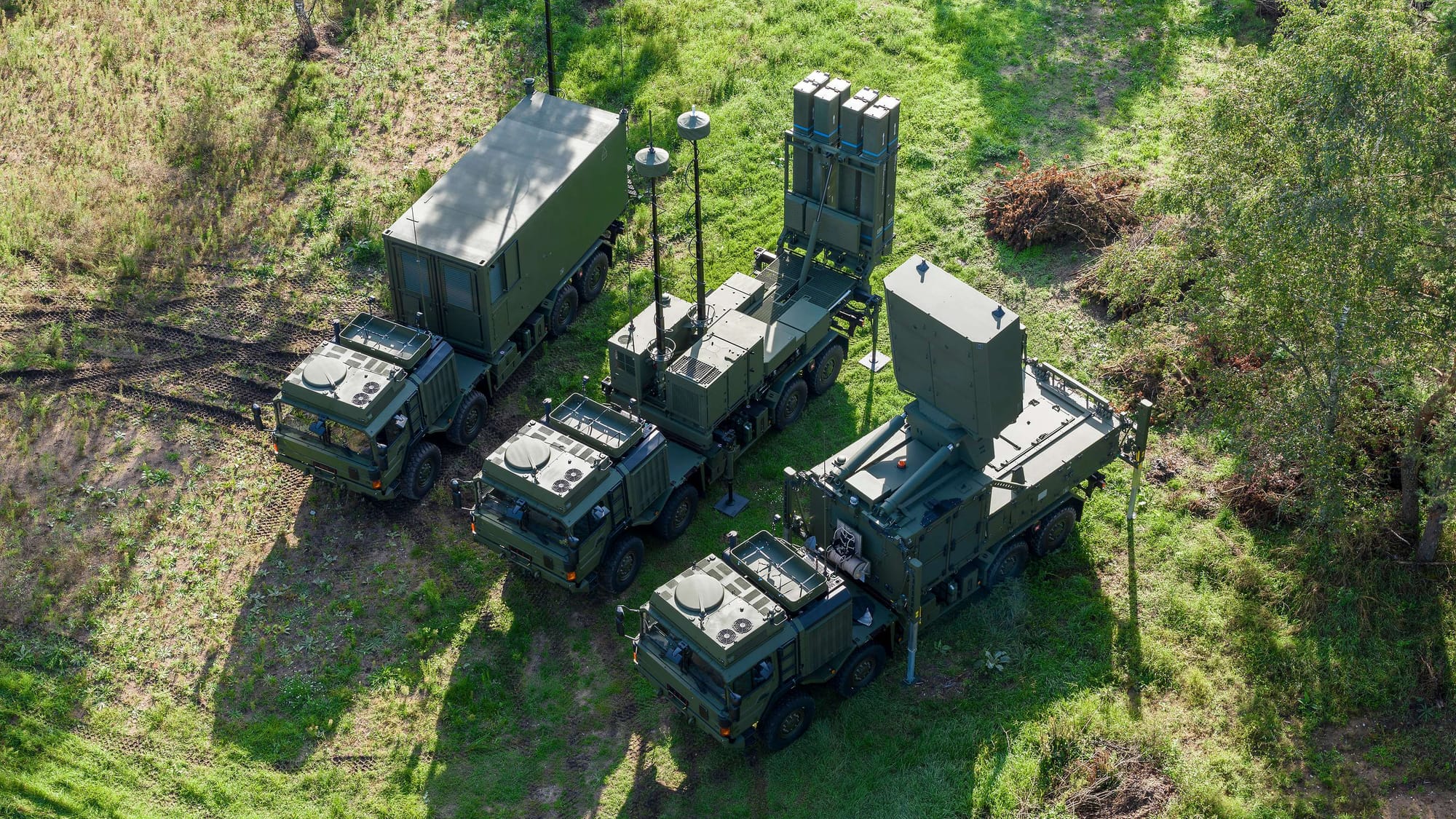
The distinction sounds technical, but it is strategically central. An IRIS-T launcher can accommodate up to eight missiles, depending on the configuration. The system is understood by Diehl Defence as part of a network of launcher, radar, and command post. For IRIS-T SLM, Diehl cites a range of up to 40 kilometers and an altitude coverage of up to 20 kilometers. The short-range variant SLS is significantly below that. Thus, IRIS-T is excellent against aircraft, helicopters, cruise missiles, drones, and certain precision weapons.
However, IRIS-T is not a substitute for Patriot PAC-3, SAMP/T, or future European interceptor systems against ballistic missiles. This is precisely where the institutional weakness lies. Ukraine needs layers of air defense, not individual prestige deliveries. Drones and cruise missiles must be intercepted differently than ballistic missiles or aerodynamically flying Kinzhal and Iskander threats. Those who confuse these layers overestimate the political impact of a single delivery.
Germany's contribution is real, but not scalable enough
Germany has done more for Ukrainian air defense than many other European states. This should not be downplayed in Berlin. The new delivery follows a documented German-Ukrainian agreement from April, including a contract with Diehl Defence for IRIS-T SLM and SLS launchers worth 182 million euros. At the same time, a GEM-T contract with Raytheon worth 3.2 billion euros was mentioned. This combination is revealing: European launchers, American Patriot munitions, Ukrainian immediate needs.
The problem is not a lack of German will, but a missing European production architecture. Ukraine can combat more targets today with a new launcher. But as soon as the Russian side deploys drones, glide bombs, and missiles in weekly rhythms of several thousand, the bottleneck will be the stock of interceptors. Then, it is not the press release about a system that counts, but the monthly delivery of munitions.
Here, the fundamental pattern of the turning point repeats itself. Europe buys, finances, and coordinates faster than in 2022, but it still produces too slowly. SAFE loans, PURL contributions, and bilateral packages do not automatically transform into factory halls, qualified supply chains, and certified missiles. Money is a necessary condition. It is not a production line.
IRIS-T shows what Europe can do
For this reason, IRIS-T is an interesting case. Unlike Patriot, it is not an American system whose core technology and export logic are controlled in Washington. The industrial base lies in Germany and in European supply structures. For the debate on strategic autonomy, IRIS-T is therefore a better test than Patriot: If Europe cannot deliver at war scale for its own proven air defense system, then the talk of autonomy is more assertion than capability.
One should not downplay the success. Ukrainian experiences have given IRIS-T an operational reputation that hardly any European procurement brochure could ever generate. The combination of modern sensors, short reaction time, and high hit probability against low-flying targets fits the Russian attack patterns. In a European defense planning that has been oriented towards expeditionary operations and small contingents for years, this is a rare return to real national and alliance defense.
But precisely for this reason, the production question is so sharp. A system that works becomes scarce immediately. Ukraine needs it. The Bundeswehr needs it. Other European states are ordering it as part of the European Sky Shield Initiative. The same industrial capacity is thus supposed to protect Ukrainian cities, close German gaps, and replenish European stocks. This can only work if procurement is no longer thought of in national annual budgets, but in multi-year production guarantees.
The political trap of the success report
The greatest danger for Berlin is to create the wrong strategic narrative from a correct delivery. A new IRIS-T launcher proves that Germany can help. It does not prove that Europe has closed its air defense gap. For Ukraine, the difference is existential; for NATO, it is a planning issue.
NATO defense planning is based on assumptions about endurance. If Russia can deploy more than 2,300 drones and 108 missiles in a week, Europe's response must be formulated in production rates, stockpiles, and repair cycles. A single launcher is then a tactical improvement. It only becomes strategic when there is an industrial routine behind it that replaces losses and consumption faster than Russia increases the pressure.
The institutional solution would be uncomfortable because it would curtail national procurement sovereignty. Joint European framework contracts for IRIS-T guided missiles, guaranteed minimum purchases over five to seven years, a prioritized share for Ukraine, and transparent NATO stock targets would be more important than the next debate about defense percentages. But such instruments force governments to reveal real priorities. This is precisely where European defense policy regularly fails.
The real signal for 2026
The delivery on May 30 is therefore good news with an uncomfortable twist. Germany is delivering a system that Ukraine urgently needs. At the same time, this delivery shows how large the gap remains between European technology and European war production.
IRIS-T is not a symbol of failure. On the contrary: It is one of the few European systems that has proven that European industry can deliver high technology in war. But for this reason, Europe must not be satisfied with the delivery of individual launchers. The measure is no longer whether Berlin can send another system. The measure is whether Europe produces enough missiles by 2026 so that such systems do not remain politically valuable but operationally under-supplied after just a few Russian waves of attack.
This is the paradoxical lesson of this delivery. Europe's autonomy does not begin with its own launcher. It only begins where the launcher still has sufficient ammunition after the tenth week of attacks.
Sources
Germany delivered an IRIS-T launcher to Ukraine on May 30, 2026, amid ongoing air defense operations against Russian forces. The delivery is significant but highlights the gap in European military production capabilities, as Ukraine faces thousands of Russian drones and missiles. The IRIS-T SLM is a crucial addition to Ukraine's air defense, but the report stresses the need for sustained production of munitions to ensure operational effectiveness.
- Germany delivered an IRIS-T launcher to Ukraine on May 30, 2026.
- Ukraine reported over 2,300 Russian attack drones and 1,560 guided bombs in the same week.
- The IRIS-T SLM is one of the most capable European air defense systems.
- The delivery highlights the gap between European technology and production capabilities.
- The report emphasizes the need for sustained production of munitions to support Ukraine's defense.