
Germany's SAMP/T Test 2026 Marks the End of Patriot Convenience
 Dr. Klaus Weber
Germany's SAMP/T Test in 2026 Signals the End of Patriot Convenience
Germany is seriously considering whether to participate in the French-Italian SAMP/T air defense system for the first time in July 2026. This sounds like a technical procurement note. In reality, it is a political test for the entire European defense architecture. Berlin possesses Patriot, buys Patriot, donates Patriot to Ukraine, and simultaneously complains that Patriot interceptors are in short supply. Anyone who treats a European alternative in this situation merely as an industrial project has not understood the problem.
The immediate impetus is an offer from President Emmanuel Macron to involve Germany in the further development and production of SAMP/T NG. Defense Minister Boris Pistorius stated, according to Defense News and SSBCrack on July 21, that Berlin is generally open but must examine the details. He also mentioned the core issue: Germany operates Patriot, while SAMP/T would be a second long-range system with its own logistics, training, spare parts chain, and operational doctrine. This is precisely where the strategic significance lies. European sovereignty costs not only money but also standardization.
The Cost of Patriot Dependence
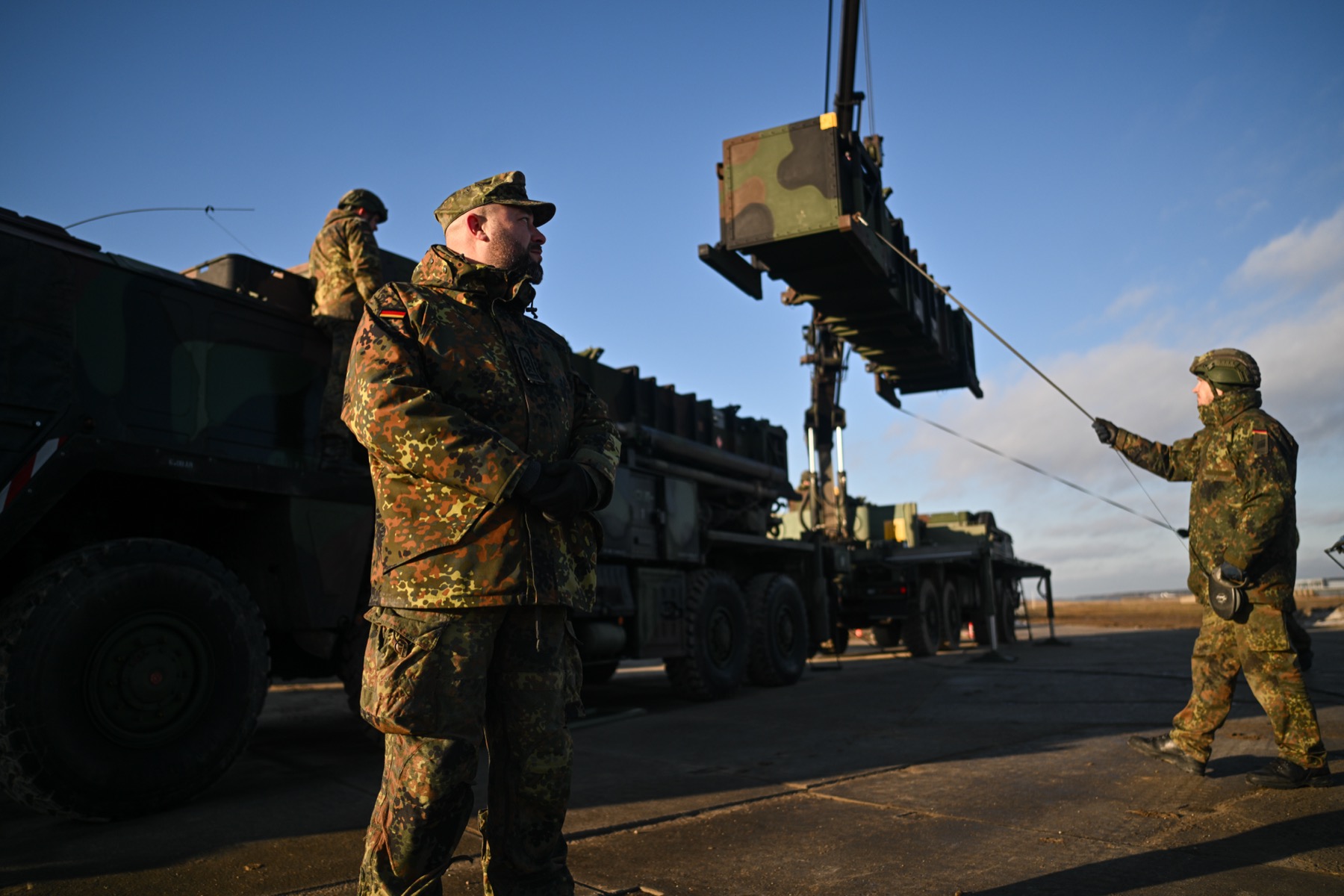
Patriot is not a bad system. On the contrary: its combat record in Ukraine has granted it political authority. But this very authority has obscured a dependency. The PAC-2 and PAC-3 interceptors come from a US-centered production and export control architecture. When the United States prioritizes its own forces and closest priorities first, Europe can order but cannot dispose of them sovereignly. The bottleneck is not just a stock issue but a matter of decision-making rights.
This is especially true for Germany. Berlin has invested a lot of money in air defense after the turning point, but the mix has remained politically contradictory: Patriot for the upper tier, IRIS-T SLM for medium ranges, Arrow 3 for exo-atmospheric missile defense, and the European Sky Shield Initiative as a collective framework. France criticized Sky Shield from the outset because the program rhetorically emphasized European autonomy while purchasing central capabilities from Israel and the USA. The German response was practical: buy available systems instead of waiting for years for European programs. Both sides were partially right. This is precisely why the SAMP/T question is so uncomfortable.
SAMP/T NG is More than a French Sales Offer
SAMP/T NG is based on the European Eurosam consortium with MBDA and Thales on the French side and Leonardo on the Italian side. The Aster-30 missile is designed for air and missile defense; the Block-1 NT variant is intended to be more capable against modern ballistic threats and more sophisticated targets. Italy received the first SAMP/T NG system in January, equipped with Leonardo radar and a specified surveillance range of over 300 kilometers. France is upgrading its systems with Thales radars, which are reported to have a range of up to 400 kilometers.
These figures do not replace operational testing, but they show: SAMP/T NG is not a symbolic EU product for conference speeches. It is Europe's only locally built long-range air defense system that can politically be considered a Patriot alternative. MBDA aims to double Aster production. France and Italy have also announced accelerated deliveries for Aster 30. If Germany joins, it would create a credible continental production network for the first time. If Germany stays out, SAMP/T remains a French-Italian niche alongside a German Patriot fleet.
Ukraine Turns Procurement into an Industrial Issue
According to several reports, Ukraine has ordered four SAMP/T NG systems; France also plans to provide two existing Mamba batteries until new systems are operational. Additionally, it concerns licenses for Ukrainian production of Aster-30 interceptors before the end of 2026. These points are crucial because they shift the old European debate. It is no longer just about whether Europe can deliver systems. It is about whether Europe possesses the production rights, supply chains, and political approvals to maintain pace in a long war.
Patriot remains irreplaceable in the short term, but the Ukraine war has exposed the industrial mathematics: a defense system is only as strong as the monthly missile production, the training base, and the political access security. A state can decide on 100 billion euros in special funds and still face empty magazines if the critical missiles do not come from its own industrial control. This is the lesson Berlin would prefer to learn later. The war forces it onto the table now.
Why Berlin Hesitates
The German hesitation is not just inertia. A second long-range system means costs, duplicate structures, and operational friction. The Bundeswehr already struggles to organize personnel, maintenance, and ammunition planning for existing systems effectively. Introducing SAMP/T in addition to Patriot without clear role distribution would be the typical European solution: more platforms, more committees, more variants, but not automatically more operational batteries.
Nevertheless, a "no" would be strategically more expensive than a "yes" with conditions. Germany would not have to replace Patriot immediately. A more sensible approach would be a three-stage plan: first, industrial participation and Aster production; then, joint testing and interoperability with NATO air defense structures; and finally, a limited procurement for a defined task, such as protecting critical infrastructure or European support for Ukraine. This way, Berlin would not take over a second system overnight, but it would take the European production base politically seriously.
The real question is not whether SAMP/T is better than Patriot. The question is whether Europe wants to be merely a user or also an owner of its air defense in a crisis.
The Institutional Core
For Macron, SAMP/T is a piece of evidence of European sovereignty. For Pistorius, it is initially a procurement act with risks. For NATO, it is potentially useful as long as interoperability and operational planning are not compromised. These three logics have been colliding for years in European defense policy. France thinks in terms of strategic autonomy, Germany in alliance integration and availability, and NATO in capabilities and standardization. None of these logics is wrong. But without an institutional compromise, they block each other.
The solution does not lie in a new German-French communiqué. Europe has had enough of that. What is crucial is a binding industrial work plan: which Aster components are produced in which country, what export approvals apply for Ukraine deliveries, how the systems are integrated into NATO Integrated Air and Missile Defense, and whether Germany receives genuine technical co-determination. Workshare here is not about small-state mentality but about who understands, maintains, and further develops the system in a crisis.
Germany can continue to use Patriot and still exit the convenience of Patriot. This would be the sober version of strategic autonomy: not decoupling from the USA, but reducing the only dependency that is most dangerous in war, namely the dependency on the political calendar of another state. More money alone does not create air defense. But without the courage to translate money into European production rights, the turning point remains an expensive shopping list.
The paradox is simple: SAMP/T does not solve Germany's air defense problem in the short term, but without SAMP/T-like decisions, Europe will not solve any in the long term. Those who want to avoid complexity today will buy dependency tomorrow.
Germany is evaluating its participation in the French-Italian SAMP/T air defense system, with a decision expected in July 2026. This move is seen as a significant political test for European defense capabilities, especially in light of the ongoing Ukraine conflict. The German Armed Forces currently rely on the Patriot system, which presents challenges in terms of supply and operational sovereignty. France and Italy are ramping up production of the Aster-30 missiles, further emphasizing the urgency of this decision.
- Germany is seriously considering participation in the SAMP/T air defense system in July 2026.
- The SAMP/T NG system is seen as a political test for European defense architecture.
- Germany currently relies on the Patriot system, which has limitations in terms of supply and sovereignty.
- The Ukraine conflict has highlighted the need for European production rights and capabilities.
- France and Italy are accelerating the production and delivery of Aster-30 missiles.