
Germany's SAMP/T Test 2026 Reveals Europe's Patriot Dilemma Despite French Offer
 Dr. Klaus Weber
Germany's SAMP/T Examination 2026 Reveals Europe's Patriot Dilemma Despite French Offer
Germany is evaluating a French offer for the co-development of the SAMP/T NG in July 2026. This sentence alone shows how late Berlin is addressing the central question of European air defense. For almost four years, the federal government has been talking about a turning point, and since 2022, it has been building the European Sky Shield Initiative around American Patriot systems, German IRIS-T SLM, and Israeli Arrow 3. Now, Defense Minister Boris Pistorius says Germany is "in principle" open to a role in the French-Italian system. This sounds pragmatic. Institutionally, it is an admission.
The news is not that France is once again demanding European sovereignty. The news is that Germany must treat it as an industrial problem for the first time after years of procurement policy. According to Defense News, Paris wants to involve Berlin and Italy in the next generation of SAMP/T. Emmanuel Macron spoke on July 17 at the Franco-German meeting of France's clear willingness to co-produce. Pistorius responded a few days later in Kassel, stating that this offer should be taken seriously and the details examined. He also mentioned a time horizon of "ten years or more." This is precisely where the contradiction lies.
Patriot Remains Indispensable in the Short Term
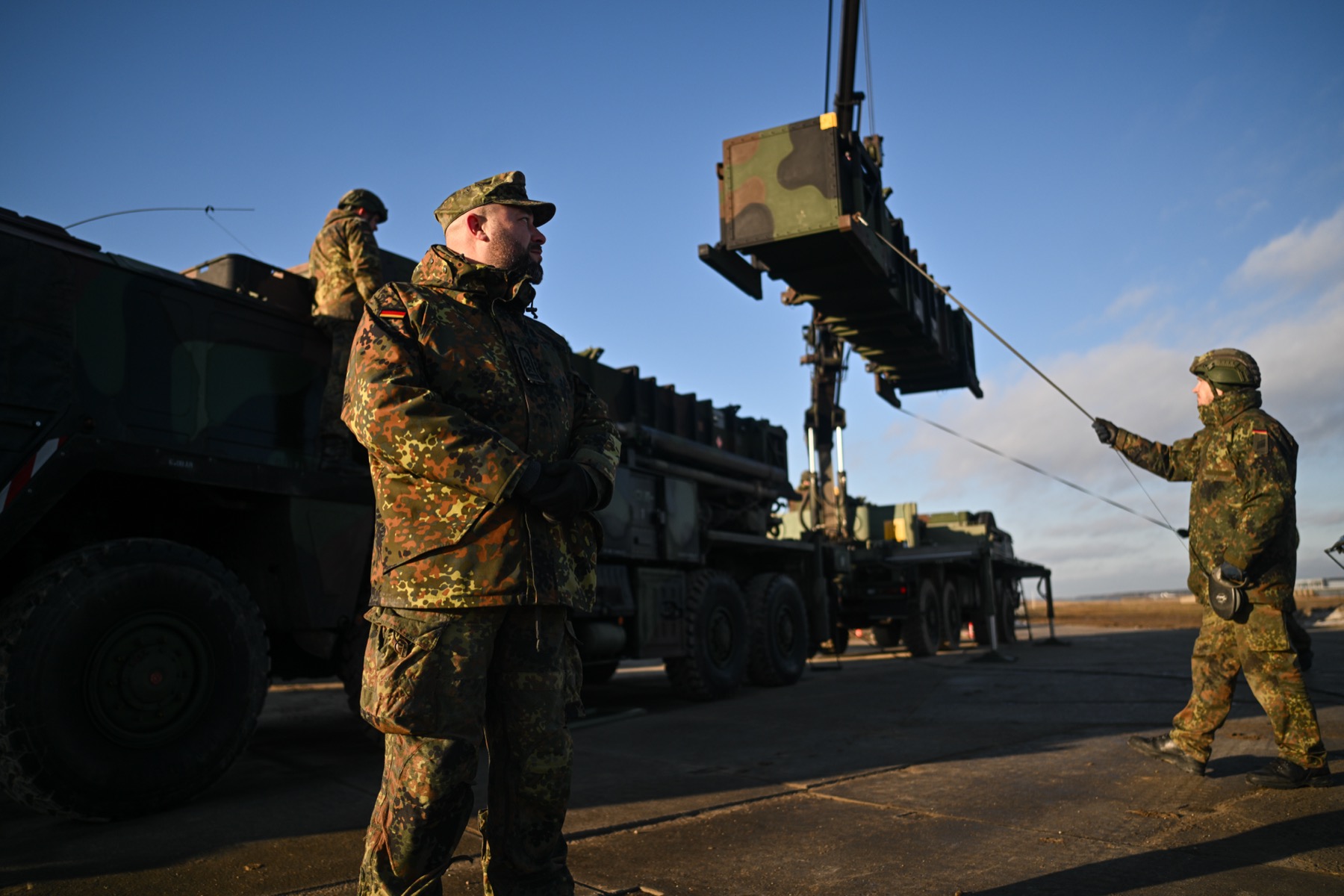
Germany is a user of Patriot, and that remains militarily rational for the foreseeable future. Patriot is embedded in NATO structures, battle-tested against ballistic threats, and has politically become the benchmark of Western solidarity in Ukraine. However, a system can be both militarily necessary and industrially problematic. The acute shortage of Patriot interceptors following the conflict between the USA, Israel, and Iran has shown European users that "interoperability" in a crisis does not mean the same as supply priority. Washington has signaled that it wants to meet American requirements first. Consequently, European orders are being pushed back both politically and in terms of production.
This is not an operational accident but the normal logic of a sovereign arms state. The USA produces first for the USA. Anyone in Europe who is surprised by this has not read their own procurement records. Berlin cannot simultaneously declare that it wants European operational capability and then permanently make the most sensitive capability of integrated air defense dependent on American production slots.
SAMP/T NG is an Industrial Option, Not a Quick Solution
SAMP/T NG offers exactly the European alternative that has often been invoked in German documents but rarely prioritized. Italy received its first system in January with Leonardo radar and a specified airspace surveillance range of at least 300 kilometers. France received a modernized system in February with Thales Ground Fire 300, which is said to have a range of up to 400 kilometers. The interceptor missile Aster 30 is European, and the system architecture is supported by Eurosam, MBDA, and Thales. On paper, this is the answer to the Patriot dilemma.
But paper does not defend airspace. SAMP/T NG is interesting for Germany not because it could immediately replace Patriot. It cannot. It is interesting because it could bring Germany from the role of a customer to that of a system co-designer. If Berlin only buys additional batteries, it repeats the old mistake under a different flag. However, if Berlin co-develops radar, fire control, interceptor production, and software integration, real European capacity could emerge over ten years. This distinction is crucial: Procurement creates stock; development creates sovereignty.
Ukraine Forces Europe to Prioritize
Ukraine has accelerated this debate. On July 14, Volodymyr Zelensky and Macron agreed on a roadmap that includes an initial tranche of SAMP/T NG, additional radars and missiles, as well as licensing agreements for Aster 30, AASM, and SCALP/Storm Shadow. France and Italy want to expedite Aster-30 deliveries by October; a license production in Ukraine is to be authorized before the end of 2026. Meanwhile, nine countries are advancing the FREYJA project with Ukraine, a European anti-ballistic capability that aims to deliver initial operational results within twelve months.
This sounds dynamic. In reality, it primarily shows the fragmentation of European air defense. Patriot remains the American high-value anchor. IRIS-T covers an important German medium range. SAMP/T NG is the European long-range option. Arrow 3 fills the exo-atmospheric gap. FREYJA aims to shape a new anti-ballistic architecture from Ukrainian war experience. Each initiative has military logic. Together, however, they do not yet form a governance structure.
Berlin Must Choose Between Purchasing Community and System Leadership
The real German decision is therefore not Patriot or SAMP/T. It is: Does Germany want to lead a purchasing community or take on system leadership? The European Sky Shield Initiative was politically successful because it quickly brought many countries together. It was institutionally convenient because Berlin did not have to immediately address the more difficult question of which European industry controls which key technology. SAMP/T NG forces exactly this question onto the table.
France is not pursuing a selfless European romanticism. Paris wants to strengthen its industrial architecture, Italy wants to secure its role in Eurosam and Leonardo, and Germany does not want to end up again in a Franco-German arms cooperation where division of labor becomes more important than combat capability. After the dispute over FCAS, mistrust is not a marginal issue but a starting condition. Anyone who ignores this produces the next joint press conference and the next failed program.
European Sovereignty Requires Unpleasant Division of Labor
A realistic German entry must meet three conditions. First, SAMP/T NG must not be treated as a symbolic addition to the European Sky Shield Initiative but must receive a defined place in NATO air defense planning. Second, Berlin needs industrial access to key components, not just final assembly or maintenance. Third, Ukraine must be not only a recipient but also a testing and production partner, as no European army understands today's missile threat as directly as the Ukrainian one.
All of this is politically more difficult than purchasing additional Patriot launchers. It means negotiations over intellectual property, export rights, software access, priorities in crisis times, and the question of who gets supplied first in a serious situation. That is precisely why it is strategically relevant. European defense capability does not arise from summit declarations but from supply chains, series production, and decision-making rights.
Germany has begun a late but necessary correction with the SAMP/T examination. If Berlin turns this into just another study, Europe will remain a customer in several systems and sovereign in none. However, if Germany is willing to accept French leadership in parts and, in return, demand genuine industrial co-responsibility, a European air defense architecture could finally grow out of the Patriot shortage. The paradoxical finding is: Europe needs Patriot today to remain secure; but it must move beyond Patriot to be politically capable tomorrow.
Sources
- Defense News, July 21, 2026, Germany to study French cooperation offer on SAMP/T air-defense system.
- Defense News, July 14, 2026, Ukraine agrees on plan to acquire SAMP/T NG and Rafale capabilities.
- Defense News, July 14, 2026, Nine nations back Ukraine’s FREYJA antiballistic initiative.
- MBDA and Eurosam product specifications for SAMP/T NG, Aster 30, and radar architecture.
Germany is evaluating a French offer for the co-development of the SAMP/T NG air defense system in July 2026. This decision reflects a shift in Germany's approach to European air defense, as it seeks to enhance its military capabilities while addressing reliance on American systems. The involvement of France and Italy in this initiative underscores the collaborative effort to strengthen European defense architecture amid ongoing geopolitical challenges.
- Germany is considering a French offer for the SAMP/T NG air defense system.
- The evaluation is set for July 2026.
- France and Italy are involved in the development of the SAMP/T NG.
- Germany's reliance on Patriot systems is highlighted as a current military necessity.
- The Ukraine conflict has accelerated discussions on European air defense capabilities.