
Germany's SAMP/T Test 2026 Reveals Europe's Patriot Dilemma Despite Aster-30 Expansion
 Dr. Klaus Weber
Germany's SAMP/T Test in 2026 Highlights Europe's Patriot Dilemma Despite Aster-30 Expansion
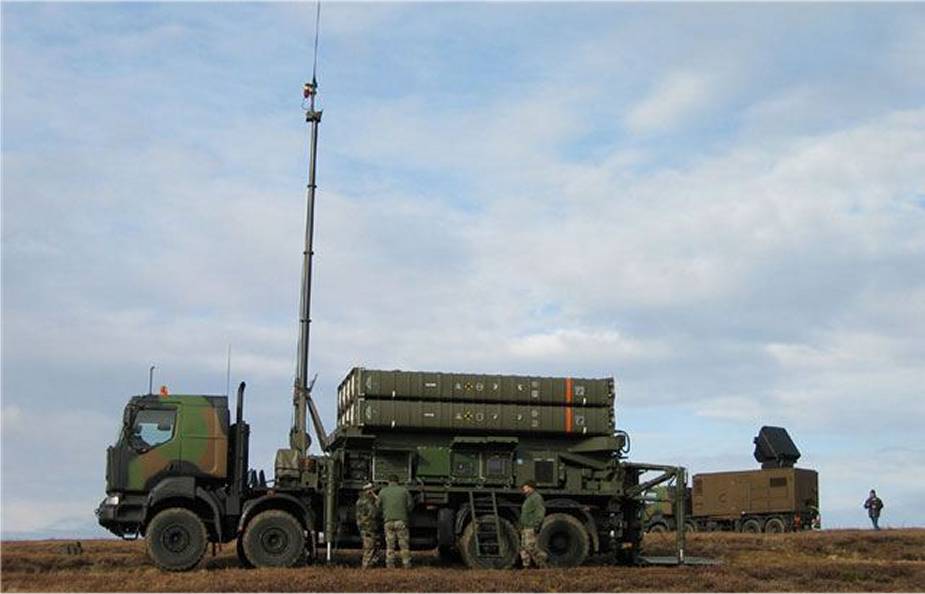
Germany is considering a move into SAMP/T NG in 2026, even though the Bundeswehr is already deeply embedded in the American Patriot ecosystem. This very contradiction makes the French offer from July 17 politically more significant than a typical procurement announcement. Boris Pistorius stated on Tuesday in Kassel that Berlin would seriously examine Emmanuel Macron's proposal. At the same time, he added the crucial caveat: operating two systems in the same range and altitude band in parallel is hard to imagine. This is not a technical detail. It is the short form of the European air defense problem.
Macron proposed at the Franco-German ministerial meeting to involve Germany in the co-production of the French-Italian SAMP/T of the new generation. The system is Europe's only locally developed long-range air defense alternative to Patriot. In a situation where Patriot interceptors are simultaneously demanded by Ukraine, the Iran war, and American needs, this sounds like strategic reason. But strategic reasoning rarely fails in Europe due to the headline. It fails due to integration, logistics, training cycles, national industrial policy, and budget logic.
The Offer from Paris Encounters German Path Dependence
The German reluctance is understandable. Patriot is not just a weapon system for the Bundeswehr, but an entire infrastructure of sensors, command software, training, spare parts, tactical procedures, and NATO interoperability. Anyone introducing an additional system of the same class today is not simply buying a second type of launcher. They are creating a second training chain, a second spare parts logic, a second munitions planning, and a second political dependency. Pistorius is therefore right to raise concerns about the parallelism.
But it is precisely this rationality that creates the strategic trap. Because Germany already operates Patriot, Patriot is always the easier next decision. Because Patriot is the easier next decision, Europe remains trapped in the American production rhythm. And because Europe remains trapped in the American production rhythm, every subsequent European exit appears even more expensive. Institutionally speaking, this is not a decision between Patriot and SAMP/T, but between short-term efficiency and long-term operational capability.
SAMP/T NG is No Longer a Symbolic European Project
The French-Italian side can argue today with more substance than just a few years ago. Italy received its first SAMP/T NG in January with Leonardo radar and a stated air surveillance range of at least 300 kilometers. France followed in February with a modernized system that uses a Thales Ground Fire 300 radar with a range of up to 400 kilometers. The Aster 30 Block 1 New Technology was tested for the first time in October 2024 and is also expected to combat medium-range missiles and hypersonic threats. This is not the complete answer to the Russian missile problem, but it is a European industrial response that actually exists.
MBDA announced in March that it would double Aster production in 2026 and increase total missile production by 40 percent this year. The order backlog was 44.4 billion euros at the end of 2025, with revenue at 5.8 billion euros. Even more importantly is the investment decision: MBDA is doubling its five-year investment plan for 2026 to 2030 to 5 billion euros and plans to hire an additional 2,800 employees. These are not just press platitudes. They are hard indicators that European air defense capacity is slowly moving from political desire into industrial planning.
Ukraine is already making this planning operationally urgent. According to Ukrainian sources, four SAMP/T NG systems are to be ordered, with module deliveries starting in 2027. A Thales GF300 radar is expected to be deployed in Ukraine as early as 2026. France and Italy want to accelerate Aster-30 deliveries by October and have authorized a licensed Aster-30 production in Ukraine before the end of 2026, according to the Ukrainian presidential administration. If these timelines hold, a European-Ukrainian air defense axis will emerge that no longer solely relies on American approval.
The Patriot Shortage Makes Europe's Autonomy Question Practical
The trigger for the German debate is not French ambition, but American scarcity. The United States is increasingly prioritizing its armed forces after massive deployments in the Middle East and its own stock needs. For European Patriot users, this means: Political solidarity with Washington does not guarantee production slots. Lockheed Martin announced on July 20 the PAC-3 ACE, a cheaper Patriot interceptor that is supposed to cost less than half of a PAC-3 MSE and is intended for cruise missiles, air-breathing targets, and short-range missiles. This is industrially smart, but it does not solve Europe's sovereignty problem. It modernizes the dependency.
The numerical comparison is uncomfortable. A PAC-3 MSE roughly costs around 4 million dollars. Fire Points Freyja interceptor aims long-term at about 700,000 dollars, while SAMP/T remains in the high-value segment, but on a European industrial basis. Europe's problem is therefore not just the price per shot. It is the question of who decides in a crisis which army is supplied first. Those who only buy compete in the queue. Those who produce negotiate priorities.
Germany Must Choose Between User Logic and Designer Role
For Berlin, SAMP/T NG is uncomfortable because it challenges the most convenient German defense assumption: that one can advocate for European sovereignty without seriously changing one's procurement architecture. This does not work. If Germany only examines SAMP/T to ultimately reject it citing Patriot compatibility, it confirms the old German role as a solvent user of American systems. However, if Germany engages, it must do more than just establish a symbolic production line. It would need to integrate governance, export policy, munitions stocks, training cooperation, and Ukrainian license production into a common system.
This is politically harder than placing an order. France will not give up its industrial leadership claims, Italy will defend its role as an equal system partner, and Germany will demand work shares and technical transparency. After FCAS, no one in Paris or Berlin knows how quickly shared sovereignty rhetoric can turn into industrial blockade. For this reason, SAMP/T NG is a better test than a new fighter jet program. Air defense is urgent, the threat is visible, the technology exists, and Ukraine provides the operational pressure.
The European Added Value Only Emerges Through Joint Stocks
The actual measure should not be whether Germany co-produces some components. The measure must be whether Europe thereby creates a common Aster-30 stock, common maintenance centers, and a robust allocation rule for crises. Without these elements, SAMP/T would only be Patriot with a European flag: nationally ordered, nationally stored, nationally prioritized. Then Europe would have another system, but still no European capability.
The lesson from Patriot is clear. Munitions production cannot be retrofitted to alliance politics. It is the core of alliance politics. Germany can reject SAMP/T NG if the technical and financial review turns out poorly. But it can no longer pretend that Patriot is solely a strategically neutral solution. Europe's air defense faces a paradox: a second system increases complexity in the short term, but without a second industrial center, Europe remains vulnerable in the long term. More simplicity today can be the most expensive dependency of tomorrow.
Source basis: Defense News on Germany's examination of the SAMP/T offer from July 21, 2026, Defense News on MBDA's Aster production expansion from March 26, 2026, Defense News on the PAC-3 ACE announcement from July 20, 2026, as well as Ukrainian information on SAMP/T NG, Aster 30, and radar deliveries.
Germany is evaluating the SAMP/T NG air defense system while being deeply integrated into the American Patriot system. This evaluation is politically significant as it reflects Europe's struggle for defense autonomy amid U.S. production priorities. France and Italy are advocating for co-production of SAMP/T NG, with Ukraine expected to order four systems starting in 2027. The situation highlights the complexities of European defense procurement and the need for a unified approach to air defense capabilities.
- Germany is considering the SAMP/T NG system despite being integrated into the Patriot system.
- France and Italy are pushing for the co-production of SAMP/T NG.
- Ukraine is expected to order four SAMP/T NG systems with deliveries starting in 2027.
- The U.S. is prioritizing its own military needs, affecting European Patriot users.
- MBDA plans to double Aster production by 2026.