
Germany's Wingcopter 262 Changes Europe's Drone Strategy for Ukraine 2026
 Dr. Klaus Weber
Germany's Wingcopter 262 Changes Europe's Drone Strategy for Ukraine 2026
The crucial number is not the range, but the production decision. Germany and the Ukrainian TAF Industries want to manufacture reconnaissance drones in Germany, while the Wingcopter 262, with an announced flight time of up to six hours, shifts Europe's perception of a tactical UAV. Therefore, the project is more than just another delivery to Ukraine. It is a test of whether Germany's promise of a turning point will finally transition from procurement to industrial organization.
From Ukrainian Front Needs to German Manufacturing
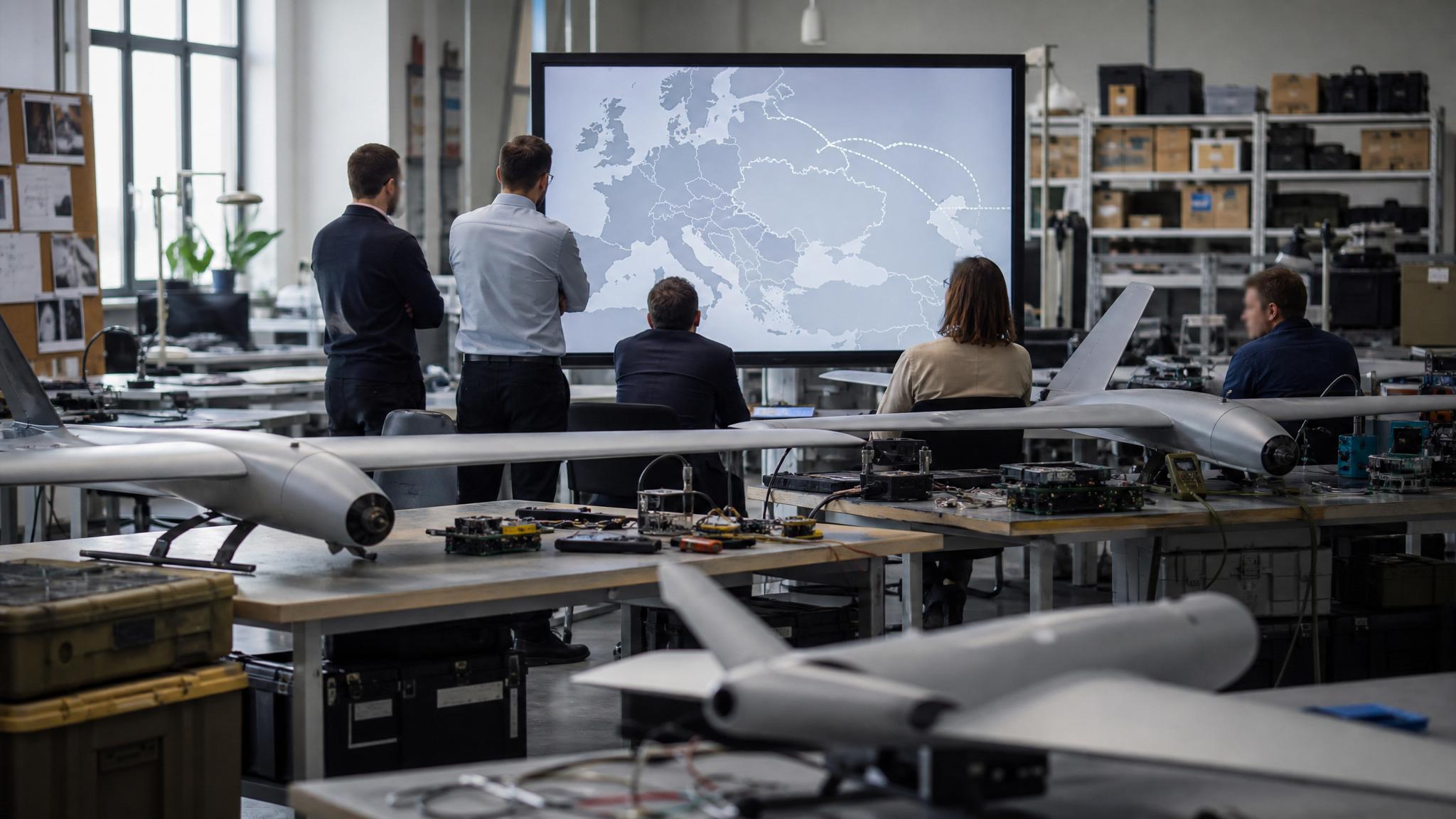
TAF Industries is part of that Ukrainian defense industry whose products are evaluated not first at trade fairs, but under combat conditions. Wingcopter announced a joint venture on February 13, 2026. TAF is to bring proven designs and operational experience, while Wingcopter provides industrial infrastructure, engineering, and manufacturing capacity. The goal is production in Germany as part of the Ukrainian "Build with Ukraine" approach. This initiative was politically elevated during a meeting at the Federal Chancellery in April, attended by Chancellor Friedrich Merz and President Volodymyr Zelenskyy.
The recent reporting on the Wingcopter 262 should therefore be understood in a broader context. It is not just about an aircraft, but about the connection of two complementary capabilities: Ukrainian front adaptation and German series production. This combination is precisely what many European armament programs lack. Europe has engineers, money, and political declarations; however, it too rarely has a mechanism that quickly turns real combat experience into a scalable product.
What the Wingcopter 262 Can Achieve Militarily
The Wingcopter 262 is presented as an electrically powered reconnaissance platform with a flight time of up to six hours. Its configuration combines vertical takeoff and landing with the more efficient cruise flight of a fixed-wing aircraft. For Ukraine, this is more important than a spectacular peak value: a UAV that can operate without a conventional runway and stay in a search area for a long time is suitable for border surveillance, artillery observation, damage assessment, and capturing Russian logistics movements.
- Platform: electrically powered, vertically takeoff and landing reconnaissance drone
- Endurance: up to six hours according to current product reporting
- Mission: ISR, meaning intelligence gathering, surveillance, and reconnaissance
- Industrial Approach: manufacturing and possible further development in Germany with a Ukrainian partner
One should not confuse these specifications with a complete military specification. Payload, sensor package, data link, electronic countermeasures, and actual operational range determine combat value. Six hours in the air are only strategically relevant if the platform also delivers usable data under Russian electronic warfare, in bad weather, and in contested airspace. This is precisely where the advantage of the Ukrainian partnership lies: TAF brings not only a design but also feedback from a war in which drones must be adapted daily.
The Real Gain Lies in the Production Architecture
European defense ministers have been talking about drone swarms and "rapid scaling" for years. In practice, scaling often fails due to supply chains, approvals, software sovereignty, and missing acceptance contracts. The German-Ukrainian model addresses at least three of these bottlenecks. First, production is geographically diversified. Second, Ukrainian know-how is not only imported as a finished product but embedded in a European industrial structure. Third, the platform can be further developed for European and NATO markets, as Wingcopter itself announces.
This is the difference between a donation and a defense industrial policy. A delivery creates short-term stock. Joint manufacturing creates learning curves, spare parts capability, and a political bond. But caution is also required here. A joint venture is not yet serial production. What matters are binding orders, an approved sensor system, secured components, and a timeline measured in months rather than in declarations of intent.
Why Berlin Must Do More with the Project
Germany has shown with the special fund that it can mobilize large sums. The weakness lies in translating financial resources into available capabilities. Therefore, a German success in the Wingcopter-TAF project should not be measured by how often ministers mention "European sovereignty." The benchmark would be a defined quantity, a publicly traceable start of production, and the ability to quickly incorporate variants from Ukrainian front practice into manufacturing.
Equally important is procurement policy. If Germany finances the drone merely as a research project, it remains a symbol. If the Bundeswehr and European partners accept it with clear batch sizes, open interfaces, and joint testing procedures, a market is created. The European Defence Agency is currently testing drones and loitering munitions in Portugal with more than 200 participants from military and industry. Such events are useful but do not replace demand. The market must show that Europe can not only test but also order.
The Strategic Importance for Ukraine
For Kyiv, production in Germany is an insurance against the failure of individual locations and against the political volatility of Western aid. For Berlin, it is a way to incorporate Ukrainian experience into its own military planning. For NATO, it creates a platform that is not inherently tied to a U.S. supply chain. This does not mean autonomy in the broad sense. Sensors, chips, satellite communication, and software can still come from third countries. However, strategic operational capability often begins with a limited ability that one can change, repair, and produce in series.
The political decision has been made. Whether this will translate into military capability is not decided in the Chancellery but on the production line.
Conclusion
The Wingcopter 262 will not decide the drone war alone. Its significance lies in the institutional question behind it. Can Germany connect Ukrainian combat experience with its own industrial capacity before the next war changes the requirements again? If so, the project would be a rare example of European defense integration with a real operational starting point. If not, it remains within the familiar pattern: Europe finances, tests, and conferences while others determine the pace of war. More money is necessary. But only the production decision turns it into security.
Sources
- Wingcopter, “Wingcopter and TAF Industries establish Joint Venture”, February 13, 2026.
- Wingcopter, “Wingcopter and TAF Industries welcomed by Chancellor Merz”, April 14, 2026.
- Kyiv Post, “What Germany’s Wingcopter 262 Means for Ukraine’s Drone War”, September 27, 2026.
- Defence Industry Europe, Report on the European Defence Agency's drone and loitering munitions testing in Portugal, September 27, 2026.
Germany and Ukraine's TAF Industries announced a joint venture to manufacture the Wingcopter 262 drone in Germany, enhancing Ukraine's ISR capabilities. The drone, designed for operations without traditional runways, can remain airborne for up to six hours. This initiative is part of the 'Build with Ukraine' strategy, aiming to integrate Ukrainian combat experience into German defense production.
- Germany and Ukraine's TAF Industries announced a joint venture to produce the Wingcopter 262.
- The Wingcopter 262 is an electric reconnaissance drone with a flight time of up to six hours.
- The project aims to enhance Ukraine's ISR capabilities and integrate Ukrainian combat experience into German industrial capacity.
- The production is part of Ukraine's 'Build with Ukraine' initiative.
- The collaboration addresses several logistical challenges in European defense production.