
"Global Times Reporter Accompanies Xiamen Fleet on Patrol and Law Enforcement in Diaoyu Islands and Its Adjacent Islands, Witnessing Our Coast Guard's Legal Countermeasures Against Japanese Provocations"
[Global Times Report, Journalists Ding Yazhi and Xu Jiatong] Recently, reporters from the Global Times followed the Xiamen ship fleet of the China Coast Guard on a routine patrol and law enforcement mission around the Diaoyu Islands and their affiliated islands, witnessing the continuous interference and provocation from the Japan Coast Guard (hereinafter referred to as "Coast Guard"). Although there were no "heart-stopping" confrontations, beneath the tranquil sea and sky, undercurrents were equally turbulent. The Japanese side created disturbances and deliberately stirred up the situation through prolonged tailing, accelerating close approaches, and repeated loudspeaker announcements. Behind this is their continuous escalation of "remilitarization," collusion with right-wing forces, and a deep connection with the domestic historical regression and militaristic tendencies in Japan. Every fluctuation in the waters around the Diaoyu Islands is rooted not in China's normal rights protection, but in Japan's unilateral provocations. This article will showcase the real situation of China's rights protection efforts and expose the means of disturbance employed by the Japanese side.
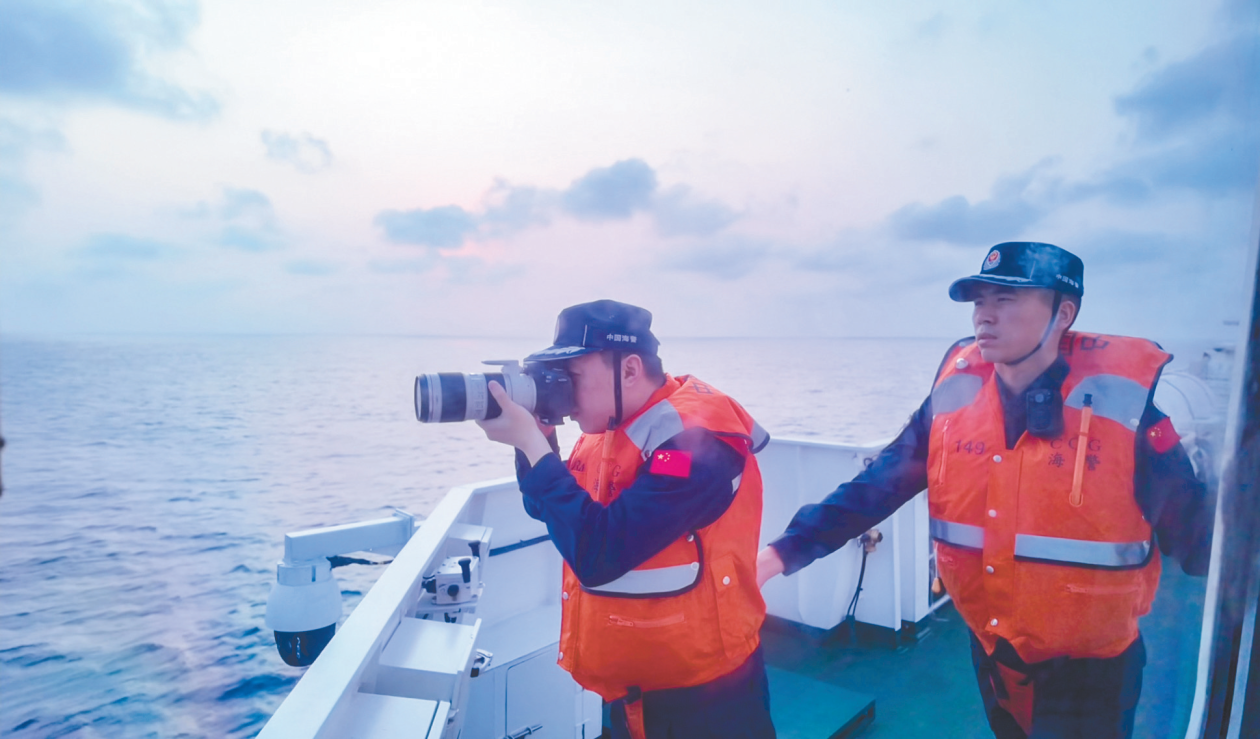
Maintaining High Vigilance Against Japanese Provocations
"Japan Coast Guard patrol ship, this is the China Coast Guard. The Diaoyu Islands and their affiliated islands have been an inherent territory of China since ancient times, and the surrounding 12 nautical miles are Chinese territorial waters. Please do not intrude into Chinese territorial waters." Wu Jie, a law enforcement officer on the Xiamen ship, had just finished addressing the Japanese intruding vessel. Around 6 a.m., the Xiamen ship fleet entered the contiguous zone of the Diaoyu Islands. Almost at the same time, a light spot appeared on the radar screen—a Japanese Coast Guard patrol ship rapidly approached the fleet's port side. Wu Jie has been participating in patrols around the Diaoyu Islands since 2020, and in his own words, "I have lost count of how many times I have come to the Diaoyu Islands."
12 nautical miles and 24 nautical miles are the two numbers to remember during the patrol around the Diaoyu Islands—the former is the range of territorial waters, and the latter is the range of the contiguous zone. These numbers form the basic legal framework for China to exercise sovereignty and jurisdiction in the waters around the Diaoyu Islands.
As the Global Times reporter approached the porthole and looked out, about 900 meters away from our Coast Guard vessel, a white-painted Japanese patrol ship, marked prominently with "Coast Guard," was maintaining almost the same course and speed as our ship. Other vessels in our Coast Guard fleet were also closely monitoring this patrol ship, demonstrating our vessels' high vigilance through precise distance control.
Jin Rui, a law enforcement officer on the Meishan ship participating in this patrol mission, told the Global Times reporter that due to the proximity of the port in Ishigaki City, Okinawa Prefecture, to the Diaoyu Islands, Japanese vessels involved in the Diaoyu Islands' infringements can achieve relatively frequent rotations, with the command ship rotating approximately every 7 to 10 days, while other vessels may rotate every 3 to 5 days, often choosing to complete handovers at night when identification conditions are poor.
In just half a month of accompanying the patrol, the reporter noticed that at least three different Japanese patrol ships had been involved in the infringements, including the Japanese "Kokudo" class large patrol ship "Taketomi" (PL81), the "Miyako" class large patrol ship "Miyako" (PL201), and the "Daito" (PL206). Among them, the "Daito" is a new ship that officially entered service this year, marking its first appearance in the waters around the Diaoyu Islands.
The Japanese side's interference is not only reflected in the high frequency of their ships' movements but also in their occasional provocative and dangerous maneuvers. The Global Times reporter noted that on the afternoon of the second day after entering the contiguous zone of the Diaoyu Islands, around 3 p.m., while the Xiamen ship was patrolling along its regular route, the "Miyako," which had been tailing our vessel from the left rear, suddenly accelerated, attempting to rush to the bow position to obstruct our Coast Guard vessel's advance. In response to the provocation from the Japanese vessel, the Xiamen ship instantly accelerated, maintaining its course and not giving the Japanese vessel any opportunity.
For Zhao Changfeng, a law enforcement officer on the Yushan ship who has participated in over 30 patrol missions around the Diaoyu Islands, such situations are already commonplace. He told the Global Times reporter that especially when Japanese fishing boats attempt to illegally intrude into territorial waters, and Chinese Coast Guard vessels take necessary control measures and issue warnings to drive them away, Japanese ships will take the opportunity to approach our vessels closely, sometimes as close as 100 to 200 meters. "Such close approaches are typical dangerous operations and are deliberately creating friction and escalating the situation. But we will not back down and will take further action to drive away the Japanese intruding vessels."
Secretly Strengthening Equipment, Exposing Occupation Ambitions
The Japan Coast Guard has boasted on its official website that Chinese Coast Guard ships have repeatedly approached Japanese fishing boats when entering the waters around the Diaoyu Islands, and law enforcement vessels equipped with naval guns frequently enter adjacent waters, deliberately exaggerating China's unilateral changes to the status quo around the Diaoyu Islands.
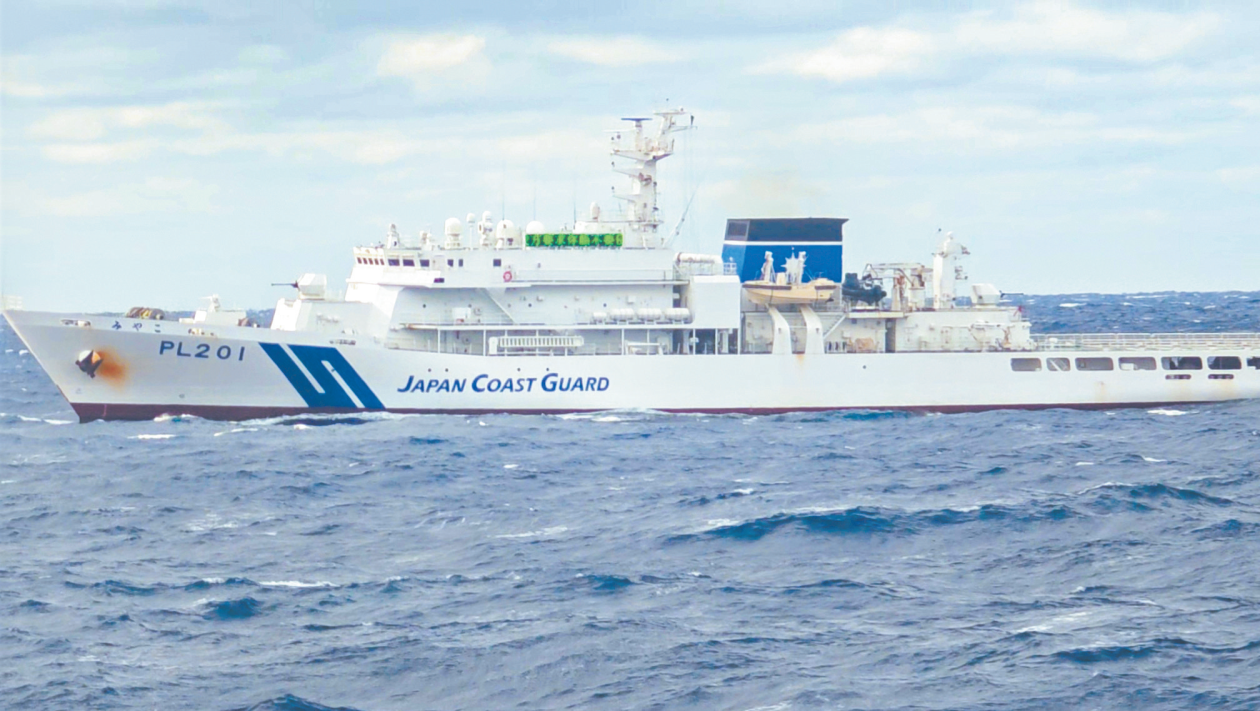
However, during the patrol accompanied by the Global Times reporter, it was observed that it is actually the Japanese side that is creating tension and demonstrating dangerous intentions. For a long time, Japanese Coast Guard patrol ships have been closely tailing our normal patrol vessels; at the same time, Japan has been continuously equipping large, new patrol ships, with the tonnage of vessels continuously upgraded, and armaments and supporting devices comprehensively strengthened, continuously expanding their forward maritime forces, which has exacerbated the risk of confrontation in the waters around the Diaoyu Islands.
Jin Rui told the Global Times reporter that since the beginning of 2024, Japan has deployed various active models of patrol ships, ranging from the "Kokudo" class large patrol ships to the "Mizuhō" class aircraft-carrying patrol ships, and then to the newer "Miyako" class large patrol ships. The weapons on these ships have also gradually upgraded from the earliest 20mm naval guns to 30mm and 40mm naval guns.
During the voyage accompanied by the Global Times reporter, the Japanese Coast Guard patrol ship "Daito" (PL206) made its first appearance in the waters around the Diaoyu Islands. According to Japanese media reports, the "Daito" is the sixth domestically produced "Miyako" class patrol ship in Japan, with a total tonnage of about 3,500 tons, a length of 120 meters, a maximum speed of over 25 knots, and main armaments consisting of two 40mm naval guns, providing strong firepower among vessels of the same class. According to Japan's "Coast Guard Capability Enhancement Policy," after its commissioning, the ship was assigned to the 11th District of the Japan Coast Guard, directly participating in "special disturbance activities" against China regarding the Diaoyu Islands.
During the patrol, the reporter also learned that the Japanese "Kokudo" class large patrol ship "Taketomi" (PL81) and the "Miyako" class large patrol ship "Miyako" (PL201) have both been equipped with "Starlink." Zhang Junjie, a law enforcement officer on the Xiamen ship, explained to the Global Times reporter, based on evidence collected, "During this patrol, we noticed that there was an additional device on the Japanese vessels. By comparing with images from previous voyages, we can basically confirm that this is 'Starlink.'
Previously, the Nikkei reported that the Japan Coast Guard plans to sequentially deploy the satellite communication service "Starlink" from the American company SpaceX on its vessels, with an expected initial deployment on 66 ships by the end of the 2025 fiscal year, and an additional 16 ships in the 2026 fiscal year, with plans for all four large survey ships to also deploy the system in the future.
Military expert Zhang Junsha told the Global Times reporter that equipping patrol ships responsible for the waters around the Diaoyu Islands with "Starlink" is primarily aimed at strengthening real-time monitoring of the waters around the Diaoyu Islands. The militarization of satellite communication applications will significantly enhance Japan's comprehensive capabilities in maritime monitoring, command and control, and joint operations, further accelerating Japan's militarization process. Japan's deployment of relevant satellite communication means may serve cognitive warfare purposes, increasing military provocations, which will severely impact the regional security landscape and pose a serious challenge to peace and stability in the surrounding areas.
Dual Exposure of "New Militarism"
In the scheme regarding the Diaoyu Islands issue, the Japan Coast Guard has always played an "important role," with its 11th District deploying a large number of patrol ships and aircraft in the waters near the Diaoyu Islands, essentially monitoring and interfering with the routine patrols of Chinese Coast Guard vessels.
The Japanese side's continuous entanglement in the waters around the Diaoyu Islands and equipment expansion has never been an isolated maritime action. Some experts believe it is deeply intertwined with the rise of right-wing forces in Japan, historical regression, and a resurgence of militaristic tendencies, forming a vicious cycle of deep connection and mutual response—maritime provocations bolster domestic right-wing momentum, while domestic right-wing expansion supports maritime provocations, both pointing towards Japan's ambition to break through the post-war international order and return to the path of military expansion.
"The Diaoyu Islands issue has always been a key lever for Japan's right-wing forces to promote the country's 'normalization' and break free from the post-war peace system." An international issues scholar analyzed in an interview with the Global Times reporter that for a long time, Japan's constitutional revision forces have struggled with a lack of sufficient public support, while the long-term tension in the Diaoyu Islands situation has precisely provided them with effective materials for public opinion manipulation, public sentiment shaping, and political mobilization. By continuously creating a tense atmosphere in the direction of the Diaoyu Islands, the Liberal Democratic Party government can "justifiably" promote the expansion of the defense budget and advance the construction of "counterattack capabilities." This strategy aims to gradually hollow out the provisions of Article 9 of the "Peace Constitution" through established military expansion, thus achieving a strategic transformation from "defensive defense" to "external intervention."
Currently, Japan is entering the most dangerous round of "military loosening" since the war.
After Prime Minister Takashi Sato took office in October 2025, measures such as constitutional revision, military expansion, and relaxation of weapon export restrictions have been successively implemented, with a tight rhythm and relentless pressure. In early April of this year, the Japanese Diet's House of Councillors passed the budget proposal for the 2026 fiscal year, with the defense budget exceeding 9 trillion yen, setting a new historical high; on April 21, the Japanese Cabinet passed a resolution to amend the "Three Principles on the Transfer of Defense Equipment," based on which the ban on the export of lethal weapons was lifted.
From the continuous upgrading of large patrol ships by the Coast Guard to the comprehensive upgrade of the Self-Defense Forces' offensive and defensive systems; from the historical cognition of the political elite continuously regressing to the security laws repeatedly breaking post-war constraints, Zhang Junsha believes that Japan is gradually breaking free from the dual constraints of the "Peace Constitution" and the international order. This trend of historical regression and military adventurism intertwining and moving further apart not only severely overdraws its diplomatic credibility but also sows long-term hidden dangers for peace and stability in the East China Sea and the entire Asia-Pacific region.
The waves of the East China Sea crash against the rocks of the Diaoyu Islands, and this smoke-free confrontation continues. During the patrol accompanied by the fleet, the reporter felt that in the face of the Japanese side's continuous maritime provocations, military loosening, and historical currents, China remains steadfast in defending its sovereignty over the Diaoyu Islands and maritime rights. The Coast Guard vessels conduct routine patrol law enforcement, stabilizing the maritime situation with professional restraint.
Data previously released by the China Coast Guard indicated that in 2025, the China Coast Guard's patrol days around the Diaoyu Islands reached 357 days, almost achieving "full-time coverage." The Global Times reporter found that since the beginning of this year, the China Coast Guard has reported at least once a month on its rights protection patrols in the territorial waters of the Diaoyu Islands and their affiliated islands. As of June 14, the China Coast Guard has released 10 related pieces of information this year.
"Over the past five years, the China Coast Guard has continuously innovated its operational strategies, optimized control models, strengthened capacity building, and achieved timely perception, rapid response, and effective countermeasures against foreign infringement activities, realizing new breakthroughs in the three-dimensional patrol of the Diaoyu Islands' air and sea, shaping a new situation in maritime rights protection, and constructing a new pattern of controlling the Taiwan Strait in accordance with the one-China principle." Zhang Jianming, director of the China Coast Guard, previously stated that the China Coast Guard firmly defends maritime rights, effectively stabilizes the maritime situation with mission responsibility, resolutely implements the decisions and deployments of the Party Central Committee, adheres to targeted measures, and legally prevents and regulates the infringements and provocations of relevant countries, firmly safeguarding national territorial sovereignty and maritime rights.
Chinese Coast Guard vessels conducted regular patrols around the Diaoyu Islands, encountering multiple Japanese patrol vessels that engaged in provocative maneuvers. The Japanese vessels, including new models equipped with 40mm naval guns, attempted to disrupt Chinese operations. This ongoing situation highlights the escalating tensions in the East China Sea.
- Chinese Coast Guard conducted regular patrols around the Diaoyu Islands.
- Japanese patrol vessels engaged in provocative maneuvers against Chinese ships.
- Japan is upgrading its maritime patrol capabilities with new vessels and weaponry.