
Grain War in the Black Sea — Strikes on Izmail and Novorossiysk Reshape Export Logistics
 Dmitri Volkov
Grain War in the Black Sea — Strikes on Izmail and Novorossiysk Reshape Export Logistics
In five days, from August 12 to 17, both sides of the conflict struck at each other's main grain ports, and for the first time since 2023, the target of the attacks was not military but purely commercial infrastructure. First, Ukrainian drones and missiles incapacitated two grain terminals in Novorossiysk — the last major base of the Black Sea Fleet; then Russian strikes set Izmail ablaze, the largest grain hub in Ukraine on the Danube; on the night of August 17, Izmail and Odessa were again targeted, where a civilian vessel flying the Togolese flag was damaged and four people were injured. These are no longer isolated episodes — this is the establishment of a new front line running through commercial docks, grain storage facilities, and shipping channels.
Izmail — the "Backup Exit" that Ceased to be Safe
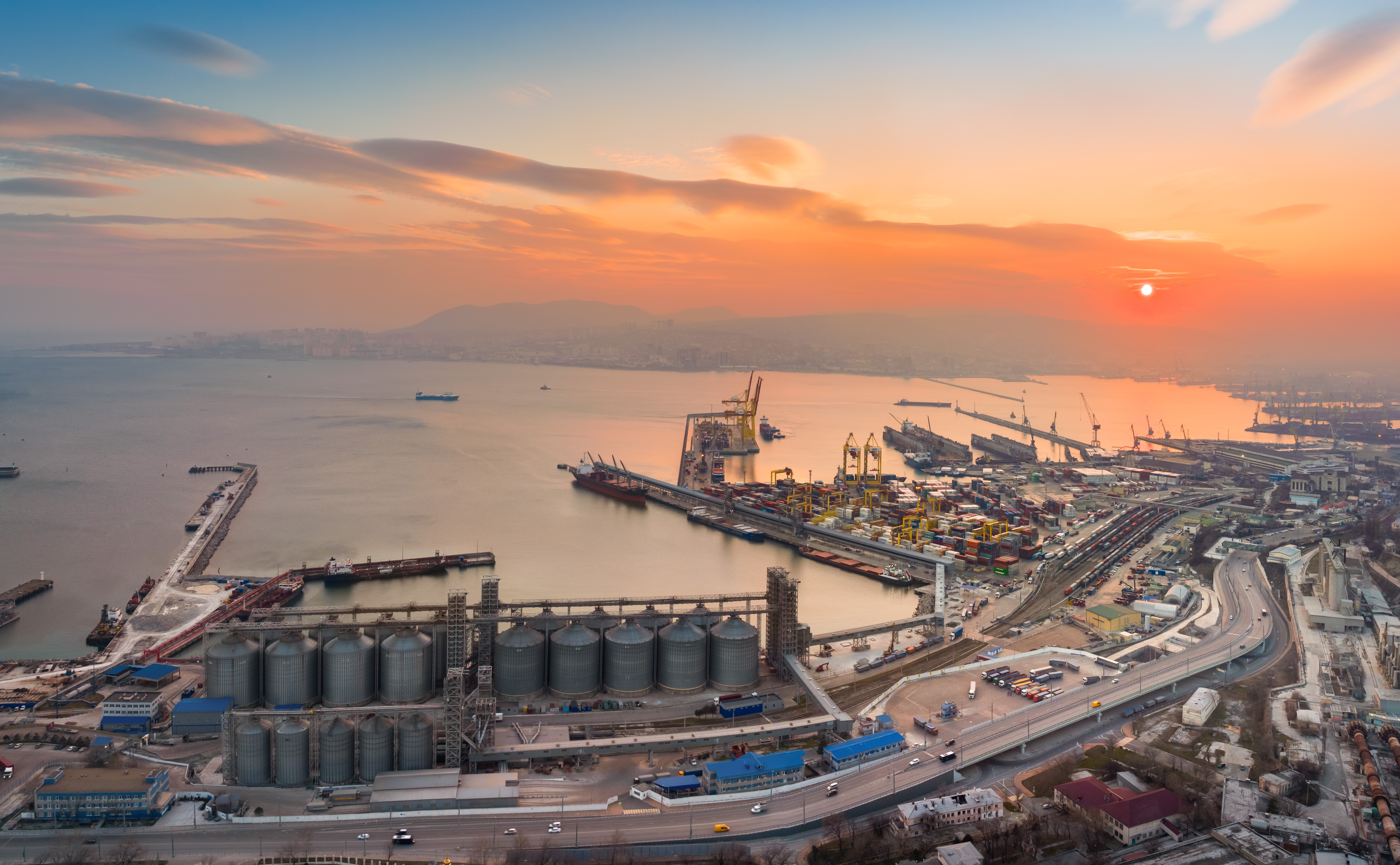
Izmail has become what it is today not by its own choice. When in the summer of 2023 Moscow effectively buried the Black Sea Grain Initiative and resumed strikes on the maritime corridor to Odessa, it was the Danube ports — Izmail, Reni, Kiliya — that Kyiv began to promote as a "backup exit" for exports. The geography provided formal protection: the river, the Romanian shore within sight, a ban on strikes on NATO territory. The reality turned out to be harsher — on August 13, a Russian strike ignited the port infrastructure of Izmail and cut off power to the southeastern part of the city, and on the night of August 17, a new series of strikes followed on the port and Odessa, which Governor Oleg Kiper reported as damage to a civilian vessel and four injured (according to Reuters, August 17, 2026).
To the military logic, a factor was added that the Russian command could not ignore — the record low level of the Danube. As early as August 10, Bloomberg reported that the river's shallowing limited the throughput of the Romanian section of the route. Thus, the strike on Izmail does not hit an abstract "infrastructure," but rather an already narrowing bottleneck. The Ukrainian Agribusiness Club (UAC) reported a 23 percent drop in exports in July. Officially, no one declares a "grain blockade," but the institutional result is the same as that of a blockade — a narrowing of the channel through which the country receives foreign currency.
Novorossiysk — a Base that Became a Target
Even more indicative is what happened on August 12 on the other side. A Ukrainian strike — which Zelensky called a "unique operation" using missiles, rockets, and naval drones — hit Novorossiysk, the last major base of the Black Sea Fleet and simultaneously one of Russia's main grain terminals. According to Ukrainian data, four warships were damaged, including two frigates; two major grain companies confirmed the suspension of their terminals, three people died, including an eight-year-old child, and 24 were injured (according to BBC, August 12–13, 2026). The Russian Ministry of Agriculture, without mentioning the attack, announced the redirection of cargo flows to the ports of the Baltic and Caspian Seas, as well as to land routes.
This is the essence of the new phase. Four years ago, the Black Sea Fleet was forced to leave Sevastopol, too exposed to Ukrainian strikes — to Novorossiysk, which was considered a deep rear. Now it too has found itself within reach, along with the civilian port economy it was protecting. There is no longer a "safe rear" for anyone: a Moscow analytical company estimates that Russian grain exports in August may fall by more than half compared to the same month over the past five years. Russia is the world's largest wheat exporter, and the strike on Novorossiysk hits precisely the position that Moscow has used for years as a lever of global influence.
Numbers that Speak for Themselves
Behind the grain war lies a broader escalation. On the night of August 16, Ukraine conducted one of the largest air attacks of the entire war: the Russian Ministry of Defense reported a record 1,478 drones shot down in a single day, with six people killed. A fire engulfed the Wildberries logistics complex near Moscow — Ukrainian military officials claim that seven out of the ten largest logistics hubs of the company have been incapacitated. According to the Kyiv Center for Security and Cooperation, the Wildberries marketplace alone accounts for about three percent of Russia's GDP. Foreign Ministry spokesperson Maria Zakharova promised to continue strikes on "objects that the Armed Forces of Ukraine use in the Black Sea to destabilize shipping," "until the threats are completely eliminated." The global price of these mutual strikes has already been recorded by the market — wheat is trading at a two-year high.
I will allow myself one personal note. I grew up in a country where bread was not just a commodity, but a category of moral order, where grain exports before 1917 were referred to as the "golden fleece" of the empire. Watching as the two largest bread exporters in the world methodically destroy each other's port infrastructure against the backdrop of a global food deficit is a particular kind of irony, understandable, I fear, only to someone with a Russian education.
Parallel with 2022 and Institutional Conclusion
A direct historical parallel is the Black Sea Grain Initiative of 2022. At that time, the mechanism worked as long as Moscow believed it was gaining more from it than it was losing; as soon as that equation stopped balancing, the agreement was terminated, and strikes on the maritime corridor resumed. Today's phase is fundamentally different: it is mutual. Russia strikes at the Danube ports and Odessa, Ukraine at Novorossiysk and its terminals, and both sides are suffering losses that cannot be passed off as a "victory." This is neither an offensive nor a defense in the classical sense, but a war of attrition transferred to the economic sphere, where the "winner" does not gain territory but receives a bill for restoration.
The institutional conclusion here is the same as I made when analyzing the problems of military command: the root is not in technology, but in structure. Both countries have built their export logistics around one or two critical nodes for years — and now both are paying for the lack of redundancy. Russia is redirecting flows to the Baltic and Caspian, but this is longer, more expensive, and limited by the capacity of railways; Ukraine is facing the shallowing Danube and a narrow maritime corridor. The grain war in the Black Sea currently has no winner, but it has a guaranteed loser — the very idea of the Black Sea as a calm trading waterway. And if the drought on the Danube drags on until the autumn harvest, and Novorossiysk continues to periodically halt operations, global grain prices will remain high not for months — but for the entire 2026–2027 season.
Ukrainian forces conducted strikes on Novorossiysk, damaging four warships and grain terminals on August 12. In retaliation, Russian strikes hit Izmail and Odesa, injuring civilians and damaging infrastructure. This mutual targeting of grain ports marks a significant escalation in the conflict, impacting both military operations and logistics.
- Ukrainian drones and missiles targeted grain terminals in Novorossiysk.
- Russian strikes caused damage in Izmail and Odesa, injuring civilians.
- Both sides are targeting each other's grain export infrastructure, indicating a new front in the conflict.