
One of the world’s most versatile attack planes is taking on the counter-UAS mission
Militaries facing waves of inexpensive one-way attack drones have a growing problem – the aircraft and weapons available to shoot them down can cost vastly more than the targets they are destroying. F-15s, F-16s and even F-35s can engage drones, but repeatedly pairing expensive fighters and their air-to-air missiles against targets costing infinitely less becomes difficult to sustain.
Ground-based c-UAS systems with kinetic and non-kinetic defeat offer another option, though their engagement range limits how far from a defended asset they can begin thinning an incoming swarm. They can also be overwhelmed by swarms and have their weapons magazines quickly depleted.
That mismatch has opened the door to a potentially more appropriate – and in many cases more effective – counter-UAS interceptor. Embraer is adapting its A-29 Super Tucano light-attack aircraft to hunt and destroy drones farther from defended bases, infrastructure, and other high-value assets, creating an airborne layer between ground-based point defenses and high-end fighters.
The A-29 dominates between those two ends of the defensive architecture, using air-to-air precision rockets, internal wing guns, and an electro-optical/infrared sensor, all fully integrated to the aircraft weapons system, to acquire and attack drones before they reach the inner defensive layer. The A-29’s high-powered turboprop engine is also better suited to pacing and defeating slower-moving aerial threats than jet-powered fighters.
“Many Air Forces are moving toward this idea of a layered defense,” said Marc Ayala, Embraer’s vice president for defense sales in North America. “It’s not just fixed-point defenses. Fixed-point defenses are great and they’re sort of the goalie in the analogy here, but you have to have some defenders that are out beyond the goalie to thin the swarm to a manageable size by the time it gets into that engagement range.”
Ayala pointed to the defense of Guam as an example, where the A-29 would handle the first line of defense covering a zone stretching from 50-200 miles out, with fixed-point ground defenses taking over the inner engagement zone from 50 miles inward.
Embraer is already putting the concept to the test. The company is working with an undisclosed country on a proof-of-concept demonstration using A-29s and actual drones as targets. This PoC aims at refining the operational concept and optimizing the human-machine interface (HMI) of the highly integrated solution.
Find, fix, and finish
Small drones flying low and slow can be difficult for an aircraft crew to detect at useful range, so the A-29 is not expected to search hundreds of miles of airspace to find drones on its own. Instead, a ground-based air-defense radar or another external source detects the incoming swarm and passes its location to the aircraft over a datalink.
“If you think about counter-UAS, you think about the weapon first, right?” Ayala said. “The weapon is definitely part of it, but the datalink on how the information is received is equally important, if not more important. We talk about the engagement as find, fix and finish.”
Once vectored into the area, the A-29 uses its L3Harris WESCAM MX-15D electro-optical/infrared sensor system with embedded moving-target-indicator and advanced video tracker capabilities to fix and track individual drones, which also helps create the firing solution. For A-29s already equipped with the system, the counter-UAS configuration does not require a hardware change to the MX-15D, according to Ayala, only a software upgrade. Aircraft without an EO/IR sensor system would have to be outfitted with one. The finish portion begins with Advanced Precision Kill Weapon System-equipped rockets, or APKWS.
The A-29’s .50-caliber machine guns are also integrated into the wings rather than carried in external pods, meaning the aircraft can load its hard points with missile pods while retaining several hundred gun rounds, depending on configuration. Ayala said the guns can be used if rockets miss or are exhausted, expanding the number of targets a single aircraft can engage.
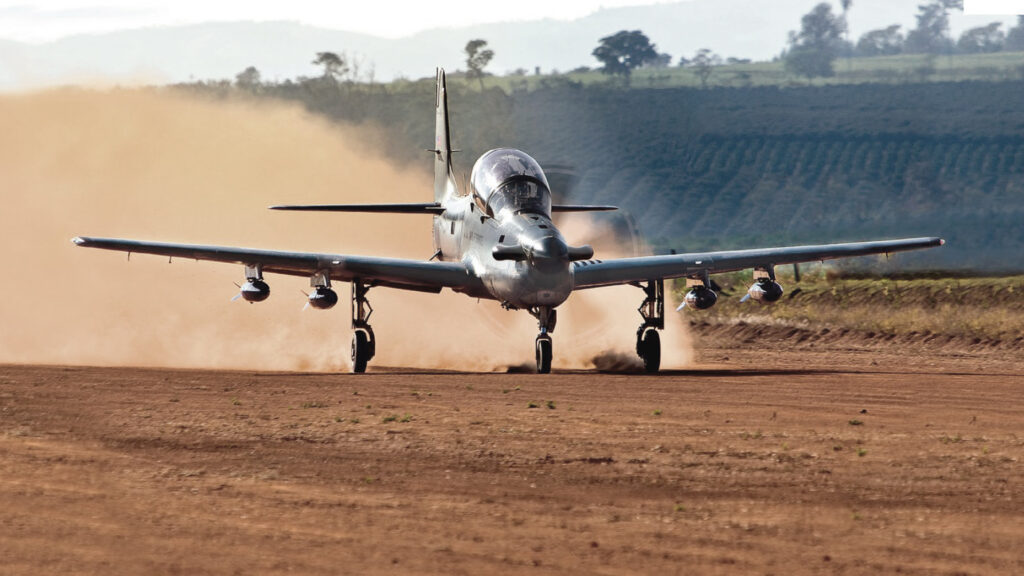 The A-29 is built on a rugged frame that can handle takeoff and landing in harsh environments. (Photo courtesy of Embraer.)
 Get there fast, attack slow
As mentioned earlier, the cost of each engagement is another part of the c-UAS challenge that A-29 addresses, with a serious mismatch between the cost of a Shahed drone, for example, versus the value of air-to-air missiles and the hourly operating costs to fly fighters. Additionally, the A-29 will save the front-line fighters airframe life, allowing them to be used for what they were designed to do.
Those high-speed aircraft also create an engagement problem for themselves. A Shahed, for example, flies at about 115 miles per hour, while an F-16 travels at speeds that are multiples of that in any type of intercept. Because the pilot may have to visually acquire a small drone, designate it, fire, and then maneuver to avoid a collision, the speed differential can leave only seconds to complete the engagement.
The A-29 operates in a different part of the flight envelope, one that’s more suited to c-UAS.
“Speed is the other main advantage, which plays itself out in two different ways,” said Ayala. “Number one, you have to get to the swarm, so you want an aircraft that’s fast enough to narrow the gap in enough time to do the job. But then you also want an aircraft that can fly slow enough to engage the target, which flies very slow.
“It can slow down, roll in behind the swarm and take out multiple targets before it has to come in and do another pass. You’ve got several seconds of engagement time versus one or two. And the odds of having a collision with one of these attack drones is much lower when you’re flying the right speed. You have to get there fast and then attack slow.”
A manned layer in the c-UAS architecture
For countries already flying the A-29 in its existing roles – including light attack, close air support, reconnaissance, border security, and advanced training – the aircraft’s new counter-UAS capability also places it at the forefront of arguably today’s most pressing air-defense challenge – how to defeat large numbers of inexpensive drones without relying exclusively on expensive interceptors or still-maturing ground-based c-UAS systems.
The transition for an A-29 pilot from attacking ground targets to engaging airborne drones is relatively straightforward, according to Ayala, while the aircraft’s ability to operate from unprepared runways with less supporting infrastructure than high-performance fighters offers another advantage.
The company is seeing increased interest in the A-29 from NATO allies looking at increasing their defense capabilities. In the US, three A-29s remain in the Air Force inventory and are currently flown by the Air Force Test Pilot School at Edwards Air Force Base. These could potentially be used to evaluate the airborne c-UAS concept.
Embraer also has an existing A-29 production line on American soil, and the aircraft includes significant US content with a large footprint of American suppliers.
“Most people, when we talk to them, do not realize that we have the US production line in Jacksonville, Florida,” noted Ayala. “And that production line is not being fully utilized at its full capacity. This mission is well aligned for the aircraft, and it’s very well aligned to the US industrial base.”
Embraer is adapting the A-29 Super Tucano to counter drones, enhancing its capabilities for air defense. This aircraft will operate between ground defenses and high-end fighters, engaging UAVs at ranges of 50-200 miles from protected assets. The A-29 utilizes advanced sensors and precision weaponry to effectively target and destroy drones, addressing the cost disparity in current counter-UAS operations. A proof-of-concept demonstration is underway with an undisclosed country.
- Embraer is adapting the A-29 Super Tucano for counter-UAS missions.
- The A-29 will engage drones at ranges of 50-200 miles from defended assets.
- The aircraft uses advanced sensors and precision weapons to target drones.
- The adaptation aims to reduce costs associated with engaging inexpensive drones.
- The A-29 is already being tested in a proof-of-concept demonstration.