
How a French frigate’s radical bow design makes for smooth sailing

PARIS — The inverted bow of France’s Defense and Intervention Frigate makes it one of the most recognizable designs among modern naval ships. The feature also makes for better seakeeping, said the former French Navy captain who commanded the lead ship of the class during sea trials.
The bow shape allows the frigate to plow through waves without impact, and the absence of slamming means much less vibration on board, said Nicolas Guiraud, who commanded the Amiral Ronarc’h frigate for four years until July and is now a marketing director at the vessel’s builder, Naval Group.
“Fewer vibrations mean a ship that ages much more slowly, cracks that won’t form, computer connectors that won’t disconnect,” Guiraud said in an interview at the Euronaval maritime-defense exhibition in Paris on Nov. 4.
“It also greater comfort for the crew, which isn’t the primary reason, but is still important because people are always part of the equation. And a well-rested sailor is a sailor who will make the right decisions.”
French Navy Chief of Staff Adm. Christophe Cluzel last month told lawmakers that while the FDI faced criticism from competitors, it has proven to be extremely maneuverable and very stable, “contrary to what some comments may have suggested.” Sweden in May announced plans to buy four of the frigates, which are already in use in the French and Hellenic navies.
“This design, which at first raised questions and left many people dubious, is now convincing a lot of people,” Guiraud said. Naval Group presented an 8,000-ton concept drone-carrier frigate at Euronaval that also features an inverted bow, “we believe in it enough to keep proposing it.”
The inverted bow design existed in the 19th century and has made a comeback on support vessels, but is new for a modern frigate, “so there was a real question mark,” according to Guiraud. The French Navy took delivery of its first FDI in October 2025.
Naval Group spent more than a decade analyzing the inverted bow design from the mid-2000s, with extensive tow-tank trials, hydrodynamic modeling, and radar-signature evaluations to address concerns about stability and wetness. The shipbuilder says the inverted bow has a reduced radar profile compared to a flared bow.
The U.S. Navy operates the Zumwalt-class stealth destroyers with an inverted bow, and while that design faced years of stability questions, the commander of the lead ship said in 2020 the vessel handled rough conditions well. The Zumwalt class differs in having a so-called tumblehome design that narrows above the waterline, compared to the French frigate’s flaring hull.
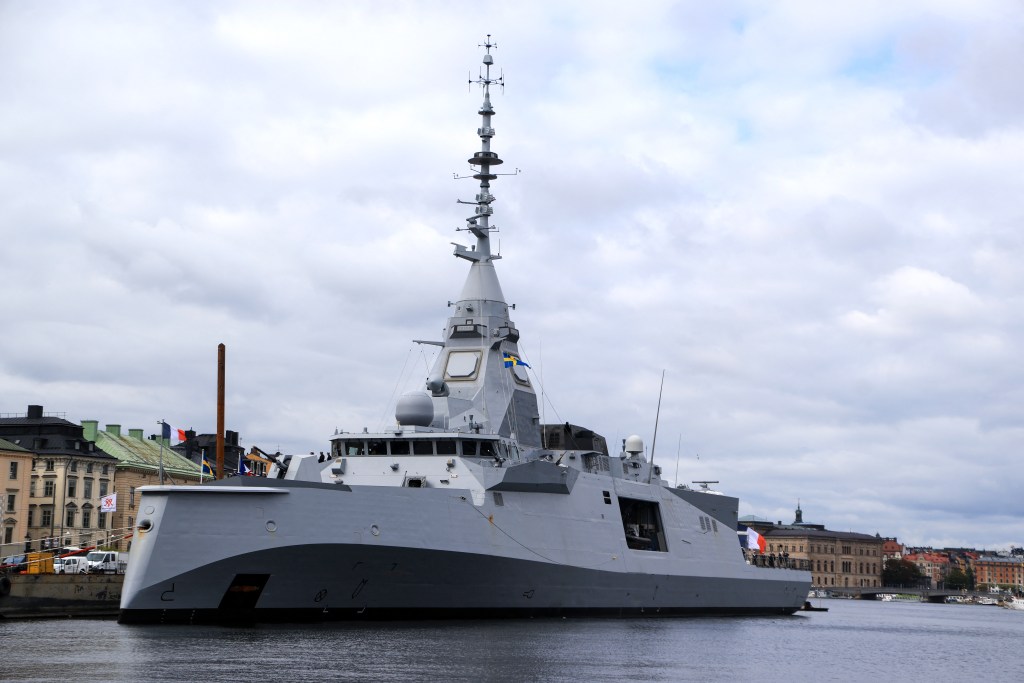 The French FDI frigate Amiral Ronarc’h is moored in Stockholm, Sweden, on Aug. 31, 2026. (Ludovic Marin / AFP via Getty Images)
Guiraud’s command of the Amiral Ronarc’h included an extended deployment that ranged from the Arctic Circle to the Equator.
Before the Amiral Ronarc’h, he served on the French multirole FREMM frigate and other ships from previous generations, where he said monitoring hull fatigue was “a central concern.” Feedback so far from the FDI is that structural wear is not an issue, he said.
The FDI’s combination of inverted bow, length-to-width ratio and stabilizing fins means “this platform doesn’t vibrate, it doesn’t experience shocks. And so we believe it will age much better.”
The frigate has a combined diesel and diesel propulsion system that is particularly energy-efficient, and while the FDI is advertised as having a range of 5,000 nautical miles when traveling at 15 knots, Guiraud said it’s actually “a good 10% more.” The maximum speed is 27 knots.
The Amiral Ronarc’h has maintained speeds of 20 knots in sea state 6, which corresponds to very rough seas with waves of 4 to 6 meters (13-20 feet), at times when “we were in a bit of a hurry,” according to Guiraud. The frigate has faced a maximum sea state 7 so far, which corresponds to waves up to 9 meters.
The former frigate commander recounted having to slow “just a little bit” when taking waves head-on in sea state 6, but as soon as the Amiral Ronarc’h adjusted course to take the waves slightly ahead of the beam, it was able to speed up to 20 knots again, “without any particular concern for the integrity of our systems.”
The shape of the bow and stabilizing fins allow the frigate to continue conducting military operations in rough seas. Operating a helicopter or towed array sonar in sea state 5 is “no problem at all,” while doing so in sea state 6 depends on wavelength, swell and wind strength.
The FDI displaces 4,500 metric tons but has the same military capabilities as a 6,000-ton frigate, according to the former commander.
“The main thing is that we continue, despite the decrease in the ship’s size, to maintain the same standards, which is already a very good result. Normally, the smaller the ship, the more complicated it is because the more it moves around.”
“Like any boat, the crew needs to be attentive to sea conditions to adjust their behavior accordingly. But that applies to all boats, and from my perspective, and from the users’ perspective, there’s no difference between a larger vessel and the Amiral Ronarc’h in that regard.”
Guiraud said increased spray caused by the bow shape is not an operational issue, with danger to weapon systems arising from swells in which a mass of water of several tons crashes down on the equipment. The FDI addresses that issue with spray rails on the hull to deflect water.
“There are no waves sweeping across the foredeck. There’s only spray, and our equipment is designed to be waterproof enough to function despite that.”
Guiraud said the bow of the FDI is so high that before the foredeck is submerged, “any boat would have been forced to adjust its course, no matter what. There’s no such thing as a boat that’s immune to having its superstructure submerged by a big wave. It doesn’t exist.”
The French Navy's Defense and Intervention Frigate (FDI) is operational and has demonstrated effective performance in various sea states. The frigate, which features an inverted bow design, enhances seakeeping and reduces vibrations, contributing to crew comfort and operational effectiveness. Sweden announced plans to purchase four FDIs, reflecting confidence in the vessel's capabilities. The first FDI was delivered in October 2025 and has shown strong performance in rough seas.
- The FDI frigate has an inverted bow design that enhances seakeeping and reduces vibrations.
- The frigate has a maximum speed of 27 knots and can operate effectively in rough seas.
- The French Navy took delivery of its first FDI in October 2025.
- Sweden plans to purchase four FDI frigates, indicating international interest.