
France's Aster Missiles and Naval Drones 2026 Highlight Europe's Autonomy Problem
 Dr. Klaus Weber
France's Aster Missiles and Naval Drones 2026 Highlight Europe's Autonomy Problem
Paris, November 6, 2026. France is ordering eight A18 underwater robots, doubling the Aster armament of its FDI frigates, and building a national ecosystem for maritime drones. This sounds like strategic autonomy. In fact, the appearance at Euronaval 2026 reveals a more difficult problem: Europe can accelerate individual capabilities, but it still lacks a common mechanism that transforms many national procurements into a robust naval power.
A Drone Program with Unusually Concrete Deadlines
Defense Minister Catherine Vautrin announced a new industrial pact on November 3, the opening day of Euronaval. Its purpose is not the next abstract innovation strategy, but the rapid convergence between the Navy's requirements and the industry's development cycles. This is a sensible approach. In the maritime domain, it is not only who demonstrates a prototype that matters, but who qualifies a system, integrates it into the fleet, and maintains it over the years.
The numbers are therefore more important than the political rhetoric. France is ordering a second remotely operated deep-sea underwater vehicle from LD Travocean. The 3,600-kilogram ROV is expected to dive up to 6,000 meters. Additionally, there are eight A18 mine countermeasure robots from Exail, which are supposed to detect and characterize sea mines using multiple sensors. Naval Group is also developing a second unmanned underwater combat vehicle. It is expected to be more than ten meters long and weigh over ten tons, capable of remaining in the water for weeks (Defense News, November 3).
The FDI Frigate Becomes a Test for Europe's Air Defense
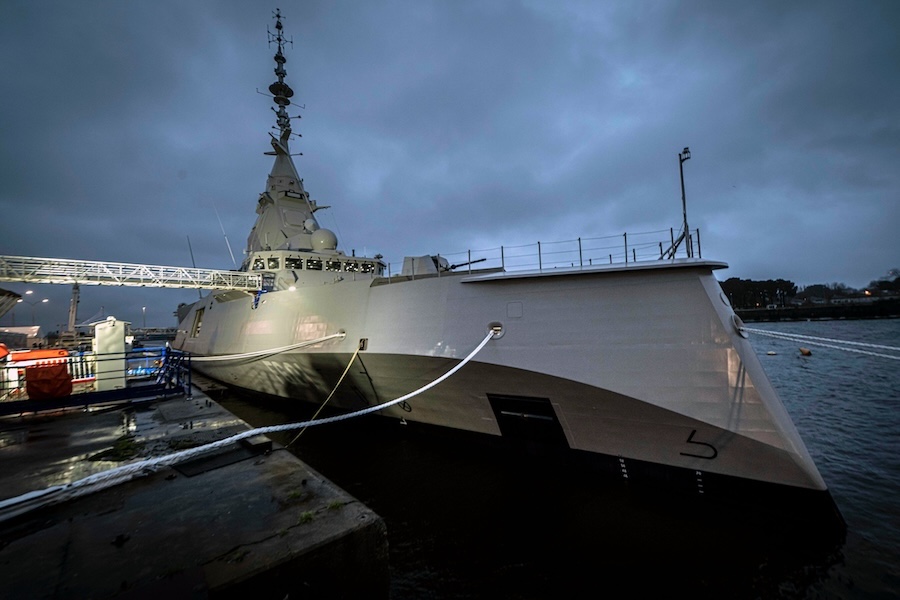
At the same time, Naval Group and MBDA agreed to retrofit the existing FDI frigates for a larger Aster loadout. The number of operational surface-to-air missiles is set to increase from 16 to 32; new ships will have this 32-cell magazine from the outset. This is not a cosmetic change. A frigate with 16 guided missiles can quickly reach the limit of its self-defense in a saturation attack. Doubling does not automatically increase the hit rate, but it extends the time during which the ship can fulfill its mission.
This is where the European context lies. Aster is a European product, but its effectiveness depends on radar sensors, command and control, logistics, and joint operational planning. A single ship with more missiles does not solve the ammunition shortage or the fragmentation of European fleets. France, Germany, Italy, the United Kingdom, and Poland announced on October 26 a renewed commitment to closer military and industrial cooperation within the framework of E5. However, a political declaration is not yet a common fleet plan, and a common fleet plan is not yet a common production line.
Why the French Approach is Not Automatically European
The French government is trying to learn from experiences with aerial drones. A national industrial network is intended to enable the Navy to formulate requirements more quickly and bring systems into series production. This makes sense for French sovereignty. However, Europe faces a dilemma. If each country establishes its own drone ecosystem, its own data architecture, and its own approval rules, the number of projects may increase, but this does not necessarily enhance the common military capability.
Euronaval itself illustrates this tension. The exhibition from November 3 to 6, 2026, reportedly has 40 percent more exhibitors than in 2024 and covers autonomous systems, artificial intelligence, cyber defense, electronic warfare, and the seabed. The market is visibly growing. However, market size and readiness are different categories. An autonomous system must be interoperable with frigates, mine countermeasures, satellite communications, and manned crews. Otherwise, it remains an expensive one-off with an impressive brochure.
The Seabed is Not a French Specialty
Paris rightly emphasizes the strategic importance of the seabed. Data cables and pipelines are critical infrastructure; sabotage and covert operations below the waterline can affect states without triggering a classic naval battle. Deep-sea robots and autonomous mine countermeasures are therefore not just naval projects, but instruments of European resilience.
However, national autonomy is insufficient for this infrastructure. Cables run through international waters, ports, and economic zones of several states. Situational awareness must be shared, responsibilities clarified, and response forces trained together. France may own a 6,000-meter ROV; Europe additionally needs a procedure that allows such a device to be deployed in crisis situations in the Baltic, the Atlantic, or the Mediterranean. Without this institutional level, the capability remains French, even though the threat is European.
More Missiles Do Not Solve the Cooperation Problem
The French initiative is therefore neither symbolic politics nor already a model for the entire EU. It is a serious attempt to bridge the gap between industrial competence and military availability. Its success will be measured by whether the drones actually enter the fleet in 2027, whether the Aster retrofit occurs without delay, and whether partner states adopt the same standards.
My sober assessment is: France is currently building capabilities, while Europe is primarily building options. This is an improvement over years of procurement policy, where each state waited for the next study. However, it is not enough for strategic autonomy. More Aster missiles increase a frigate's survivability; eight mine robots improve reconnaissance. What is still lacking is the political decision to treat these national capabilities as a common system. Europe can order its fleets nationally and still remain collectively vulnerable. This is precisely the paradoxical lesson of Euronaval 2026.
Sources
France ordered eight A18 underwater robots and doubled the Aster missile capacity on its FDI frigates during Euronaval 2026. A new industrial pact was announced to align naval requirements with industrial development cycles. The operational Aster missiles on frigates will increase from 16 to 32, enhancing their defensive capabilities. Despite these advancements, European nations face challenges in creating a unified naval capability.
- France ordered eight A18 underwater robots and doubled the Aster missile capacity on its FDI frigates.
- A new industrial pact was announced to align naval requirements with industrial development cycles.
- The number of operational Aster missiles on frigates will increase from 16 to 32.
- France is developing a second unmanned underwater combat vehicle capable of long-term deployment.
- European nations are struggling to create a unified naval capability despite individual advancements.