
Grassland Partners Training Begins at the End of 2026: PLA Northern Army Tests Cross-Border Mobile Combat Chain
 Li Minghui
Steppe Partner 2026 Training to Begin at the End of June, PLA Northern Army Tests Cross-Border Mobile Combat Chain
On May 18, Chinese Ministry of Defense spokesperson Jiang Bin confirmed that the China-Mongolia "Steppe Partner-2026" joint army training will take place in Inner Mongolia from late May to early June. This news may not seem as eye-catching as aircraft carriers going to sea or the situation in the Taiwan Strait, but from the perspective of army modernization, it actually provides a better observation of a key issue that the PLA is currently focused on: whether the troops can connect combined battalions, railway deployment, battlefield communication, and rear support into a reliable combat chain.
Not a Large-Scale Exercise, but Interesting Subject Selection
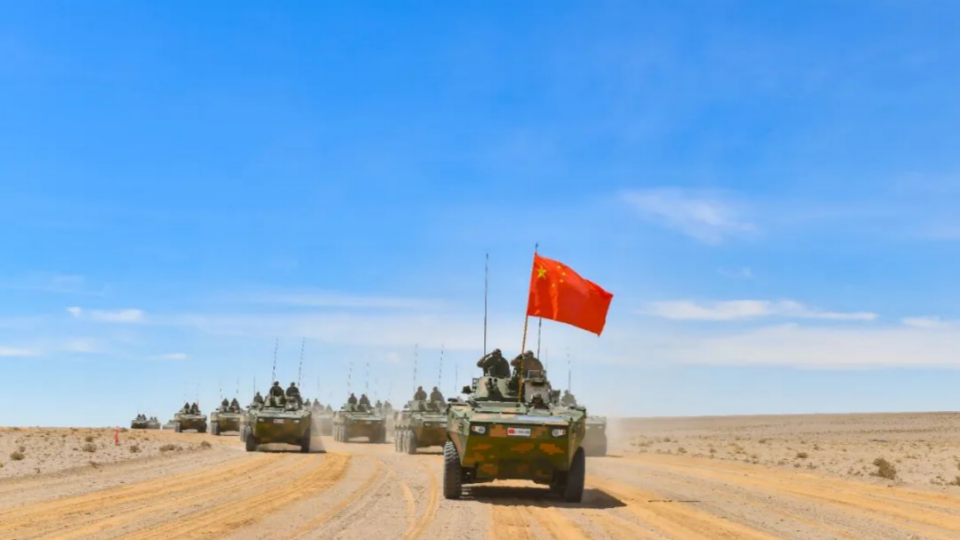
The official theme is "Joint Strike Against Illegal Armed Groups," marking the second joint army training of this kind between China and Mongolia. The statements from Xinhua News Agency and the China Military Network are largely consistent: the location is in Inner Mongolia, and the time spans from late May to early June, focusing on enhancing both sides' capabilities to jointly maintain regional security and stability. The wording is quite conventional, and the real details will refer back to the first "Steppe Partner" in 2024. At that time, the Chinese participating troops mainly came from a brigade of the 79th Group Army, which included elements such as wheeled armored assault, fire assault, operational support, and logistical support, and was carried out in three phases: troop deployment, joint training, and withdrawal.
This indicates that "Steppe Partner" is not merely a border defense exchange, nor is it a training session where several units take group photos. It resembles a foreign affairs version of a small combined brigade-level project: first, deploying troops and vehicles to a designated area, then establishing command, coordination, supply, and fire processes in unfamiliar terrain. In simple terms, the challenge of the exercise lies not in "who to fight," but in "who to bring, what to bring, how to get there, and how to fight once there."
The Northern Ledger Behind the Experience of the 79th Group Army
Public information does not specify which unit China will send in 2026, so it cannot be directly assumed that it will still be the 79th Group Army. However, if the organizational logic of 2024 is continued, the Northern Theater Army remains the most natural training subject. The 79th Group Army has long faced the northeastern, steppe, and cold region directions, with an equipment structure that emphasizes wheeled assault, armored mobility, artillery firepower, and engineering support. For such units, the steppe terrain has a characteristic: wide visibility, large maneuvering space, but poor concealment conditions, which can amplify issues related to communication, electromagnetic control, and logistical fuel consumption.
Wheeled armored vehicles have a speed advantage in this environment, and railway and road deployment are easier to carry out; however, the downside is the maintenance pressure after sustained off-road operations. In 2024, foreign media observed that China had deployed troops and armored vehicles via railway, with some reports mentioning that the number of participating vehicles exceeded 100. This figure should not be mechanically applied to 2026, but it suggests a direction: the PLA Army is transforming "being able to leave the camp" into "being able to take the system out of the camp." This is more critical than individual equipment parameters.
System Training Under the Shell of Joint Counter-Terrorism
"Illegal armed groups" is a low-intensity expression, yet it can encompass many modern battlefield subjects. Unmanned reconnaissance, armored assaults, artillery suppression, electronic interference, border control, and casualty evacuation can all fit within this framework. I believe the value of the China-Mongolia joint training lies not in simulating a specific opponent, but in providing the PLA Army with a training scenario that has lower political risks, significant terrain differences, and real foreign military coordination.
This aligns with the PLA's recent emphasis on joint operational training reform. An analysis from the U.S. Army War College's China Land Power Studies noted that the PLA's joint training still has an exploratory nature, with ongoing adjustments in cross-service, cross-regional, and cross-unit coordination. In exercises like "Steppe Partner," what is most worth observing is not whether new types of vehicles are showcased, but whether the command post can quickly share the situation, whether fire units can respond at a unified pace, and whether the logistics convoy can keep up with the armored unit's rhythm.
Geopolitical Implications in the Mongolian Direction Should Be Viewed Moderately
China-Mongolia military cooperation certainly carries diplomatic signals. Mongolia is sandwiched between China and Russia, maintaining a balanced diplomatic stance; through annual and institutionalized army joint training, China can stabilize its northern peripheral relations without overly provoking security anxieties. However, interpreting this as a rehearsal for some large-scale military expansion lacks sufficient evidence. Public information indicates that 2026 will still be the second training of this kind, with neither the scale nor the subjects reaching the threshold of strategic-level exercises.
A more realistic judgment is that the PLA Army is using these medium and small-scale joint trainings to fill in the gaps that are "difficult to truly measure in peacetime." Whether equipment can operate, whether artillery can fire, can be verified in regular training fields; but after cross-regional deployment, whether personnel, fuel, ammunition, maintenance, communication, and foreign coordination can synchronize can only be exposed when placed in a complete process. What is truly worth continuing to observe is whether the 2026 "Steppe Partner" will reveal more details about unmanned systems, long-range firepower, or joint command platforms. If these elements appear, it indicates that this seemingly low-key border joint training has further shifted from counter-terrorism cooperation to system combat capability verification.
Main Sources
- China Ministry of Defense English website, May 18, 2026, China, Mongolia to hold Steppe Partner 2026 joint army training.
- Xinhua News Agency English website, May 18, 2026, China, Mongolia to hold joint army training.
- China Ministry of Defense English website, May 13, 2024, China-Mongolia Steppe Partner-2024 joint army training kicks off.
- U.S. Army War College Strategic Studies Institute, February 2026, The PLA’s Joint Operations Training Reform Remains in an Exploratory Phase.
The People's Liberation Army (PLA) will conduct joint military training with Mongolia, named 'Steppe Partner 2026', in Inner Mongolia from late May to early June 2026. The exercise aims to enhance capabilities against illegal armed groups and improve regional security. It follows a similar training in 2024, indicating ongoing military collaboration between China and Mongolia.
- Joint military training named 'Steppe Partner 2026' confirmed by Chinese Defense Ministry spokesperson.
- Training will occur in Inner Mongolia from late May to early June 2026.
- Focus on enhancing capabilities to combat illegal armed groups and improve regional security.
- Previous training in 2024 involved the 79th Group Army, indicating continuity in military collaboration.
- The exercise aims to test the PLA's operational capabilities in unfamiliar terrain.