
Greece's 3.5 Billion Euro Achilles Shield Turns Israel's Technology into NATO's Southeast Flank
 Dr. Klaus Weber
Greece's 3.5 Billion Euro Achilles Shield Makes Israel's Technology Part of NATO's Southeastern Flank
3.5 billion euros, 35 months until full operational readiness, and at least 25 percent Greek industrial work: These three figures encapsulate almost the entire ambivalence of the new Greek air defense program. On July 23, Athens approved the procurement of a layered system from Israel, named Achilles Shield, which is intended to intercept ballistic missiles, aircraft, and drones. Formally, this is a sovereign national step. Politically, however, it is a very European problem.
Greece is taking action while many larger EU states are still sorting through strategy papers. The country currently spends about 3.5 percent of its gross domestic product on defense, plans modernization expenditures of around 28 billion euros by 2036, and links the new shield with F-35 procurement, French Rafale, new frigates, F-16V upgrades, and C-390 transport aircraft. But is that enough to strengthen European defense capability? Or is it merely a particularly rapid, particularly visible form of strategic outsourcing?
What Athens Has Decided
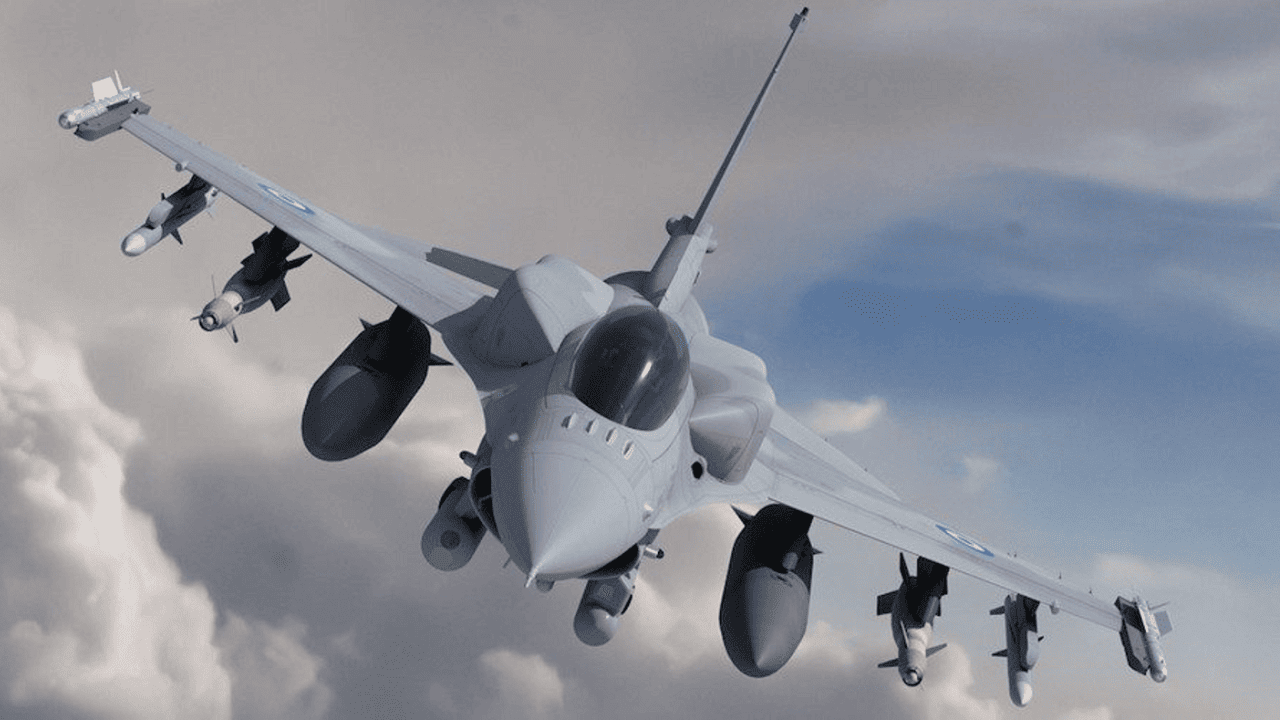
According to Defense Minister Nikos Dendias, the Greek Security Council KYSEA has approved contracts for an Israeli layered system. The core will consist of radars and missiles from Rafael and Israel Aerospace Industries. The architecture is intended to counter three classes of threats: ballistic missiles, conventional aerial targets, and unmanned systems. This is no trivial matter. The war in Ukraine, the Iranian-Israeli missile and drone salvos, and ongoing tensions with Turkey have taught Greece the same lesson: air defense is no longer just a protective shield for airports, but a prerequisite for political freedom of action.
The decision goes beyond Achilles Shield. Reuters and Defense News also report on three Embraer C-390 transport aircraft, ten British VICTA mini-submarines for special operations, American V-BAT drones, and Israeli Heron UAVs. Therefore, the package is not merely air defense, but an acceleration of the entire Greek capability planning. In procurement language, this is a portfolio. In security policy language, it is a vote of no confidence against slow European standardization.
The European Contradiction
Europe has been talking about strategic autonomy for years. Greece is now purchasing the most important new element of its territorial defense from Israel, supplementing it with American and Brazilian platforms, and integrating it into a NATO architecture whose key technologies still lie outside the EU. This is not irrational. On the contrary: from Athens' perspective, it is likely more rational than waiting for an ideal European solution that is politically desired but not industrially available quickly enough.
That is precisely the problem. When an EU member with a high perception of threat and a high willingness to pay does not primarily rely on European systems, it is not a moral failure of Athens. It is a market test for Europe's defense industry. This test is sobering. SAMP/T NG remains important, IRIS-T SLM remains important, European radar and C2 components remain important. Yet no European consortium can today present the same political narrative as Israel: combat-proven, layered, tested daily against missiles and drones, and deliverable within a clear timeframe.
The Greek decision does not show that Europe talks too little about autonomy. It shows that operational urgency rhetorically accepts autonomy but often circumvents it in procurement policy.
The 25 Percent Clause is Industrial Policy, Not Autonomy
Dendias emphasized that Greek companies would produce at least 25 percent of the system. This is necessary for domestic politics and makes industrial sense. It creates job shares, know-how interfaces, and parliamentary legitimacy. However, 25 percent national value creation does not mean 25 percent strategic control. Whoever controls the core radars, interceptors, software architecture, and update rights controls the actual sovereignty of the system.
This distinction is regularly blurred in Europe. Governments present local assembly, maintenance, or subcontracting as technological autonomy. In reality, industrial participation often arises without system leadership. Greece can live with this because its immediate priority is deterrence against Turkey and protection of critical infrastructure. For the EU as a whole, however, the same process is problematic: every national special path increases interoperability only if interfaces, data rights, and rules of engagement are considered jointly from the outset.
Why Greece Calculates Differently Than Berlin or Paris
Greece is not a small special case on the edge of NATO. It is a state on the southeastern flank, with a real air and naval force competition with Turkey, with experiences from the Aegean, and with immediate proximity to conflict zones in the eastern Mediterranean. This leads to a different political calculus. Athens cannot afford the German luxury of institutional patience. It buys what is available and combines suppliers from Israel, the USA, France, Italy, Brazil, and the UK.
France would likely criticize this approach as a weakening of European sovereignty. Germany would view it more quietly, as Berlin itself has not established a coherent European line between Patriot, Arrow 3, IRIS-T, and SAMP/T. This is where Greece becomes analytically interesting: it makes visible that European defense does not fail due to a lack of summit declarations, but due to diverging threat timelines. Paris thinks in terms of industrial sovereignty, Berlin in terms of budget and alliance risks, Athens in terms of 35 months.
Strategic Consequences for NATO and the EU
For NATO, Achilles Shield is initially a gain. A better-protected Greek infrastructure strengthens the southeastern flank, increases resilience against drones and missiles, and relieves other allied air defense capacities in times of crisis. For the EU, the findings are mixed. On one hand, a member state is spending a lot of money on concrete capabilities. On the other hand, a key contract is not flowing into the European core of the air defense industry.
This is not a plea against Israeli technology. Israeli air defense has operational credibility that many European programs still need to prove. But European politics must honestly name what is happening here. The EU cannot simultaneously promise strategic autonomy and allow every urgent capability build-up to be organized nationally, bilaterally, and supplier-driven. Autonomy does not arise from the sum of uncoordinated procurements, even if each individual procurement is militarily sensible.
Source Situation
- Reuters via Defense News, July 23, 2026: Greece approves an Israeli air defense system worth up to 3.5 billion euros, C-390 transport aircraft, VICTA mini-submarines, V-BAT and Heron drones.
- Times of Israel, July 23, 2026: Achilles Shield is to use Israeli radars and missiles from Rafael and IAI as its core and be operational within 35 months.
- Greek Ministry of Defense, March 2026 and Agenda 2030 documents: Achilles Shield is part of a broader reform and aims to organize air, missile, and drone defense in a layered manner.
Conclusion
Greece is providing Europe with an uncomfortable lesson. Increased defense spending can indeed be translated into real capabilities when threat, decision, and procurement coincide. But these capabilities are not automatically European just because an EU state pays for them. Achilles Shield strengthens Greece and likely also the NATO southeastern flank. At the same time, it reminds Brussels, Berlin, and Paris that strategic autonomy is measured by delivery timelines. Those who need protection in 35 months do not wait for a European doctrine. They buy a system.
Greece approved a 3.5 billion euro air defense system from Israel, known as Achilles Shield, on July 23, 2026. This multi-layered system aims to counter ballistic missiles, aircraft, and drones and is expected to be operational within 35 months. The decision is part of a broader modernization effort, which includes various military procurements to enhance Greece's defense capabilities against regional threats, particularly from Turkey.
- Greece approved a 3.5 billion euro air defense system from Israel on July 23, 2026.
- The Achilles Shield system will be operational within 35 months.
- The system will include components from Rafael and Israel Aerospace Industries.
- Greece plans to modernize its defense capabilities with a total expenditure of about 28 billion euros by 2036.
- The procurement reflects Greece's strategic response to regional threats, particularly from Turkey.