
Hanwha, General Atomics test runway-free drone in South Korea
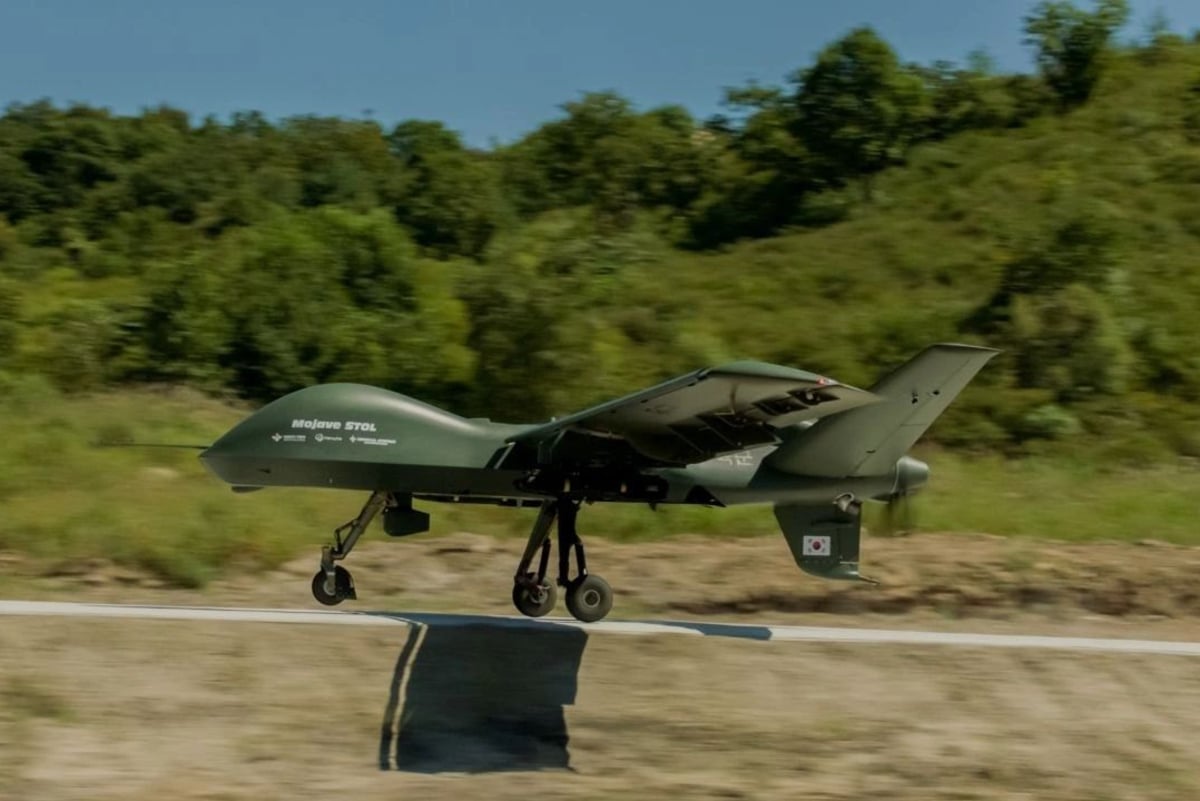
Hanwha Aerospace and General Atomics Aeronautical Systems flew the Mojave short-takeoff-and-landing (STOL) drone from a South Korean Army airfield, landed it on a tank maneuver route, and flew it back again during a demonstration at the 2026 Defense Drone Technology Exhibition in Pocheon.
The maneuver was meant to show the aircraft can operate from short, unimproved sites rather than depend on a conventional runway. Mojave uses a 450-horsepower turboprop engine paired with high-lift wing systems to shorten its takeoff and landing distances, and the companies say the design supports surveillance and reconnaissance, ground attack, logistics runs and communications relay missions.
Hanwha Aerospace said in a statement that it plans to build research, development and production infrastructure for the aircraft in South Korea, with a goal of sourcing more than 70 percent of the components domestically once the program reaches mass production.
“The successful demonstration marks another step forward in our collaboration with GA-ASI and our efforts to advance next-generation unmanned capabilities in Korea,” Hanwha Aerospace said.
Mojave is General Atomics’ short-takeoff variant of its MQ-1C Gray Eagle drone, built around the same avionics and flight control systems but fitted with enlarged wings and a rugged undercarriage for rough-field operations. The company unveiled the concept in December 2021 and has since put it through a series of unusual tests: a 2023 demonstration on a dirt strip near El Mirage, California, where it took off in as little as 586 ft (179 m) and landed in 335 ft (102 m); a launch and recovery from the deck of the Royal Navy carrier HMS Prince of Wales that same November; and live-fire tests in 2024 in which the aircraft destroyed stationary targets. In November 2024, Hanwha and General Atomics launched and recovered Mojave from the South Korean Navy’s amphibious ship ROKS Dokdo off the coast of Pohang, the first time the aircraft had operated from a Korean warship.
That partnership became a formal program in October 2025, when the two companies signed an agreement at the Association of the U.S. Army’s annual conference to jointly develop a production version of the aircraft, renamed the Gray Eagle STOL. Hanwha is investing more than 750 billion won, roughly $517 million, in Korean development and production facilities for the airframe and its engines. Under the deal, Hanwha will supply engines, landing gear, fuel systems, avionics and mission equipment, while General Atomics handles final systems integration and continues building its other Gray Eagle models in San Diego. The companies are targeting a first flight in early 2027 and initial deliveries in 2028, with South Korea’s Ministry of National Defense and the U.S. Department of War identified as the program’s first likely customers.
The production aircraft is expected to carry a payload of roughly 1.6 tons, including up to 16 Hellfire missiles, and to fly at speeds around 140 knots (161 mph) with an endurance of about 25 hours, according to General Atomics.
Content preview only. Full article available at source. View Full Article
Hanwha Aerospace and General Atomics demonstrated the Mojave drone's capabilities at the 2026 Defense Drone Technology Exhibition in Pocheon, South Korea. The drone successfully took off and landed on a tank maneuver route, showcasing its ability to operate from short, unimproved sites. Hanwha plans to establish production facilities in South Korea, with the first flight of the production version expected in early 2027.
- Hanwha Aerospace and General Atomics tested the Mojave drone at the 2026 Defense Drone Technology Exhibition in Pocheon, South Korea.
- The drone can operate from short, unimproved sites without a conventional runway.
- The Mojave drone is a short-takeoff variant of the MQ-1C Gray Eagle.
- Hanwha plans to build production infrastructure in South Korea, aiming for over 70% domestic component sourcing.
- The first flight of the production version is targeted for early 2027.