
Hazelnut over Kyiv — 690 Targets and the New Economy of Russian Coercion
 Dmitri Volkov
Hazelnut over Kyiv — 690 Targets and a New Economy of Russian Coercion
690 aerial targets in one night — this is no longer a "retaliatory strike," as the Russian Ministry of Defense prefers to say, but rather the accounting of a war of attrition. On the night of May 24, Russia launched 600 drones of various types and 90 missiles from air, sea, and ground platforms at Ukraine; the Ukrainian side reported the destruction or suppression of 549 drones and 55 missiles. Even if we take these figures with the usual caveat of military communication, the ratio is important: Moscow is now building its strike not around one "wonder-missile," but around saturating defenses with hundreds of cheap targets, where the expensive "Hazelnut" is inserted as a political symbol.
Massive Strike as a Production Report
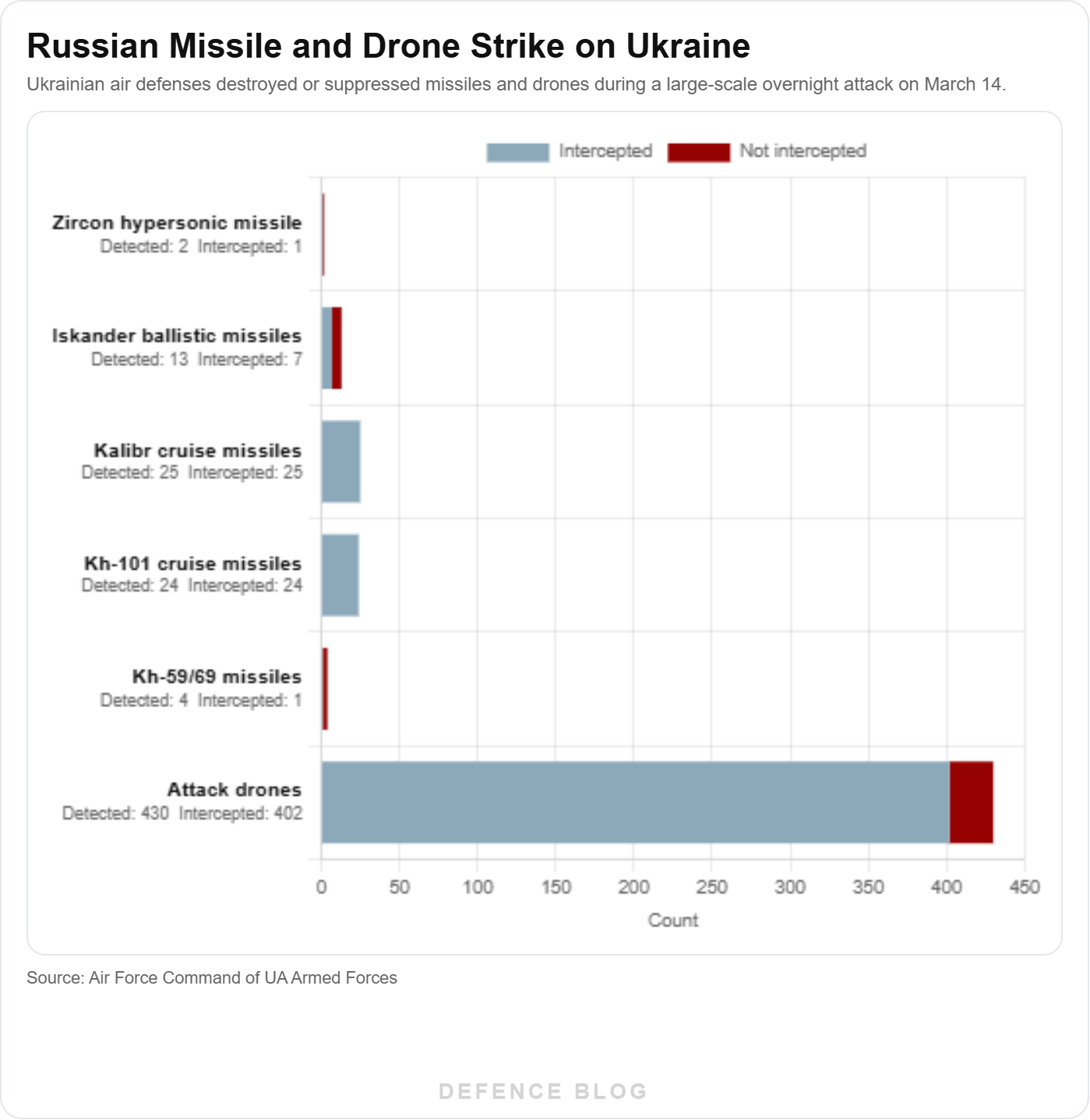
According to Associated Press and the Ukrainian Air Force, the strike included 600 strike drones and 90 missiles, including ballistic, cruise, and air-launched ballistic weapons. The Kyiv region, primarily the area of Bila Tserkva, once again became one of the main targets of the attack; Ukrainian officials reported the use of a missile from the "Hazelnut" system, which is usually described as a medium-range variant of the RS-26 "Rubezh" family. The Russian side, through reports from state and official-adjacent sources, presented the strike as a response to attacks on facilities in Russian-controlled territory, including Starobilsk. This explanation is convenient, but it does not explain the main point: preparing such a barrage requires accumulating munitions, deploying crews, synchronizing aviation, naval forces, missile troops, and drone operators. Decisions are not made overnight after a television outcry.
That is why this strike should be viewed not only as an episode of terror against a rear city but also as a demonstration of the current capacity of the Russian strike system. If in 2022 the Russian army attempted to paralyze Ukraine with relatively limited packages of cruise missiles, by 2026 it had transitioned to a different model: cheap "Geraniums" and similar devices create a mass load on air defense, while more expensive missiles seek gaps in the system, and the "Hazelnut" serves as a signaling tool for the external audience. The Soviet school would call this a combination of firepower and military-political pressure. The only difference is that today, a cheap drone has become as important a unit of calculation as a missile division in old staff tables.
Why the "Hazelnut" is Less Important than it Seems
In public discourse, attention is almost inevitably focused on the "Hazelnut." This is understandable: a medium-range missile, nuclear compatibility, hypersonic rhetoric, short flight time — all of this works well for political fear. But the military significance of the May strike lies not in one missile. One non-nuclear ballistic missile, even with a separating warhead, does not change the course of the war. What changes it is the state's ability to regularly produce, procure, store, and launch hundreds of munitions in a coordinated manner, forcing the opponent to expend interceptors, repair brigades, generators, medical resources, and political attention.
Here, an unpleasant arithmetic emerges for Kyiv and its allies. If Ukrainian data is accurate, about 91.5% of drones were shot down or suppressed, but approximately 51 drones still reached their targets or areas of impact. The picture is worse for missiles: 55 intercepted out of 90 means that about two-fifths of the missile portion of the barrage penetrated the defense or were not neutralized in the air. For a Western audience, this looks like a success for air defense; for a staff officer, it looks like a warning about the cost of success. A system that intercepts most targets but does so at the cost of expending expensive interceptor missiles and continuous strain on calculations remains vulnerable to repetition.
New Tactics Do Not Cancel Old Logic
Russian military culture loves technological symbols, but historically it has won not with symbols, but with mass, patience, and raw organizational resilience. In this sense, the May strike resembles not a "revolution in military affairs," but a return to the old Soviet logic of saturation, only in a digital and drone format. Where artillery barrels and fire density per kilometer of front were once counted, now the number of false routes, decoy drones, guidance channels, engine stocks, navigation modules, and night shifts on assembly lines are counted.
This does not mean that the Russian system has become effective in the Western sense of the word. It remains wasteful, brutal, and often technically primitive. But war has shown several times that primitiveness does not equal uselessness. A cheap chassis, a commercial navigation component, an Iranian or Russian assembly scheme, followed by a mass launch under the cover of a missile package — such a construct does not look elegant, but it creates a load that cannot be ignored. In military affairs, as in a poor Soviet economy, a deficit of quality is sometimes compensated by a forced surplus of quantity. The sad joke is that this formula works again.
Strategic Addressee of the Strike
The immediate addressee of the strike is Kyiv and the Ukrainian air defense system. But the political addressee is broader. Washington, Berlin, Warsaw, and Brussels had to see that Moscow is ready to raise the cost of defending Ukrainian skies precisely at the moment when the issue of supplying Patriot, SAMP/T, missiles for NASAMS, and IRIS-T is once again becoming a matter of stockpiles rather than diplomatic statements. After four years of war, Russia has learned to strike not only at a target on the map but also at the logistical chain of the opponent's decisions: how many interceptors are left, who will pay for the next batch, how many months production will take, which ally will be the first to say that its own defense is being depleted.
It is worth noting Bila Tserkva separately. If confirmation of the use of the "Hazelnut" specifically against this area is firmly established, the choice of target will be indicative. Bila Tserkva is not a symbolic capital but a military and industrial hub south of Kyiv, regularly appearing in Russian logic as part of Ukrainian defense infrastructure. A strike on such a target allows Moscow to simultaneously declare the "military nature" of the operation and maintain the psychological effect of an attack on the Kyiv region. This is a typical compromise of Russian information warfare: formally speaking about military objects, while actually impacting civil society through scale, night, sound, and fear.
What Changes for Ukraine and NATO
For Ukraine, the main conclusion is unpleasant but clear: the air defense system must evolve not only upwards, towards more expensive means against ballistic missiles, but also downwards, towards mass cheap solutions against drones. One cannot respond to every "Geranium" with a missile whose cost is dozens of times higher than the target. Echelons are needed: mobile fire groups, radar and acoustic networks, electronic warfare means, cheap interceptors, automated target distribution, and preservation of expensive systems for ballistic threats. Ukrainians understand this better than many Western staffs; the problem is that understanding does not produce munitions by itself.
For NATO, the May strike serves as yet another argument against the comfortable illusion that the Russian military machine is exhausted. It is worn out, but not stopped. It is technologically dependent, but adaptive. It suffers enormous losses, but is capable of producing regular packages of strategic-scale strikes. In this contradiction lies present-day Russia: a country that cannot offer an attractive model for the future but can still very expensively destroy someone else's present.
Sources: Associated Press, May 24, 2026; Ukrainian Truth citing the Ukrainian Air Force, May 24, 2026; Anadolu Agency, May 24, 2026; Reuters/MarketScreener, May 25, 2026; Le Monde, May 25, 2026.
My forecast is cautious. The "Hazelnut" will not become a daily weapon of this war: it is too expensive, politically noticeable, and limited in available stock. But mixed barrages of 500-700 targets could become the new norm of the Russian coercion campaign if Ukrainian air defense does not receive more cheap interception means and a sustainable stock of expensive missiles. The Russian defense industry has not defeated sanctions; it has simply found a sufficiently narrow corridor to continue the war. For Ukraine, the danger lies precisely in this corridor, not in the beautiful name of another missile.
On the night of May 24, 2026, the Russian Armed Forces launched a massive airstrike against Ukraine, deploying 690 aerial targets, including 600 drones and 90 missiles. The primary target areas included Kyiv and Bila Tserkva, with Ukrainian forces claiming to have intercepted a significant number of these threats. This operation reflects a shift in Russian military strategy towards overwhelming air defenses with mass attacks.
- Russia launched 690 aerial targets against Ukraine, including 600 drones and 90 missiles.
- Ukrainian forces reported intercepting 549 drones and 55 missiles.
- The strike targeted Kyiv and specifically the Bila Tserkva area.
- The operation is part of a new strategy to overwhelm Ukrainian air defenses with massed attacks.
- The 'Oreshnik' missile was used as a political symbol rather than a primary weapon.