
Heightened Vigilance! Japan's Latest Military Developments
On March 31, the Japanese Ministry of Defense deployed long-range missiles with so-called "counterattack capability," the "Type 25 Surface-to-Ship Missile" and the "Type 25 High-Speed Glide Bomb," in Kumamoto Prefecture and Shizuoka Prefecture, respectively. This marks Japan's first deployment of such missiles, with the "Type 25 Surface-to-Ship Missile" having a range of approximately 1,000 kilometers, far exceeding Japan's territorial limits and possessing clear offensive attributes.
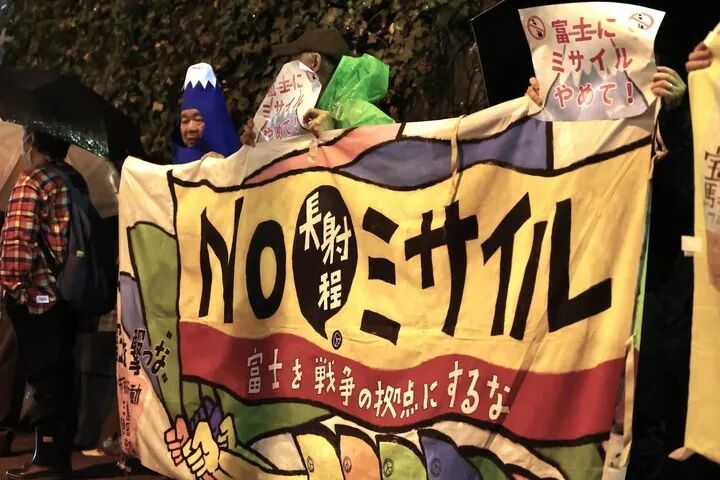
On March 31, citizens gathered in front of the Japanese Ministry of Defense in Tokyo to protest the government's deployment of long-range missiles with "enemy base attack capability" in Kumamoto Prefecture and Shizuoka Prefecture. Xinhua News Agency reporter Yue Chenxing photographed.
Japan's explicit deployment of long-range offensive weapons completely tears away the facade of "defensive defense" and "passive defense," fully proving that Japan's "new militarism" is not just a dangerous sign but a blatant reality threat, seriously undermining regional peace and security.
Deploying offensive weapons far exceeding the needs of "self-defense" under the pretext of enhancing so-called "counterattack capability" is merely a deceptive word game. This self-deceptive approach is a common tactic of the Japanese government. The Japanese helicopter destroyers "Izumo" and "Kaga" are designed with a flat-deck structure and, after modification, can carry F-35B stealth fighters with vertical takeoff and landing capabilities, effectively becoming aircraft carriers. Japan's pacifist constitution states that it "will not maintain land, sea, and air forces or other war potential," and Japan has adopted a "defensive defense" policy based on this principle. In this context, labeling these two "quasi-aircraft carriers" as "helicopter destroyers" is essentially a means to deceive public opinion and expand military capabilities under the guise of "defense."
The development and deployment of so-called "counterattack capability" fully expose the ambitions of Japan's right-wing forces to continuously promote "remilitarization." In 2015, the Abe Shinzo government overturned the constitutional interpretation that prohibited the exercise of collective self-defense, forcibly pushing the National Diet to pass new security legislation, thereby lifting the ban on collective self-defense and providing the necessary conditions for the subsequent establishment of so-called "counterattack capability." In 2022, the Kishida Fumio government passed a new version of the "Security Three Documents," proposing the possession of so-called "counterattack capability." Now, the Takagi Sanae government is accelerating the deployment of this so-called "counterattack capability."
Japan's right-wing forces are accustomed to disguising and fabricating false narratives, constantly shifting attention, provoking neighbors, creating incidents, and escalating tensions, fabricating a false sense of being threatened and having no retreat, using "survival" and "defense" as excuses to drag their own citizens into war. In recent years, Japan has not only significantly adjusted its security policies, but Japanese officials have also openly advocated for "nuclear armament," seeking to amend the "Three Non-Nuclear Principles" and lift restrictions on arms exports, continuously pushing for military deregulation in a "salami-slicing" manner, casting more shadows over regional peace and security.
The acceleration of military expansion by Japan's right-wing forces, constantly breaking through post-war norms and international regulations such as the "defensive defense" principle, challenges the post-war international order and poses a threat to regional and global peace and stability. The international community must remain highly vigilant and resolutely deter this; otherwise, the consequences will be endless.
Reporter: Chen Zean
Japan deployed Type 25 Surface-to-Ship Missiles and Type 25 High-Speed Glide Bombs in Kumamoto and Shizuoka on March 31, 2023. This marks Japan's first deployment of such long-range offensive missiles, exceeding its territorial defense needs. Public protests erupted in Tokyo against this military expansion, highlighting concerns over Japan's shift from a defensive posture to a more aggressive military stance. The move is seen as part of a broader trend of re-militarization by Japan.
- Japan deployed Type 25 Surface-to-Ship Missiles and Type 25 High-Speed Glide Bombs on March 31, 2023.
- This is the first deployment of such missiles by Japan, exceeding the range of its territory.
- Public protests occurred in Tokyo against the missile deployment, citing concerns over Japan's military expansion.
- The deployment marks a significant shift from Japan's post-war defense policy of self-defense.
- Japan's government is accused of advancing militarization under the guise of self-defense.