
Hellfire Strike on Lian Star in the Gulf of Oman Reveals the Limits of Iran's Maritime Blockade 2026
 Ahmed Al-Rashid
Hellfire Strike on Lian Star in the Gulf of Oman Reveals Limits of Iran's Maritime Blockade 2026
On May 29, 2026, the incident in the Gulf of Oman was not just an interception of a small vessel. An American aircraft launched a Hellfire missile at the engine room of a commercial ship flying the Gambian flag, named M/V Lian Star, after more than twenty warnings as it continued sailing towards an Iranian port. This is the kind of detail that seems tactical in a military statement, but in the Gulf, it quickly turns into a larger political question: who has the right to control the movement of ships when war hangs in the balance under the name of a fragile ceasefire?
The U.S. Central Command statement said that the ship was no longer heading to Iran, and that U.S. forces had disabled five commercial vessels and redirected 116 ships as part of enforcing the blockade. The Associated Press added that the ship remained aground or adrift in the Gulf of Oman, and that U.S. forces did not board it. Meanwhile, specialized maritime press noted that the Lian Star is a small general cargo ship with a capacity of about 1,600 tons, approximately 71 meters long, built in 1993, and that its owners are registered in the UAE. This is not a giant tanker, and that is exactly what makes the message more important than the size of the target.
From Intercepting a Ship to Testing the Rules of Engagement
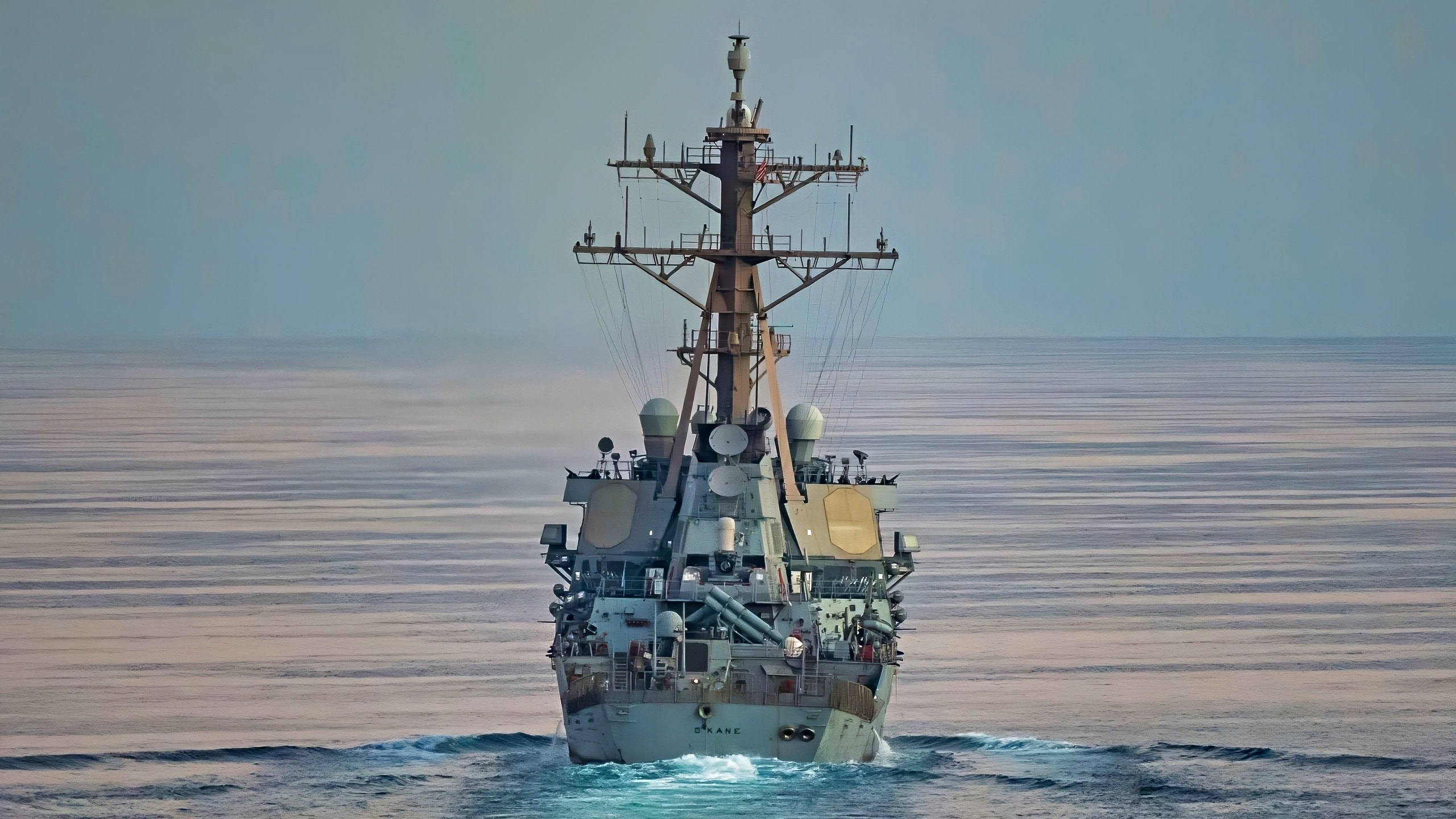
Militarily, the choice of Hellfire to strike the engine room rather than the hull of the ship or the bridge carries a calculated message. The missile is primarily designed for armored or small targets, and using it against the engine of a commercial ship means that Washington wants to disable movement, not sink the ship. This is tactical precision, but it does not eliminate the political risk. At sea, disabling a commercial vessel in international waters always opens a wide legal door, especially when the blockade itself is part of a war that has not yet closed.
The incident came as U.S. Secretary of Defense Pete Hegseth was saying in Singapore that the blockade remains in place, and that the Strait of Hormuz must be open without fees to the world. At the same time, Washington and Tehran were discussing extending the ceasefire for sixty days and arrangements regarding the nuclear program and reopening the strait. This duality is not just a flaw in messaging; it is a method of pressure. Diplomacy here does not run alongside power, but directly above its surface.
Why a Small Ship Matters to the Gulf States
Some may say that the Lian Star is a marginal ship compared to the oil and gas tankers passing near Hormuz. This is true in commercial terms, but it is not true in security terms. In the Gulf, every small maritime incident becomes a test of insurance systems, captain decisions, port positions, and calculations of countries that do not want to appear as parties in the war. If the ship's owner is linked to the UAE as maritime reports have indicated, the question becomes more sensitive: can Gulf commercial companies operate in an area controlled by Washington and Tehran with rules changing every week?
Experience from officers in the region teaches us that armies do not lose control only when they fail to shoot down a missile. Sometimes they lose it when they cannot explain the rules they want civilians to adhere to. More than twenty warnings seem like a lot on paper, but they are not enough if shipping, insurance, and port companies do not know in advance where the danger zone begins and where it ends. This is the difference between organized maritime control and a deterrent policy based on punitive examples.
The Gulf Equation Between Protection and Dependency
For Saudi Arabia, the UAE, Qatar, Kuwait, and Oman, the incident confirms an old dilemma in a new guise. These countries need American power to prevent the closure of Hormuz from turning into a complete economic strangulation, but they cannot afford to appear as if their waters, ports, and company ships are part of an open American blockade against Iran. The tighter Washington tightens the maritime noose, the greater the chances that Tehran will respond indirectly through missiles, drones, navigational jamming, or pressure on its proxies in Lebanon, Yemen, and Iraq.
Kuwait is a clear example. Reports of intercepting missile threats or drones near American bases there remind us that Gulf air defense is not a purely national system, but an intertwined network of American and Gulf interests. When Washington strikes a ship in the Gulf of Oman, the cost may come in the form of an air alert in another Gulf city. In my view, this is the point that much Western analysis overlooks: the region is not just a theater of operations, but a home inhabited by others while the big players exchange messages above its roof.
Iran Understands the Message but Does Not Need to Respond Directly
Tehran does not necessarily need to attack an American ship to respond to the Lian Star incident. It is enough to raise the cost of passage slightly, or increase ambiguity around mines, or allow GNSS jamming in specific areas, or push the Houthis and Hezbollah to keep pressure fronts active. These are tools less than total war but sufficient to confuse the market and force Gulf countries to seek more American guarantees. And here the cycle returns: every American guarantee increases political and military dependency, and every dependency weakens the Gulf's defensive independence narrative.
From a capabilities perspective, it is not enough to purchase maritime radars, patrol aircraft, and air defense missiles if there is no unified decision-making system among the fleet, coast guards, ports, energy companies, and insurance bodies. The Gulf has spent tens of billions on weapons, but it still sometimes acts as if maritime security is a ready American function. The old military adage says that the sea does not recognize a vacuum. If you do not fill it with your rules, monitoring, and ability to communicate, others will fill it with their rules and missiles.
After Lian Star
The real impact of the Hellfire strike is not in hitting the engine room of a ship over three decades old. The impact is in establishing a new model: a ceasefire on land and in the air, with an active blockade at sea, and nuclear negotiations taking place under the pressure of limited fire. This is a dangerous model because it allows each party to claim it does not want war while exercising its tools at a calculated level.
If Washington succeeds in enforcing the blockade without human losses and without direct Iranian escalation, it may consider it a repeatable model. If Tehran sees that a small ship can become a symbol of American dominance over the Gulf, it will seek a response that does not appear to be a complete breach of the ceasefire. Meanwhile, the Gulf states will remain in the middle, buying protection and paying the cost of uncertainty. That is the paradox that arms deals do not resolve: those who ask outsiders to guard the gate of their home must accept that outsiders sometimes decide who enters and who stops at sea.
Sources
On May 29, 2026, a U.S. aircraft launched a Hellfire missile at the engine room of the M/V Lian Star in the Gulf of Oman. This action followed over twenty warnings as the vessel approached an Iranian port. The U.S. Central Command reported that the ship was redirected and no longer heading towards Iran, highlighting the complexities of maritime control amid ongoing tensions in the region.
- A U.S. aircraft launched a Hellfire missile at the M/V Lian Star in the Gulf of Oman.
- The vessel was reportedly heading towards an Iranian port despite multiple warnings.
- The U.S. Central Command stated that the ship was redirected and not heading to Iran anymore.
- The incident raises questions about maritime control and the implications of U.S. military actions in the region.
- The M/V Lian Star is a small general cargo ship registered in the UAE.