
How would the US Navy counter Iran's mines?
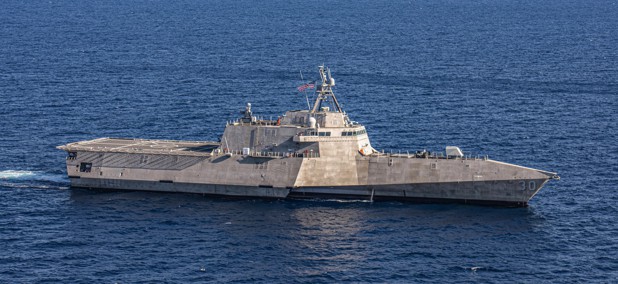
It's not clear whether Iran has put naval mines in the Strait of Hormuz, but its longstanding ability to do so is part of the reason ships have all but stopped moving through the critical global chokepoint. The time may come for the U.S. Navy's littoral combat ships to demonstrate their long-touted ability to hunt mines.
According to a March 2026 congressional report, Iran is believed to possess roughly 6,000 naval mines. Although CENTCOM commander Admiral Brad Cooper has said that Iran’s conventional navy has been rendered combat-ineffective, some reports indicate that Iran has deployed mines in the strait. The Islamic Revolutionary Guard Corps Navy has hundreds of speedboats with which to rapidly deploy mines across the narrow waterway.
Last fall, the Navy decommissioned the backbone of its minehunting capabilities: the four Avenger-class minesweepers stationed in Bahrain; four more remain elsewhere in the fleet. Purpose-built for mine warfare, the Avengers have wooden hulls wrapped in fiberglass to reduce magnetic signatures that trigger mines. But the Avengers are slow, outdated, lack any meaningful self-defense systems, and can’t launch helicopters or unmanned systems.
The Avengers were replaced in the Persian Gulf by the long-controversial littoral combat ships: high-speed, agile surface combatants designed for near-shore surface warfare, anti-submarine operations, and mine countermeasures. The Gulf LCSs—all Independence-class vessels—are equipped with minesweeping and mine-hunting capabilities: the LCS Mine Countermeasures Mission Package. The MCM MP supports mine warfare operations using aviation assets and unmanned systems equipped with an array of sensors to detect, localize, and neutralize surface, near-surface, moored, and bottom mines in the littorals. To date, the USS Canberra (LCS 30), USS Santa Barbara (LCS 32), and USS Tulsa (LCS 16) are known to have received the MCM MP. A fourth LCS, the USS Kansas City (LCS 22), is equipped with MCM MP for crew training and relief support.
With aluminum hulls, Independence-class LCSs must stay outside minefields, sending in MH-60S Seahawks, unmanned surface vessels (USVs), and unmanned surface vehicles (USVs) to hunt the underwater weapons.
USVs can tow the AN/AQS-20 mine-hunting sonar system, which uses sensors to find bottom and moored mines. The USVs can also deploy the unmanned influence sweep system (UISS), which mimics the magnetic and acoustic signature of a ship to detonate mines safely. LCSs can also deploy the Knifefish UUV, which can find buried and proud mines using low-frequency broadband sonar.
Crewed MH-60S Seahawks can be equipped with the AN/AES-1 Airborne Laser Mine Detection System (ALMDS), which detects floating and near-surface moored mines, as well as the AN/ASQ-235 Airborne Mine-Neutralization System (AMNS), whose expendable Archerfish UUV can destroy mines.
How might the U.S. Navy conduct counter-mine operations in the Persian Gulf? As of March, the four remaining Avengers were in Japan. The USS Tulsa and USS Santa Barbara were spotted at port in Malaysia on March 15, reportedly conducting brief logistical stops. The USS Canberra was reportedly in the Indian Ocean around the same time. The absence of these vessels in the Persian Gulf is surely no accident. Moving U.S. warships, particularly the three LCSs, out of port in Bahrain ahead of the conflict was likely a calculated decision to keep these vessels well out of the range of Iranian drones and missiles. Moreover, the U.S. military’s strikes on Iranian vessels in port have demonstrated the vulnerability of ships docked in the Gulf.
Yet, even if the LCSs are sent to the Persian Gulf, there are concerns around the capability of the LCS MCM MP. The unmanned assets require hours of pre-mission calibration. They cannot operate beyond line of sight ot the LCS. The AN/AQS-20 has struggled to identify g mines, even when tested in the relatively benign waters of Southern California. Perhaps most concerning, the Pentagon’s testing office said in March 2026 that it could not determine the operational effectiveness of the LCS equipped with the MCM MP.
Finally, mine-clearing is a slow, deliberate process made even more arduous when occurring in an environment contested by Iranian missiles and drones. Neither the purpose-built Avenger-class nor the LCS equipped with a relatively unproven MCM mission package would likely prove effective without a robust military escort.
The U.S. Navy is preparing for potential mine countermeasures in the Persian Gulf amid concerns over Iranian mine deployment. As of March 2026, the Navy has decommissioned its Avenger-class minesweepers and replaced them with Independence-class littoral combat ships (LCSs) equipped for mine warfare. However, there are significant concerns regarding the operational effectiveness of these systems in a contested environment.
- Iran is believed to possess roughly 6,000 naval mines.
- The U.S. Navy has decommissioned its Avenger-class minesweepers, replacing them with LCSs.
- LCSs are equipped with mine countermeasures capabilities and unmanned systems.
- Concerns exist regarding the effectiveness of LCS mine countermeasures in contested environments.
- U.S. warships have been moved out of the Persian Gulf to avoid Iranian threats.