

The M16A4 was the last of a breed. It was the final full-length M16 to serve as America’s frontline infantry rifle, and for nearly two decades it was the weapon Marines carried into Fallujah, Ramadi, and Helmand. It was accurate, reliable, and built for the long-range marksmanship the Marine Corps has always prided itself on. However, the wars it fought were close, urban, and mounted. The rifle was built for one fight and deployed to another.
That mismatch is the story of the M16A4.
The Flat-Top Changed Everything
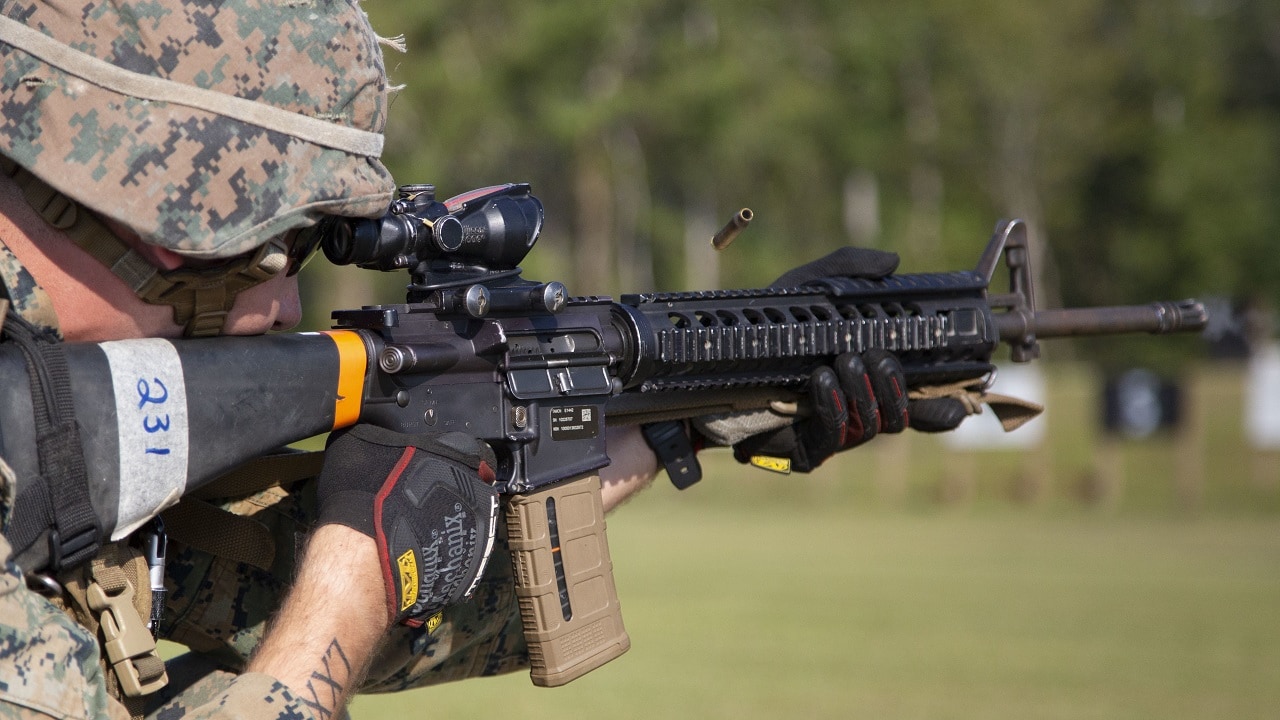
U.S. Marine Corps Lance Cpl. Noah Larose, motor transportation operator, Combat Logistics Battalion 6, 2nd Marine Logistics Group, fires an M16A4 rifle during a rifle marksmanship qualification on Alpha Range at Stone Bay on Camp Lejeune, North Carolina, Oct. 3, 2019. Marksmanship qualification is required once a year for all Marines and consists of two tables that test the individual’s knowledge and skills while operating the M16A4 rifle or the M4 carbine in order to maintain mission readiness. (U.S. Marine Corps photo by Lance Cpl. Ginnie Lee)
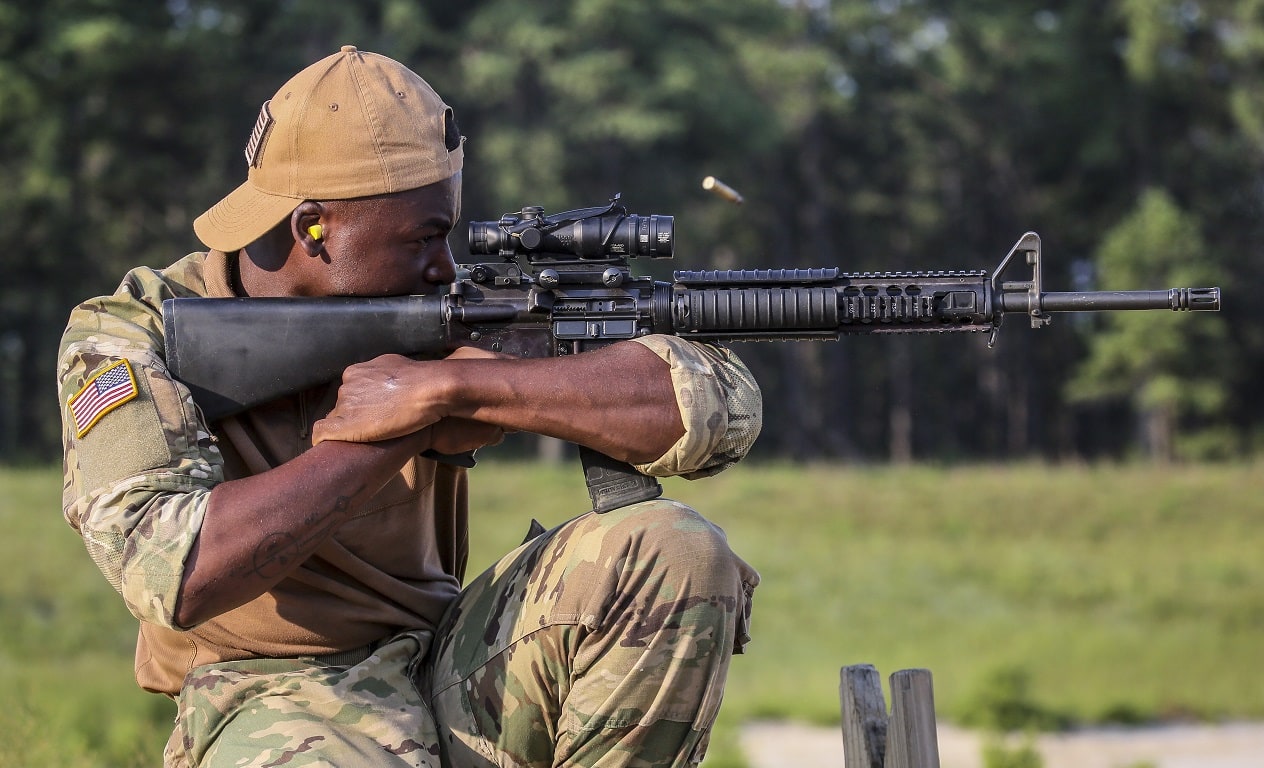
U.S. Army Private 1st Class Andre Matthews fires an M16A4 rifle during the Squad Designated Marksman Course instructed by the New Jersey Army National Guard’s 254th Regiment on Joint Base McGuire-Dix-Lakehurst, N.J., July 20, 2017. The course teaches the Squad Designated Marksman to directly support their squad with well-aimed shots at ranges slightly beyond the normal engagement distances for riflemen, up to 600 meters. The 254th Regiment is based out of the Regional Training Institute, National Guard Training Center, Sea Girt, N.J. (U.S. Air National Guard photo by Master Sgt. Matt Hecht/Released)
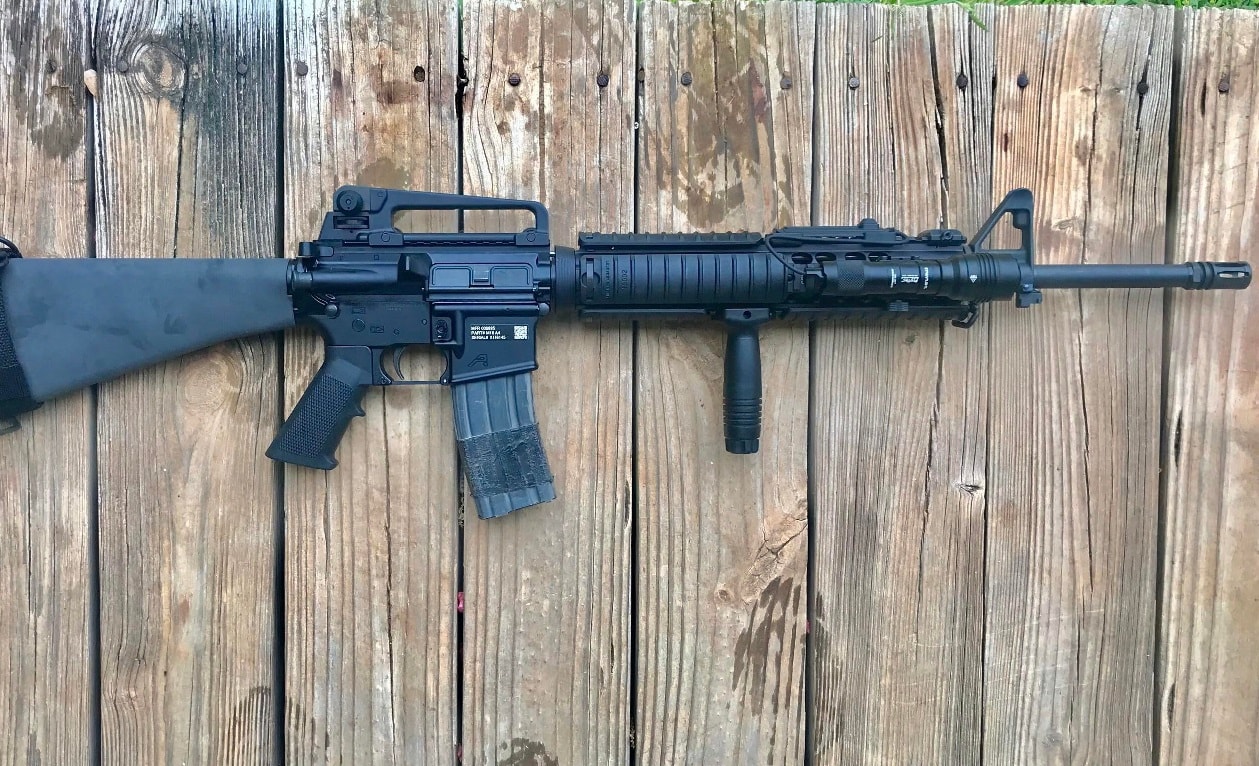
M16A4 Variant of M16 Rifle. Image Credit: Creative Commons.
According to Small Arms Review, the M16A4 officially replaced the M16A2 as standard issue on July 29, 1997.
The prototype carried the M16A2E4 designation before it was classified as a type.
Mechanically, it was still an A2 at heart.
The big change was on top. The A2’s fixed carry handle was gone, replaced by a flat-top upper receiver with a Mil-Std-1913 Picatinny rail borrowed from the M4 carbine program.
The carry handle, with its rear sight adjustable to 600 meters, became detachable.
That sounds minor.
It wasn’t.
For the first time, a standard-issue rifleman could mount an ACOG, a red dot, or night vision without a gunsmith or a jury-rigged mount.
Early rifles shipped with standard A2 round handguards. Later ones got the Knight’s Armament M5 Rail Adapter System, a quad rail that turned the fore-end into a mounting platform for lights, lasers, and grips. Colt built some.
However, FN Manufacturing in Columbia, South Carolina, produced the vast majority of military M16A4s.
A Marine Corps Rifle
The Army bought the M16A4, but the Marine Corps made it its own.
The Corps valued the rifle’s reliability and the 20-inch barrel’s ability to support marksmanship training out to 600 yards.
Every Marine is a rifleman, and the A4 was built for that creed.
FN America’s numbers tell the tale.
It fires 5.56x45mm NATO from a 1:7 twist barrel, runs 39.63 inches overall, and weighs 8.79 pounds with a loaded 30-round magazine.
FN lists effective range at 550 to 800 meters.
Fire modes are semi-automatic and three-round burst, a holdover from the A2.
That burst setting was never popular.
Task & Purpose noted that the burst mechanism produced a sloppy, inconsistent trigger pull, whereas modern training emphasizes aimed semi-automatic fire.
I was never the biggest fan of the three-round burst feature, preferring either fully automatic fire or semi, but others may disagree.
To me, it was an unnecessary fix for poor fire discipline.
The M16A4 and the M4 Carbine were first issued to select units in the mid-90s.
In the Special Forces, we were issued M4s around 1995.
The Marine Corps adopted the M16A4 in 1997. It was the primary weapon of Marines until 2015, when the Corps announced its switch to the M4.
The Length Is The Trade-Off In Tight Spaces
That 20-inch barrel squeezed every foot per second out of the 5.56 round.
However, it came with a fixed stock and nearly 40 inches of rifle.
Try climbing out of an MRAP, clearing a stairwell in an urban combat setting, or shouldering it over plate carriers and body armor, and you get the idea.
Task & Purpose called the fixed stock a holdover from Cold War-era design.
The grunts noticed.
When Commandant Gen. Robert Neller approved the M4 as the standard infantry weapon in October 2015, Marine Corps Times reported that testing showed the M4 outshot the A4 at all ranges out to 600 meters with new ammunition.
The M4 would be fielded across infantry battalions by September 30, 2016.
The reaction from the ranks was predictable. “I’ve never heard a grunt ever say he prefers the M16A4 over the M4,” one former sergeant told Marine Corps Times.
The A4 could still shoot. It just didn’t fit.
The M4 wasn’t the end of the line either. The Corps later bought just over 14,000 M27 Infantry Automatic Rifles for its infantrymen and combat engineers.
Why It Still Matters
So was the M16A4 a failure?
Not at all.
It brought optics to the standard infantry rifle, and every rail-equipped service rifle since owes something to that flat-top upper.
Task & Purpose notes the A4 still serves in training and non-combat units.
Say what you want about its length.
That’s beside the point. For nearly 20 years, it did the job in places where it was particularly well suited, in the hands of Marines who made it work.
The M16A4 was the last of a breed.
Debates will continue to rage on whether the A4 or the M4 was the better weapon.
And ultimately, it pretty much depends on the situation in which the weapon is being used.
About the Author: Steve Balestrieri
Steve Balestrieri is a National Security Columnist. He served as a US Army Special Forces NCO and Warrant Officer. In addition to writing on defense, he covers the NFL for PatsFans.com and is a member of the Pro Football Writers of America (PFWA). His work was regularly featured in many military publications.