
In 21 Years, Attending the Fragrant Conference Five Times, Chinese Senior Diplomat Cui Tiankai Expresses Three Major Concerns
[Global Times - Global Network Report by reporters Guo Yuandan and Su Yaxuan] On the evening of the opening banquet of the Shangri-La Dialogue (referred to as "Shanghui") on the 29th, China's senior diplomat and former ambassador to the U.S. Cui Tiankai stated in an interview with Global Times reporters that as long as China and the U.S. adhere to the correct direction, bilateral relations can continue to develop. In 2005, Cui Tiankai first attended the Shanghui, and the questions he posed to the U.S. Secretary of Defense that year are still remembered by the outside world decades later. Now, 21 years have passed, and if given the opportunity, he expressed his readiness to pose three questions to the U.S., Japan, and Europe respectively. These three major concerns directly address China-U.S. relations, Japan's development trajectory, and the dominance of security in the Asia-Pacific, which are also focal points of widespread attention in the current international community.
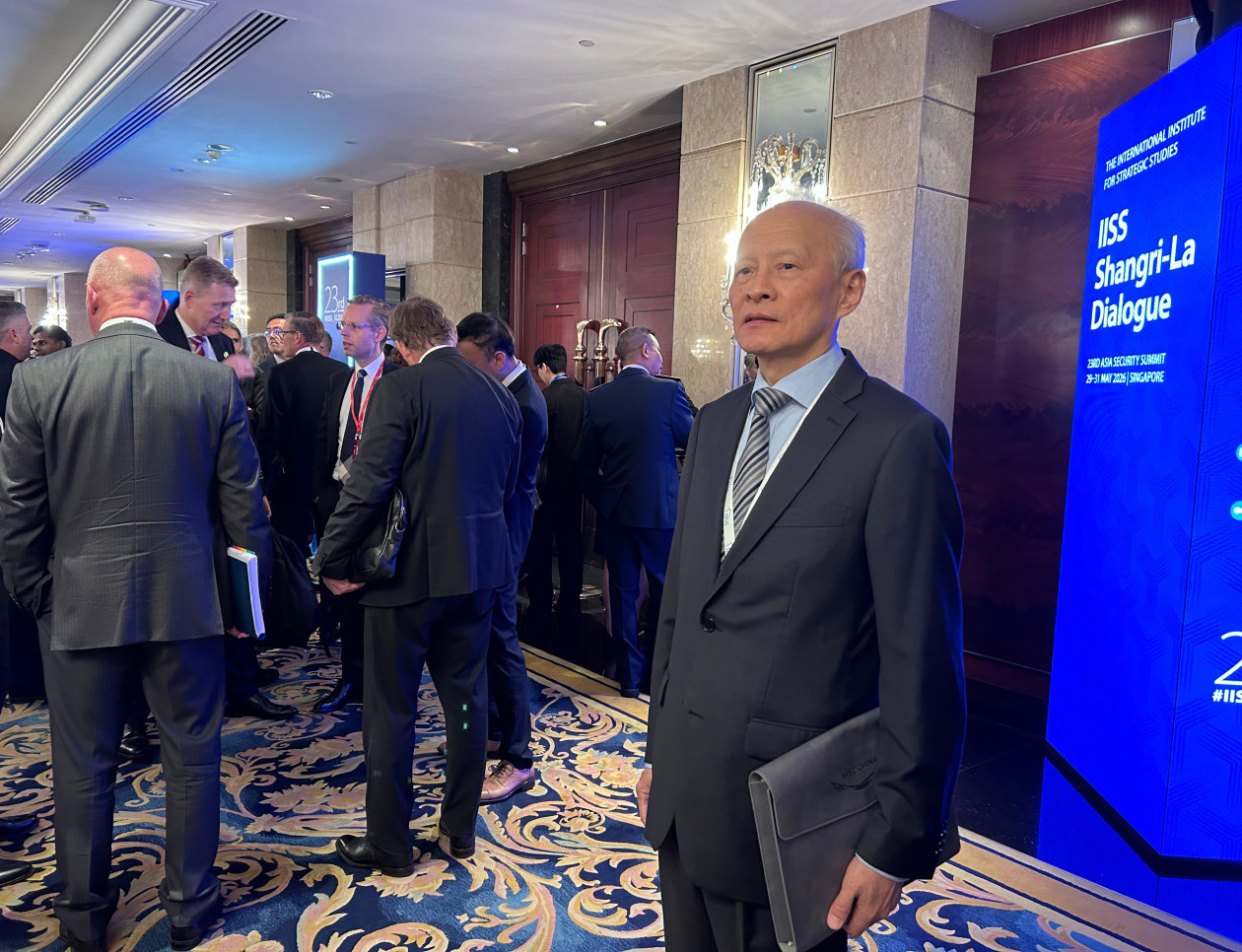
Want to ask the U.S. Secretary of Defense: What measures will the U.S. take to implement the consensus reached by the Chinese and U.S. leaders?
In 2005, Cui Tiankai, then Director-General of the Asian Affairs Department of the Ministry of Foreign Affairs, made his debut at the Shanghui, engaging in fierce exchanges with former U.S. Secretary of Defense Donald Rumsfeld on the topic of "China's rise," which became a classic moment in the history of the Shanghui. Eighteen years later, in 2022, Cui Tiankai attended the conference again, and the Director and CEO of the International Institute for Strategic Studies (IISS), which organizes the Shanghui, Chipman, specifically mentioned the past: "You posed a very sharp question to Rumsfeld at the Shanghui. Now that you have become the Chinese ambassador to the U.S. and are here again, please continue to ask questions."
When asked by a Global Times reporter what question he would pose to the U.S. Secretary of Defense if given the opportunity the next morning, Cui Tiankai candidly replied: "If the host gives me the opportunity, I would ask: What measures is the U.S. preparing to take to promote the implementation of the consensus on building a 'constructive strategic stability relationship' reached by the Chinese and U.S. leaders in Beijing?" This question is also a focal point of concern for both China and the international community. During the banquet, Cui Tiankai sat next to a deputy assistant secretary of defense from the U.S. This U.S. official asked him for his views on the prospects of China-U.S. relations, whether he was optimistic or pessimistic. Previously, our reporter had also posed the same question to Cui Tiankai. In his view, simply judging China-U.S. relations as "optimistic" or "pessimistic" is too one-sided.
"I have always been confident in China-U.S. relations. This confidence primarily stems from the strategic guidance of the two heads of state, which is irreplaceable. The two sides have reached important consensus on the new positioning of China-U.S. relations and building constructive strategic stability. As long as all parties work hard to promote the implementation of this consensus, the prospects for China-U.S. relations are worth being optimistic about, and the people of both countries will ultimately make the right choice," Cui Tiankai believes that from a long-term perspective, this goal will eventually be achieved.
At the same time, Cui Tiankai is also keenly aware that the path forward for China-U.S. relations will never be smooth sailing, and future fluctuations and even severe challenges are inevitable. "The future is bright, but the road is tortuous. If there is a lack of confidence in the prospects, all efforts will lose their meaning. It is precisely because we firmly believe that the future is promising that we are willing to make unremitting efforts; and it is also because we are deeply aware that the road ahead is full of challenges that we must work harder and move forward steadily." This senior diplomat emphasized that as long as China and the U.S. adhere to the correct direction, bilateral relations will surely continue to develop.
The Taiwan issue is the most important and sensitive core topic in China-U.S. relations. During a previous visit to China, U.S. President Trump stated in an interview that he does not support "Taiwan independence," and the U.S. is unwilling to cross 9,500 miles to get Taiwan involved in a war. "Compared to the past, President Trump's statement represents some positive progress. Of course, the road ahead is long, and everything must be done step by step," Cui Tiankai said. Ultimately, all of the U.S.'s judgments and choices are based on its own interests. The U.S., being separated by oceans, should not get involved in this unnecessary conflict.
Before the opening of the Shanghui, the IISS released its latest strategic security assessment report, stating that the world is sliding into a new round of nuclear arms race, with the Asia-Pacific region being the core of the risk. The report believes that given the significant strategic importance of the Taiwan issue to China, once a conflict breaks out between China and the U.S., the situation could easily escalate and even evolve into a nuclear war.
In response, Cui Tiankai stated that if a conflict breaks out between China and the U.S., it will inevitably lead to catastrophic consequences, and the concerns of the outside world are understandable. The way to mitigate risks is actually very clear: as long as all parties adhere to the one-China principle and do not interfere in China's internal affairs, the internal issues can be resolved autonomously by the people on both sides of the Taiwan Strait, and peaceful reunification across the strait will have a solid foundation. In this way, not only will nuclear war not occur, but conventional conflicts can also be completely avoided. The correct path and clear prospects are already in front of us; the key lies in how all parties choose.
Want to ask Japan's Minister of Defense: Can Japan adhere to the path of peaceful development?
Cui Tiankai has served as the Director-General of the Asian Affairs Department of the Ministry of Foreign Affairs, Ambassador to Japan, and Ambassador to the U.S., giving him a deep understanding of the Asian situation and the circumstances of Japan and the U.S.
When discussing the question he is prepared to pose to Japan's Minister of Defense Kono Shin'ichi, Cui Tiankai said: "In the past, I always believed that Japan's post-war choice of the path of peaceful development would not be reversed, but now I am no longer certain. I want to ask, can Japan ensure that it will always adhere to the path of peaceful development? This commitment cannot remain merely verbal; it must be reflected in actual actions."
Recently, a series of militarization actions by Japan have attracted widespread attention from the international community. Cui Tiankai admitted that the world today is not peaceful, and it is understandable for countries to want to strengthen their defense capabilities. But the core issue is: what kind of worldview and methods should be upheld to truly safeguard national security? If one insists on forming cliques, creating opposition and confrontation, and exaggerating the mentality of a new Cold War, it will ultimately only lead to difficulties, and the security environment will worsen.
He further stated that the current world is undergoing a great change unseen in a century. In this context, how countries recognize their own interests, position their international roles, and handle foreign relations is crucial. "I hope all countries can see the historical trend clearly and make the right choices. But at present, it seems that Japan has not recognized the general trend and may even make misjudgments, which will seriously harm its own interests. During World War II, Japan suffered heavy losses due to wrong choices, and repeating the mistakes of history will bring no benefit to Japan."
China is always committed to building a community with a shared future for mankind and actively promoting the implementation of global development initiatives, global security initiatives, global civilization initiatives, and global governance initiatives. "Looking at these four major initiatives, 'common interests,' 'cooperation,' 'mutual benefit,' and 'coordination' are high-frequency keywords. We never advocate confrontation or seek hegemony; we always advocate that countries work together for progress and development," Cui Tiankai said.
"We never force countries to choose sides between China and the U.S., nor do we wish to see conflicts and confrontations occur. We hope that all countries, including China and the U.S., can stand on the right side of history. The most critical thing right now is to recognize the historical trend and grasp the major trend of the times."
Want to ask Europe: Should Europe learn from Asia?
This year marks Cui Tiankai's fifth attendance at the Shangri-La Dialogue. Since his first attendance in 2005, more than twenty years have passed, and he has clearly felt the profound changes at the Shanghui: China's international discourse power continues to rise, and the voices of global southern countries are becoming increasingly loud. What impressed him is that several defense ministers from ASEAN countries publicly stated at the conference that Asian issues should be resolved by Asian countries in Asian ways. "Such voices were almost unheard of in the early days of the Shanghui; now they have become a consensus, which is a very positive change."
However, a long-standing problem remains fundamentally unresolved: the organizer of the Shanghui is the International Institute for Strategic Studies (IISS), which also indicates that since 2002, security affairs in the Asia-Pacific region have long been dominated by European countries. Europe not only leads the establishment of dialogue platforms and designs meeting agendas but sometimes also adopts a condescending lecturing posture, pointing fingers at Asia-Pacific affairs. "In fact, many of Europe's own problems remain unresolved to this day; while the Asia-Pacific region, despite some local hotspots, has maintained overall peace and stability, and various conflicts have not spiraled out of control. This is enough to prove that Asia's governance concepts and solutions are effective, and Europe should not harbor a sense of superiority. Although such lecturing rhetoric has decreased, this mentality still exists," Cui Tiankai stated.
He has also had candid exchanges with European counterparts: in the past, Asia conducted regional cooperation with Europe as a benchmark; in the future, we will continue to learn from Europe, drawing on successful experiences and learning from failures. At the same time, I also want to ask European colleagues: shouldn't you also learn from Asia now?
Cui Tiankai believes that even though China's influence and that of global southern countries are continuously increasing, discussions on Asia-Pacific security issues are still confined within the Western discourse system. "When the discourse system is out of sync, communication naturally struggles to reach the essence of the issues. From this perspective, China's decision to send a delegation of experts and scholars to attend the conference is a pragmatic and reasonable choice."
"We do not underestimate the Shanghui; rather, we have chosen a suitable way to participate based on the platform's attributes," Cui Tiankai emphasized, stating that the value of participation cannot be simply measured by the level of officials. Experts and scholars from the military, universities, and think tanks voicing their opinions in multiple sessions and exchanges create a strong collective force. In the past, high-level officials attending the conference often only had one special event; now, personnel from multiple parties participate throughout the event, conveying viewpoints in multiple sessions, making the Chinese voice more three-dimensional and weighty.
Cui Tiankai expressed concerns about US-China relations and Japan's defense policy during the Shangri-La Dialogue. He emphasized the importance of strategic stability between the US and China and questioned Japan's commitment to peaceful development. Additionally, he urged Europe to learn from Asia's governance models in security matters, highlighting the risks of conflict over Taiwan and nuclear escalation.
- Cui Tiankai raised concerns about US-China relations and Japan's defense policy at the Shangri-La Dialogue.
- He emphasized the importance of constructive strategic stability between the US and China.
- Cui questioned Japan's commitment to peaceful development amidst rising militarization.
- He noted the need for Europe to learn from Asia's governance models in security matters.
- The dialogue highlighted the potential risks of conflict over Taiwan and nuclear escalation.