

Summary and Key Points: The USS United States was a 65,000-ton aircraft carrier designed to launch nuclear bombers. Truman approved it in 1948, Newport News laid the keel on April 18, 1949, and Defense Secretary Louis Johnson canceled it five days later in a budget fight with the Air Force’s B-36. The Navy Secretary resigned, and the admirals took the fight to Congress; Truman relieved the CNO on Navy Day. The B-36 never dropped a bomb in anger.
65,000 Tons of Aircraft Carrier: Meet USS United States
When it comes to names for United States Navy warships, what’s a more patriotically obvious moniker than USS United States? Especially for an aircraft carrier, more specifically a “supercarrier,” the U.S. Navy’s primary power-projection tool of the U.S. Navy from the Cold War to the present day.
Yet the would-be supercarrier USS United States (CVA-58) never came to fruition…but it still made history by sparking what became known as the “Revolt of the Admirals.”
No, the Revolt of the Admirals wasn’t a military coup d’etat? So, what was it?
USS United States Initial Premise and Promise
Both the supercarrier concept and the resultant revolt had their roots in America’s victory in World War II…and the interservice rivalries that received an extra infusion of energy from that victory.
As noted by Naval History and Heritage Command (NHHC), “Thus, the Navy and the AAF held different views on lessons learned from World War II…The Army Air Force believed World War II demonstrated it needed sole control over the air.
At the same time, the Navy argued that the Pacific campaigns substantiated the need for its own air component.”
In 1947, the Army Air Forces officially became the separate, independent branch of service we know as the U.S. Air Force, and that same year, the National Security Act of 1947 formally established the Joint Chiefs of Staff (JCS) and the position of Secretary of Defense (SECDEF).
The brass of the newly independent USAF saw the wave of the future in the Convair B-36 Peacemaker, a gargantuan strategic bomber with 10 engines and a 230-foot wingspan; that wingspan gave the Peacemaker a still-unbroken record as the longest wingspan of any military aircraft ever made.
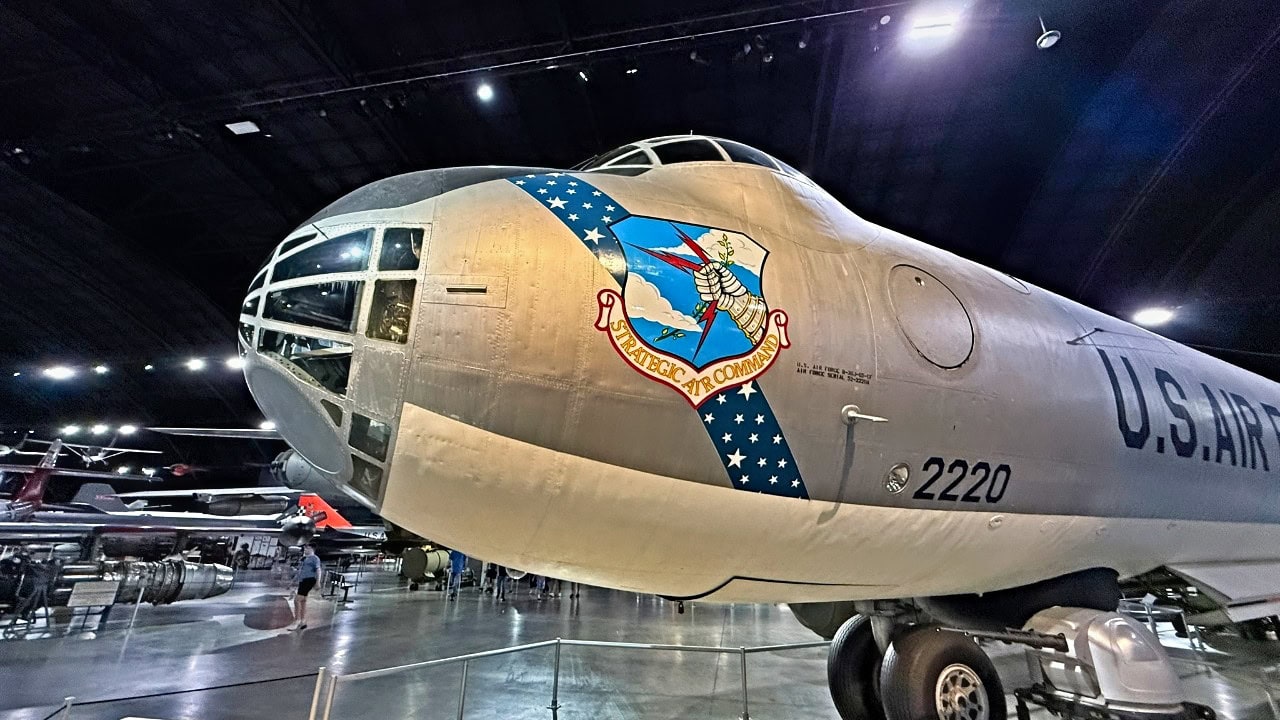
B-36 19FortyFive museum photo.
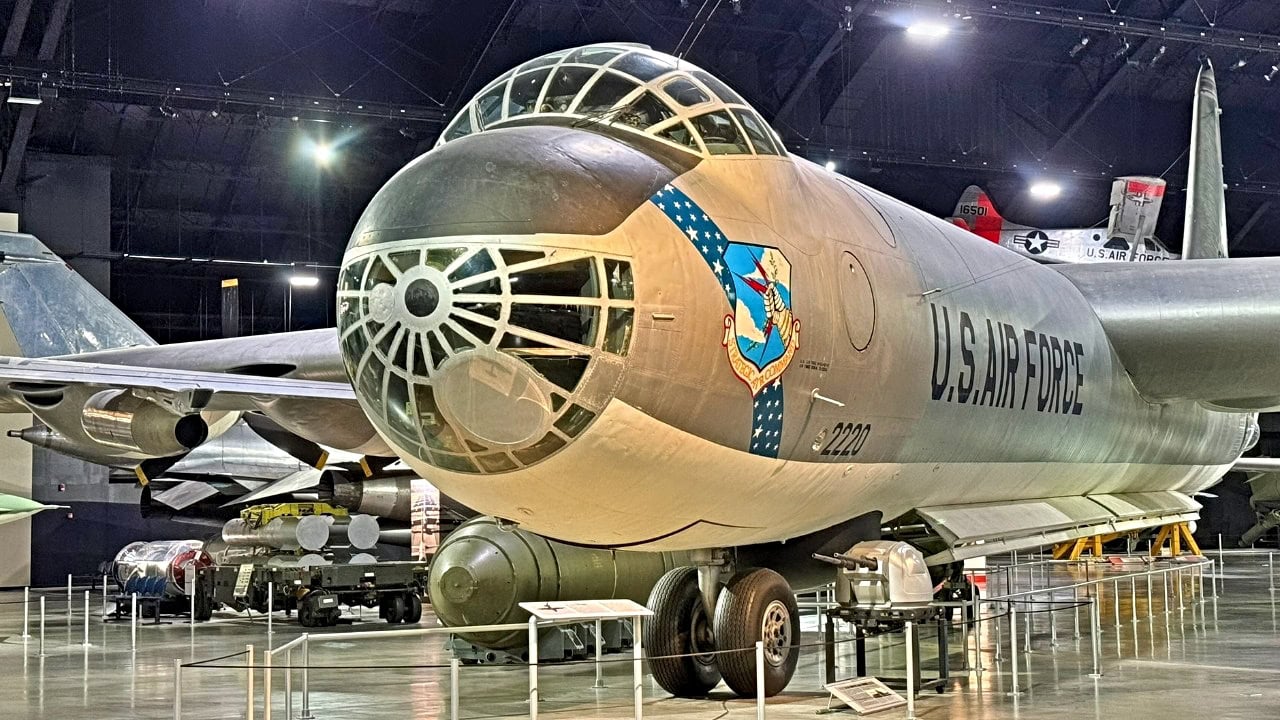
B-36. 19FortyFive.com image.
Meanwhile, the USN brass saw the wave of the future in CVA-58, which would have displaced 65,000 tons and had a hull length over 1,000 feet; these specifications were necessary to be able to launch and recover the large aircraft of 100,000 pounds required to carry early nuclear weapons, which weighed as much as five tons.
Indeed, on 29 July 1948, then-President Harry S. Truman approved construction of the supercarrier, making it the largest warship the U.S. Navy had ordered up to that point. On 18 April 1949, dockyard workers in Newport News, Virginia, laid the keel for the USS United States.
So far so good, right?
The Spark for the Revolt
However, in the words of former ESPN college football analyst Lee Corso put it, “Not so fast, my friend.” Just five days after CVA-58’s keel was laid, newly minted SECDEF Louis A. Johnson canceled the would-be mighty warship’s construction, prompting Secretary of the Navy (SECNAV) John L. Sullivan to resign in protest shortly thereafter.
The USN admirals weren’t going to take that snub lying down.
Instead, six months after SECDEF Johnson abruptly canceled the order, they took the fight to Congress. Of course, it wasn’t just the admirals; a few good captains and commanders helped, too.
The opening blow of that fight was an “anonymous document” circulated in Washington calling the B-36 a “billion-dollar blunder” and pointing out that Johnson had previously been connected to Convair, the bomber’s manufacturer.
The “anonymous” author was soon identified as Cedric R. Worth, a former Navy commander and Silver Star recipient who worked as a civilian assistant to the Under Secretary of the Navy. CDR Worth was dismissed for his troubles after a naval court of inquiry.
From 6 to 17 October 1949, the House Armed Services Committee (HASC), chaired by Rep. Carl Vinson—who himself eventually had a supercarrier (CVN-70) named in his honor— held hearings on the B-36 and on unification of the services.
CAPT John G. Crommelin had already gone public, telling reporters that unification was a mistake and that the Navy was being deliberately undermined.
The Chief of Naval Operations (CNO), ADM Louis E. Denfeld, backed his officers in his own testimony. Like CDR Worth, Crommelin and Denfeld paid a political price for speaking their minds; on 27 October 1949—Navy Day no less, adding insult to injury—Harry Truman relieved ADM Denfeld, and CAPT Crommelin was later forced to retire.
However, the latter did manage to attain the rank of RADM. To its credit, the HASC condemned Denfeld’s removal as reprisal for his testimony and noted Congress’s role in its report.
A cleverly titled October 2025 article on the U.S. Naval Institute’s (USNI) Naval History website calls Louis Denfeld “A Revolting Admiral.”
Oh, the Irony…
The B-36 won the budget battle against CVA-58 but eventually lost the proverbial war: it never dropped a bomb or fired a shot in anger during a literal war, and it was retired in 1959 after just 10 years of operational service.
What’s more, Convair is sadly long defunct.
Four of the behemoth bombers are preserved for posterity in museums today, including the National Museum of the United States Air Force at Wright-Patterson AFB, Ohio.
The Peacemaker also gained a bit of cinematic fame thanks to the 1955 movie “Strategic Air Command,” starring the late, great Jimmy Stewart; his protagonist, Lt. Col. Robert “Dutch” Holland, loosely mirrors the real-life military life of Brig. Gen. (USAF, Ret.) James Maitland “Jimmy” Stewart.
Meanwhile, as we noted, the supercarrier concept is still going strong, as the platform has fought in more conflicts than you can shake a stick at; it first earned that vindication in the Korean War.
Granted, quite a few pundits out there claim that the “flattop” is now obsolescent in this day & age of drone warfare and ship-killing missiles, but that’s a debate for another time.
Postscript: What’s In a Name?
The USN almost did end up with a supercarrier named USS United States after all, and a Nimitz-class carrier to boot. Instead, CVN-75, the eighth ship of the class, was christened in 1995, ironically enough, as the USS Harry S. Truman.
About the Author: Christian D. Orr
Christian D. Orr is a Senior Defense Editor. He is a former Air Force Security Forces officer, Federal law enforcement officer, and private military contractor (with assignments worked in Iraq, the United Arab Emirates, Kosovo, Japan, Germany, and the Pentagon). Chris holds a B.A. in International Relations from the University of Southern California (USC) and an M.A. in Intelligence Studies (with a concentration in Terrorism Studies) from American Military University (AMU). He is also the author of “Five Decades of a Fabulous Firearm: Celebrating the 50th Anniversary of the Beretta 92 Pistol Series,” whose second edition was recently published.