
In Mali, FLA and JNIM tighten the noose around Anefis — 50 soldiers lost and Moscow exposed
 Marie Dubois
In Mali, FLA and JNIM tighten the noose around Anefis — 50 soldiers lost and Moscow exposed
On July 18, on the dusty track between Gao, Tabankort, and Anefis, a convoy of the Malian Armed Forces and the Russian Africa Corps was ambushed. Al Jazeera reports at least 50 Malian soldiers killed near Anefis; France 24, citing the Associated Press, reports soldiers killed or captured in numbers, vehicles destroyed, and others seized. Bamako has confirmed the attack without providing a precise toll, merely announcing an ongoing counterattack.
This silence is not insignificant. In northern Mali, a convoy that no longer passes is not just a tactical loss. It is a road that closes, a camp that begins to count its ammunition, a capital that discovers the official map no longer matches the terrain.
The Gao-Anefis road becomes the real battlefield
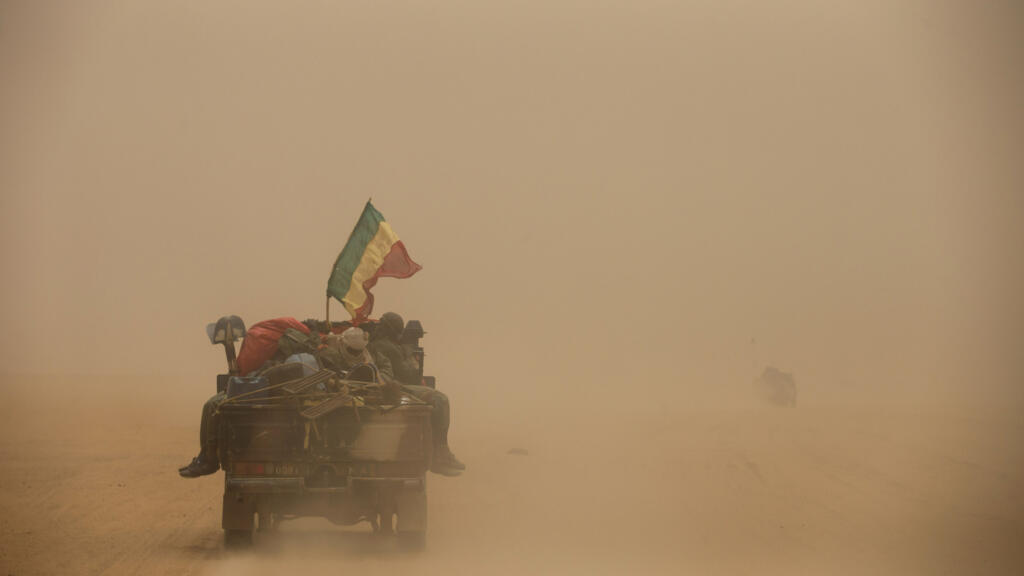
Anefis is not a large city. Its importance lies in its position: a stronghold on the axis connecting Gao to Kidal, in an area where distances wear down men as much as the enemy. Between Gao and Anefis, the road crosses an open space, difficult to control, ideal for long-range observation, improvised mines, and quick withdrawals to fallback areas.
On the ground, holding Anefis without controlling the road that supplies it is like occupying an island. One can plant a flag, post a garrison, bring in reinforcements in fits and starts. But if every movement requires heavy escort, air cover, and armored vehicles, the adversary has already shifted the center of gravity. They are no longer just seeking to conquer the position. They are looking to make its defense too costly.
Deutsche Welle, citing Reuters and AFP, indicates that another convoy was transporting more than 200 Russian fighters and over 100 Malian soldiers to Anefis when it was attacked near Tabankort. The accuracy of the figures should be handled with caution, as rebel sources have an interest in amplifying their successes. However, the repetition of ambushes is confirmed by several channels.
A FLA-JNIM alliance without ideological illusion
The most serious fact is not just the toll. It is the signature. The ambush was claimed separately by the Azawad Liberation Front (FLA), a predominantly Tuareg separatist coalition, and by the Support Group for Islam and Muslims (JNIM), affiliated with Al-Qaeda. These two armed groups do not share the same political project. One speaks of Azawad, territory, autonomy, or independence. The other speaks of Islamist governance and regional jihad.
Yet, they can fight together when the immediate enemy is the same: the Malian army and its Russian partners. Héni Nsaibia, an ACLED analyst cited by Al Jazeera, summarizes this logic by talking about force multipliers. That is exactly what it is. The FLA brings its detailed knowledge of the terrain, local networks, and routes. The JNIM brings broader experience in attrition warfare, combat propaganda, and simultaneous action across multiple theaters.
This cooperation should not be romanticized. It can remain tactical, fragile, reversible. But in a war of roads and isolated posts, it is not necessary for an alliance to be ideologically solid to be militarily dangerous. It is enough for it to function for a few weeks in the right place.
The Russian promise stumbles on Sahelian logistics
Since the replacement of Wagner by the Africa Corps as the main Russian military instrument in Mali, Bamako has gained in strike capabilities, aerial intelligence, and direct support. Drones and aviation can punish identified groups. They can also save a garrison on the brink of collapse. But they cannot, alone, transform a road of several hundred kilometers into a secured space.
This is the old lesson of the Sahel. The enemy does not need to dominate the entire region; it is enough for them to choose the moment when a column stretches, when dust reduces visibility, when the lead and rear vehicles lose contact. A successful ambush then forces the army to slow down, concentrate its resources, and announce counter-operations. Meanwhile, armed groups shift the pressure elsewhere.
Russia can harden the Malian army in combat. It does not replace the network that MINUSMA still partially provided: observation, presence, local contact channels, logistics, early warning. Paris has long overestimated what Barkhane could resolve through mobility and precision. Moscow risks making the same mistake today, with less political restraint and fewer civilian intermediaries.
The UN warning comes at a bad time for Bamako
On July 28, before the Security Council, Leonardo Santos Simão, head of UNOWAS, warned that terrorism in West Africa is changing its face. He cited coordinated attacks, the increasing use of drones, sophisticated communications, cryptocurrencies, and links with criminal networks. In his assessment, Mali is already under pressure: simultaneous attacks on April 25 against Bamako, Kati, Gao, Kidal, and Mopti; persistent fighting in the north; partial road blockages; sabotage of power lines.
This UN reading confirms an evolution that military personnel have seen for years in their operational maps: armed groups no longer reason solely in terms of sanctuaries. They reason in terms of flows. Fuel, food, ammunition, money, rumors, population movements. Those who disrupt these flows can weaken a better-equipped force without having to defeat it everywhere.
For the Alliance of Sahel States, this is a brutal test. Mali, Niger, and Burkina Faso claim to be taking back control of their security after breaking with Paris and ECOWAS. But the armed groups do not respect either the new diplomatic architectures or the sovereignist statements. If Gao-Anefis becomes a model, other axes may be targeted: towards Ménaka, towards Liptako, towards the northern gates of Burkina Faso.
What to watch for now
Three indicators will tell whether the ambush at Anefis remains a local shock or becomes a turning point. The first is the frequency of Malian and Russian convoys heading north. A visible decrease would mean that losses have altered the logistical calculation. The second is the fate of prisoners and captured equipment, as video propaganda can transform a tactical victory into a recruitment tool. The third is Bamako's ability to sustainably reopen roads without depleting other sectors.
I do not rule out a violent reaction from the Africa Corps in the coming days, likely through airstrikes or drones against presumed regrouping areas. But from experience, striking after the ambush does not solve the problem of the next track. The operational warning is simple: if Bamako does not regain the initiative on the axes, Anefis will not just be a battle around a camp. It will be the beginning of a war of attrition against the entire northern Malian depth.
On July 18, a convoy of Malian armed forces and Russian Africa Corps was ambushed near Anefis, resulting in at least 50 Malian soldiers killed. The ambush was claimed by the FLA and JNIM groups, highlighting a tactical alliance against the Malian army. Bamako confirmed the attack and is currently conducting a counterattack, as the Gao-Anefis route becomes a critical battleground.
- At least 50 Malian soldiers killed in an ambush near Anefis.
- A convoy of over 200 Russian fighters and 100 Malian soldiers was attacked.
- The ambush was claimed by both FLA and JNIM groups.
- Bamako confirmed the attack and announced a counterattack.
- The Gao-Anefis route is becoming increasingly dangerous for military convoys.