
Indonesia's Passing Exercise Just Normalized Beijing's Claim East of Taiwan
 Marcus Chen
Indonesia's Passing Exercise Just Normalized Beijing's Claim East of Taiwan
On Tuesday evening, China's Ministry of National Defense announced that a PLAN frigate and an Indonesian Navy frigate will hold a "navigation exercise" in waters east of Taiwan in mid-August. It is the first time either navy has done this there. The tactical content is close to nothing. The political content is the whole story.
What the Drill Actually Is
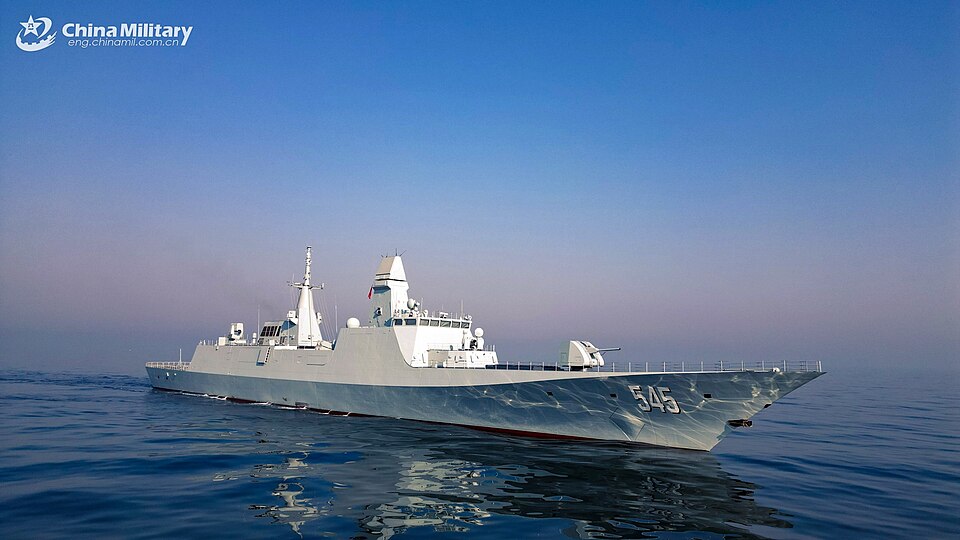
The Chinese ship is the Type 054A frigate Honghe — a 4,000-ton Jiangkai II-class hull with 32 VLS cells for HQ-16 SAMs and a YJ-83 anti-ship battery. The Indonesian ship is KRI I Gusti Ngurah Rai, a Martadinata-class frigate (the Damen SIGMA 10514 design, about 2,365 tons, 12 VL MICA cells). The drill, per Beijing's announcement, consists of communications training and replenishment at sea. No live fire. No ASW. No shared tactical data.
Anyone who has served on a destroyer knows what that list means: it is the lowest bar of naval interoperability. Comms and UNREP are what you practice with a navy you want a relationship with but do not yet trust. That is precisely the point. Replenishment at sea is also the evolution that decides whether a task group can stay on station — it is where logistics meets endurance, and east of Taiwan is exactly where Beijing needs endurance most. The island's eastern approaches are its back door: the side where Taiwan's submarine force shelters and where any US reinforcement would flow. A 4,000-ton frigate practicing underway replenishment there with a foreign partner is a sustainment rehearsal for operations Taipei and Washington both consider their lane.
Location Over Tactics
China has been layering presence east of Taiwan all year. Coast Guard patrols began in June, framed as "routine law enforcement." Research vessels have been pressing into Taiwan's EEZ. Last year's "Justice Mission 2025" swept every axis around the island, including the east. Now the PLAN adds the one layer its unilateral operations could never produce: a foreign navy's hull, voluntarily present in those waters.
That is why PLA-affiliated commentators are calling the drill "great significance" and arguing that a foreign warship's participation proves China's sovereign rights over the EEZ, continental shelf and territorial sea east of Taiwan. The legal claim was not established by the drill, of course — it is asserted by it. But Beijing does not need the claim to be legally accepted. It needs it to look normal.
Jakarta's Arithmetic
"The exercises were not intended for war fighting, but were merely passing exercises," a spokesman for the Indonesian Navy said — consistent with Indonesia's non-aligned foreign policy.
Here is the detail that makes the "passing exercise" framing so convenient: KRI I Gusti Ngurah Rai is returning from Japan, where it joined the GARSAMEX exercise with the Japan Maritime Self-Defense Force in Sagami Bay. One deployment, two drills — one with Japan, one with China, on the way home. That is Jakarta's free-and-active doctrine in a single voyage, and it is not hypocrisy; it is a hedge.
But the two drills are not symmetric. For Japan, Indonesia is a security partner. For China, Indonesia is a jurisdictional witness. Jakarta gets professionalization, equipment modernization conversations and a working relationship that does not disturb its One-China policy. Beijing gets something no amount of sorties could buy: an ASEAN navy drilling with the PLAN east of Taiwan, on the record, with a partner who will later explain it was "just passing through."
Indonesia has real skin in the Taiwan question — more than 335,000 Indonesian migrant workers on the island and US$11.27 billion in bilateral trade in 2025, with no formal diplomatic relations. The human and economic stake is enormous. The political price of one frigate's fuel hose is, for now, invisible. That is how precedents get set: not with a bang, but with a routine that everyone politely declines to call what it is.
Why the Timing Matters
Beijing announced the drill hours before US Under Secretary of Defense for Policy Elbridge Colby sat down with Indonesia's defense minister during his Southeast Asia tour. The message was aimed past Taipei, at Jakarta and Washington simultaneously: China can hold Southeast Asian partners closer than the United States can, and it will do so in the one waterway the US considers its own backyard. Taiwan's Mainland Affairs Council called the exercise a "military provocation" and accused Beijing of "exercises in name, expansion in reality." For once, the official statement was precisely accurate.
The Precedent Problem
The obvious objection is that this is two frigates doing radio checks and a fuel transfer — navies do this every day, and one drill changes nothing. That objection is true and irrelevant. The first foreign-navy drill east of Taiwan is valuable to Beijing precisely because it is minimal: the less tactically meaningful the drill, the harder it is to call it a threat, and the easier the next one becomes. Two ships become four. Communications become data links. A "passing exercise" becomes an annual event. None of those steps will look like escalation at the time.
Taipei has asked Jakarta for details, and will get none that matter. Washington will note the drill and move on. That is the outcome Beijing designed: an arrangement so low-key that objecting to it makes you look like the destabilizing party.
The math is uncomfortable. Indonesia got a professional training event and kept its options open. China got a foreign warship east of Taiwan and a precedent it will cite for a decade. The drill was never about what those two frigates could learn from each other. It was about what the rest of the region learns to accept.
China's Ministry of National Defense announced a navigation exercise involving a PLAN frigate and an Indonesian Navy frigate east of Taiwan in mid-August. The exercise, which includes communications training and replenishment at sea, marks the first naval collaboration in this area and is viewed as a means for China to assert its claims over the region. Indonesia's participation is framed as a passing exercise, reflecting its non-aligned foreign policy while engaging with both China and Japan.
- China's Ministry of National Defense announced a navigation exercise with Indonesia's Navy east of Taiwan.
- The exercise involves a Type 054A frigate from China and a Martadinata-class frigate from Indonesia.
- The drill includes communications training and replenishment at sea, with no live fire or ASW.
- The exercise is seen as a normalization of China's claims over the waters east of Taiwan.
- Indonesia's participation is framed as a passing exercise, consistent with its non-aligned policy.