
Iran Launches Super Heavy Missile Revenge, US Says No Agreements Will Be Reached, UN Warns Situation May Spiral Out of Control
The military strikes by the United States and Israel against Iran entered their eighth day on March 7. In the past 24 hours, the conflict has continued to escalate. The Israeli military announced the destruction of an underground bunker used by Iran's late Supreme Leader Khamenei, while Iran retaliated with heavy missiles for the students who lost their lives in the attacks, launching a large-scale assault with a new generation of missiles targeting U.S. aircraft carriers and American military bases in multiple countries in the Middle East.
The impact of the Middle East crisis continues to spill over, with the number of refugees in affected areas reaching 25 million. United Nations Secretary-General Guterres warned that the situation in the Middle East "could spiral out of control."
Escalation of Mutual Attacks
Israeli military destroys bunker used by Khamenei
The Israeli military stated on the 6th that in the morning, the Israeli Air Force destroyed the underground bunker used by Iran's late Supreme Leader Khamenei, with about 50 aircraft dropping approximately 100 bombs on the bunker. The Israeli military claimed that this underground bunker was an emergency shelter used by Khamenei to command the war, and after Khamenei's death, this area continued to be used by senior members of the Iranian regime.
Iran launches heavy missiles for the students who lost their lives
The Iranian Islamic Revolutionary Guard Corps announced on the 6th that during the 22nd round of Operation "Real Commitment 4," Iran launched the "Khoramshahr-4" long-range ballistic missile and the "Fattah" hypersonic missile, targeting U.S. and Israeli "targets from the Persian Gulf to Tel Aviv," aiming to avenge the 165 victims of the Iranian girls' primary school who were killed in airstrikes.
The announcement stated that in this round of powerful strikes, the heavy "Khoramshahr-4" missile, carrying a 2-ton warhead and traveling at speeds exceeding Mach 14, was also fired at the enemy. U.S. military bases in Gulf countries, the central Israeli city of Tel Aviv, Israel's largest airport Ben Gurion International Airport near Tel Aviv, and the military center in Haifa, northern Israel, were all struck by Iran's new generation of missiles.
Iran destroys U.S. military radars in three Middle Eastern countries
Another attack on the USS Lincoln
The Iranian military announced on the 6th local time that starting from early that morning, the Iranian Navy launched a massive drone attack on U.S. military assembly points and bases in Abu Dhabi's artificial islands in the UAE and the Kuwaiti Biling military camp, while also attacking radar facilities at the Israeli military base in Sdot Yam.
The Iranian Islamic Revolutionary Guard Corps launched multiple groups of missiles and drones, destroying the U.S. "THAAD" missile defense system radars located in the UAE and Jordan, as well as the U.S. FPS-132 radar in Qatar. The Iranian Army and Navy missile systems fired a coastal-to-sea missile at the U.S. aircraft carrier USS Lincoln.
The attacks have resulted in 1,332 Iranian deaths
Iran's permanent representative to the United Nations, Iravani, stated that according to the latest data from the Iranian Red Crescent Society, the attacks by the U.S. and Israel on Iran have resulted in 1,332 Iranian deaths. Since the escalation of the situation, 3,643 civilian facilities in Iran have been damaged, including 3,090 residential buildings and 528 commercial and service facilities.
U.S. Maximum Pressure
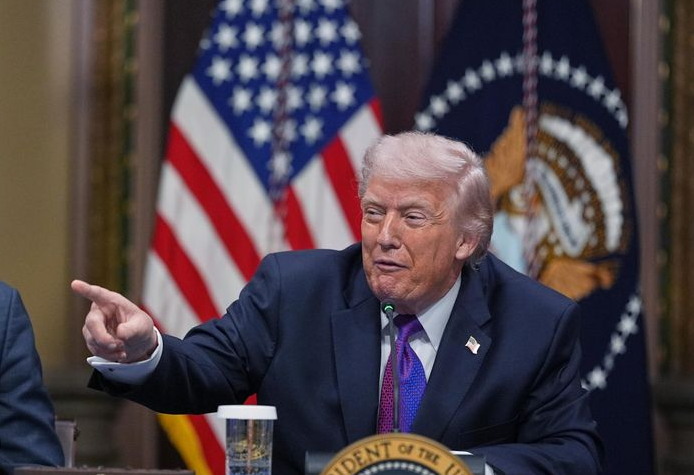
U.S. President Trump reiterated a tough stance on U.S. military actions against Iran on the 6th, declaring that "no agreement will be reached with Iran unless it surrenders unconditionally." He also stated that the U.S. "and many of its allies" want to "make Iran great again!"
Additionally, whether the U.S. will send ground troops to Iran is one of the focal points of public concern. U.S. President Trump stated on the 5th Eastern Time that considering sending ground troops to Iran at this stage is "a waste of time," claiming that Iran "has lost its navy, lost everything," and that the pace and intensity of U.S. strikes on Iran "will continue." In response, Iranian Foreign Minister Amir-Abdollahian stated in an interview on the 5th that Iran is prepared to respond to a U.S. ground invasion.
After Khamenei was attacked and killed, Iran established a new three-member institution to handle national affairs, but a new Supreme Leader has not yet been selected. Trump threatened that if Iran produces a new leader who "continues Khamenei's policies," it would force the U.S. to "return to war within five years." On the same day, Iranian Foreign Minister Amir-Abdollahian stated in an exclusive interview that "this is entirely a matter for the Iranian people, and no one has the right to interfere."
Thousands dead and injured in Lebanon
The Israeli military's dual operations in Iran and Lebanon have led to a continued escalation of the regional situation. The Israel Defense Forces launched multiple airstrikes on the southern suburbs of Beirut, Lebanon, on the 6th local time, targeting areas near the Iranian embassy in Lebanon.
According to the Lebanese Ministry of Public Health's emergency action center, from the early morning of March 2 to the evening of the 6th, Israeli attacks have resulted in 217 deaths and 798 injuries in Lebanon.
Israel has also reported injuries among its personnel. The Israel Defense Forces stated that earlier on the 6th, Hezbollah fired rockets into northern Israel, hitting an IDF position near the Lebanese border and injuring eight IDF soldiers. The son of Israeli Finance Minister Smotrich was also lightly injured in this rocket attack.
U.S. and Israel's long-planned conspiracy exposed
Israeli Defense Minister claims Khamenei was targeted as early as last November
Israeli Defense Minister Katz recently stated in a media interview that as early as last November, Israel had already included Iran's Supreme Leader Khamenei in its list of targets. The initial strike plan was set for mid-year, around June. However, as the situation rapidly developed, this plan was ultimately moved forward.
U.S. and Israel reportedly plan to support Kurdish forces to invade Iran
Recent reports indicate that the U.S. and Israel are planning to support Kurdish armed forces in Iran and Iraq to conduct ground operations in Iran to undermine the Iranian regime.
According to U.S. sources, President Trump has spoken with Kurdish leaders in Iraq and the leaders of the "Iranian Kurdistan Democratic Party" within Iraq after the war began, promising extensive air cover and other support to help "anti-government Iranian Kurds occupy parts of western Iran."
Additionally, a senior officer from the Israel Defense Forces revealed that the Israeli military is conducting airstrikes on military and police targets in the Kurdish region of northwestern Iran, near Iraq, to clear obstacles for the Kurdish armed forces.
Ahmadian, a representative of the Supreme Leader to the National Defense Council, warned on the 6th that if any Kurdish armed forces cross into Iran, all facilities in the Kurdish region will become targets for strikes.
The Middle East crisis continues to spill over
On the 6th, United Nations Secretary-General Guterres issued a statement warning that the situation in the Middle East "could spiral out of control," calling on relevant parties to "stop fighting and engage in serious diplomatic negotiations."
The head of the UNHCR's emergency situations and project support division, Ito Rei, stated on the 6th that the escalating crisis in the Middle East has constituted a "major humanitarian emergency." Continuous attacks have triggered population movements in Iran, neighboring countries, and the broader region. The number of refugees in affected areas has reached 25 million.
The U.S. and Israel's military strikes against Iran have caused the conflict to spill over, shaking global markets. The Director of the International Energy Agency, Fatih Birol, stated on the 6th that the logistics disruptions caused by the conflict in the Middle East are posing challenges to many countries, but oil supplies in the global market remain sufficient. European Central Bank President Lagarde emphasized that the global economy is facing higher risks. She stated that the key characteristic of the current moment is not just the rising risks, but that we are moving from a world where risks can be assessed and modeled into a world that is truly filled with uncertainty.
Reporters丨Li Jiannan, Zhang Zhuoya, Zhu Lei, Yang Yuan, Cao Jian
Israeli airstrikes destroyed an underground bunker in Tehran used by former leader Khamenei on March 6, 2023. In retaliation, Iran launched heavy missile strikes, including Khorramshahr-4 and Fattah missiles, targeting U.S. military bases and Israeli cities. The conflict has resulted in 1332 Iranian casualties and has displaced 25 million refugees across the region. U.S. President Trump reiterated a hardline stance against Iran, stating no agreements will be made unless they surrender unconditionally.
- Israeli airstrikes destroyed an underground bunker used by former Iranian leader Khamenei.
- Iran launched heavy missile strikes in retaliation, targeting U.S. and Israeli locations.
- 1332 Iranian casualties reported due to U.S. and Israeli attacks.
- The UN reports 25 million refugees affected by the ongoing conflict in the Middle East.
- U.S. President Trump stated there will be no agreements with Iran unless they surrender unconditionally.