

The State of Nevada proudly boasts the motto of “Battle Born,” so it’s poetically apt that a United States Navy warship named in honor of the state—that being the battleship USS Nevada (BB-36)—would participate in the battle that “birthed” America’s entry into World War II, i.e., the Imperial Japanese Navy (IJN) raid on Pearl Harbor on December 7, 1941. The “Battle Born” BB-36 refused to die at Pearl Harbor or in any other battle she fought in. Heck, for that matter, after the war ended, she stubbornly refused to die easily even after being struck by an atomic bomb.
Now we take a look at USS Nevada’s remarkable, hardscrabble history.
WWII USS Nevada (BB-36) Initial History, Premise, and Vital Stats
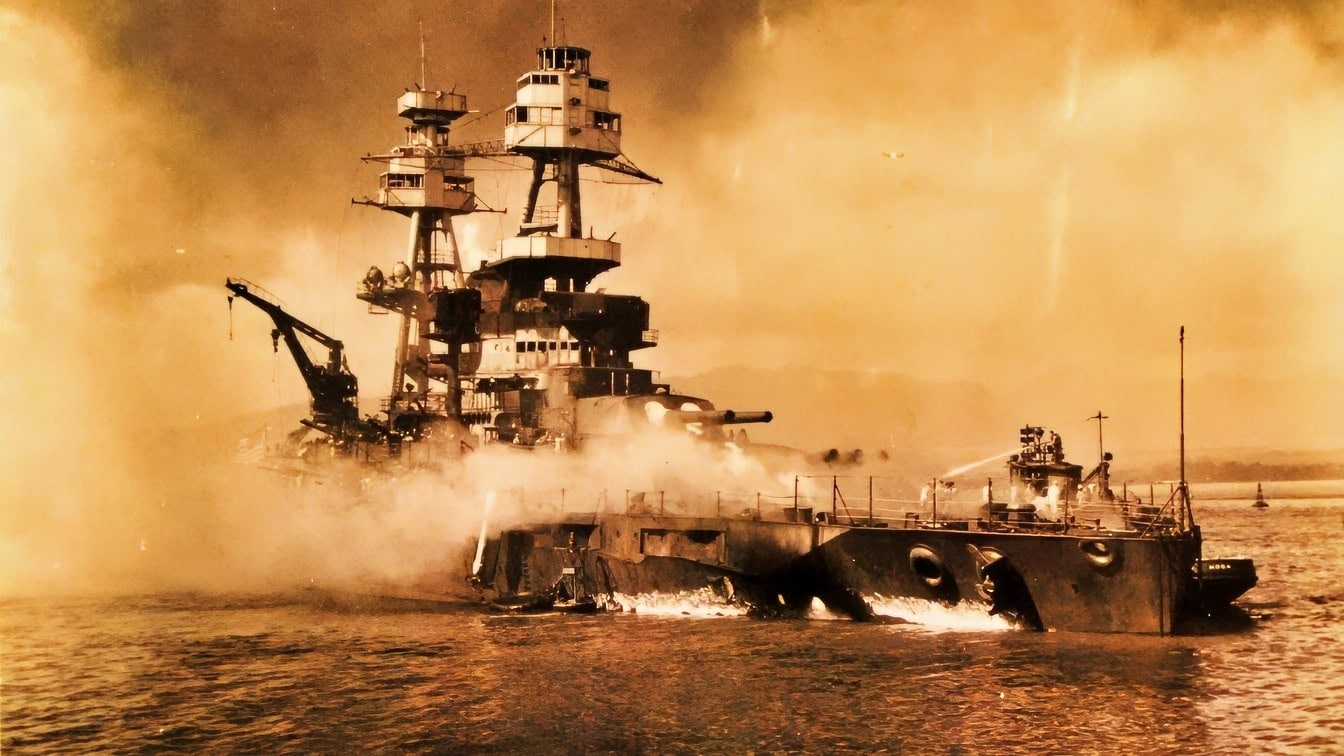
USS Nevada Creative Commons Image
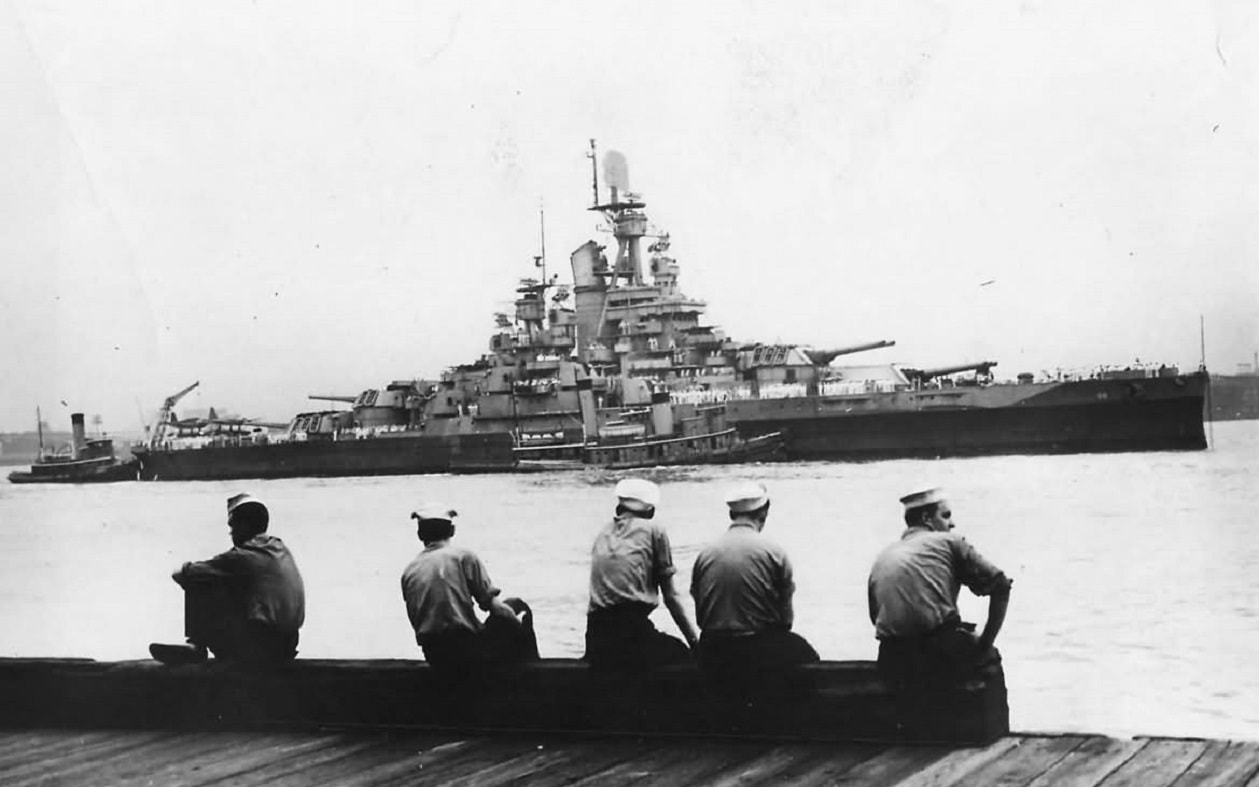
Battleship USS Nevada. Image: Creative Commons.
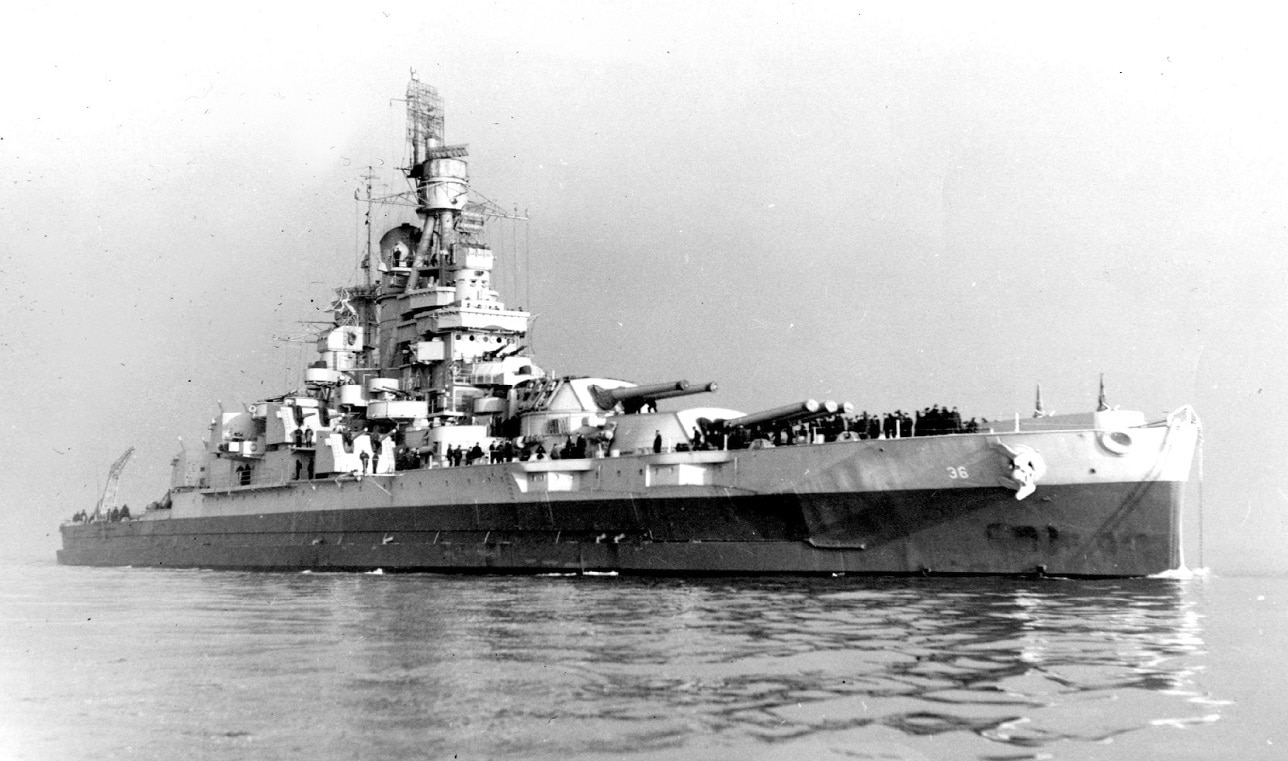
USS Nevada. Image Credit: Creative Commons.
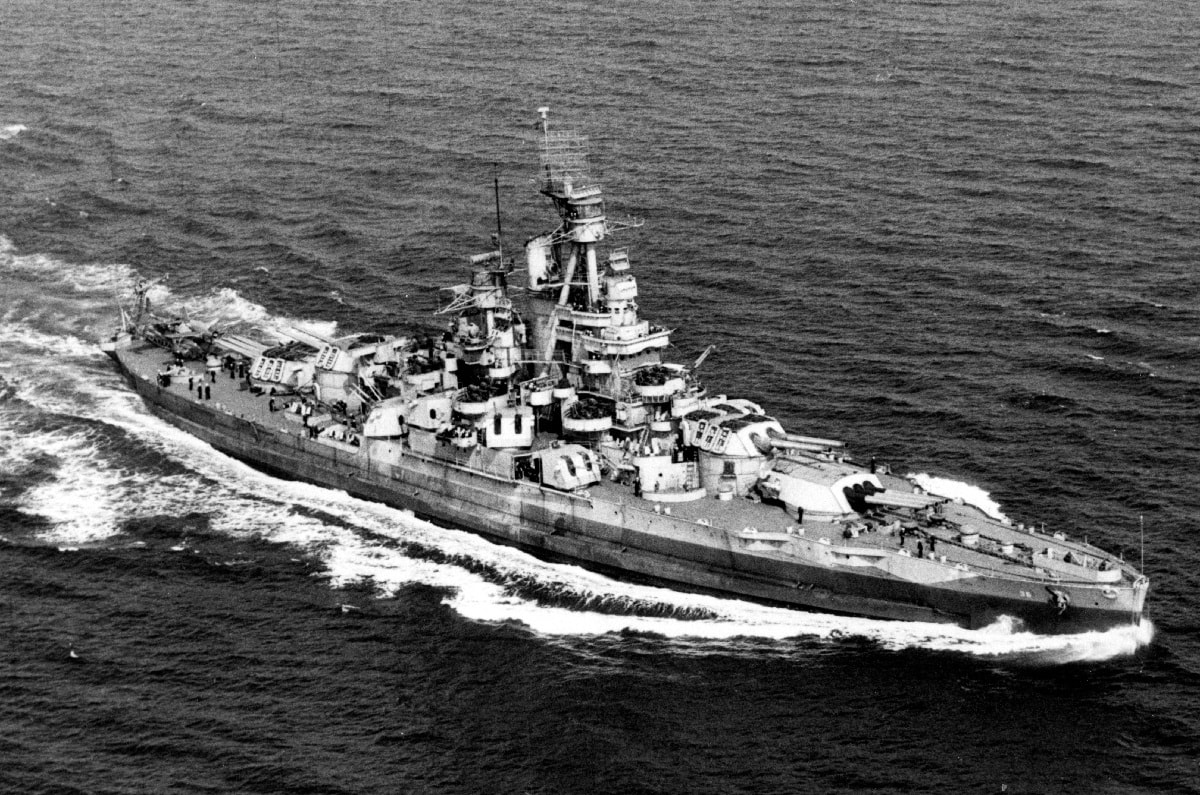
Underway off the U.S. Atlantic coast, 17 September 1944. Photographed from a blimp of squadron ZP-12. Official U.S. Navy Photograph, now in the collections of the National Archives.
BB-36 was the third USN vessel to bear the USS Nevada moniker and the lead ship of the two-ship-strong Nevada-class dreadnoughts, along with her sister ship USS Oklahoma (BB-37).
The now-defunct Fore River Shipbuilding Company in Quincy, Massachusetts, built her; her keel was laid on 4 November 1912, she was launched on 11 July 1914, and she was commissioned on 11 March 1916.
As noted by Samantha Franco of War History Online, “When launched in 1916, the USS Nevada was seen as a revolutionary vessel, with The New York Times calling her ‘the greatest [battleship] afloat.’ She was the first such ship in the US Navy to feature triple gun turrets, among other advancements, and donned the ‘all or nothing’ method of armor, with maximum protection being placed over critical places and none over less important areas.”
Those two triple gun turrets, along with two twin turrets, hosted a total of ten 14-inch/45 caliber guns. At its thickest point, the main armor belt was 13.5 inches.
Secondary armament consisted of 21 5-inch/51 caliber guns, and tertiary armament was two 3-inch/50 caliber anti-aircraft (AA) guns. Oh yes, it also had four 21-inch torpedo tubes.
Additional key stats included a hull length of 583 feet, a beam width of 95 feet 3 inches, a draft of 28 feet 6 inches, and a fully laden displacement of 27,500 tons. Max speed was 20.5 knots.
A total of 864 commissioned officers and enlisted seamen made up the crew complement.
Operational History in Brief Part I: World War I
Though it was via Pearl Harbor and the Second World War that USS Nevada would be truly “blooded” in combat and ultimately gain fame, the first war in which she actually served was the First World War.
She didn’t get to fire her guns in anger during the so-called “Great War,” but the potential for action was certainly there, as she was sent to Bantry Bay, Ireland, tasked with escorting convoys to the British Isles to protect them from the ever-lurking menace of German Unterseeboote (U-boats).
Operational History in Brief Part II: Pearl Harbor and Entry into WWII
During that “date which will live in infamy,” USS Nevada was the lone bright spot—thus earning the nickname “The Cheer Up Ship”—as she was the only American battlewagon to get underway during the attack.
As Fate/Lady Luck/Karma/Joss would have it, earlier that fateful morning, Nevada’s deck officer ordered a second boiler lit, which ensured the ship had enough power to attempt a mad dash away from port.
True to that “Battle Born” motto, Nevada was the first battleship to return fire at the IJN attackers and the first to shoot one of them down.
She still sustained at least six bomb hits from Aichi D3A “Val” dive bombers and one torpedo hit from a Nakajima B5N “Kate” torpedo bomber. She had to be beached, but she was salvageable. She was sent to the West Coast for repairs in April 1942 and declared shipshape in May 1943.
Operational History in Brief Part III: WWII Pearl Harbor Payback
BB-36’s first offensive actions against the other major Axis power, Nazi Germany. She distinguished herself as the only battleship present at both Pearl Harbor and the D-Day landings.
During the Normandy invasion, her initial designated target was a German gun emplacement at Azeville, just north of the Utah landing site; from there, she engaged German emplacements near St. Vaast-la-Hogue, followed by close support to the 101st Airborne Division units fighting to take Ste. Mere-Eglise.
Two months later, during a shore bombardment of the port of Toulon, she literally wore out her gun barrels!
For good measure, for both pragmatic and symbolic reasons, she was retrofitted with one of the gun barrels from the ill-fated USS Arizona (BB-39).
She finally started collecting payback against the Rising Sun during the invasions of Iwo Jima and Okinawa in April 1945, surviving kamikaze strikes in the process. USS Nevada earned a total of seven battle stars; “Cheer Up,” indeed.
Brief Life After WWII: Refusing to Die Quietly
Alas, USS Nevada wasn’t saved for either the “mothball fleet” or as a floating museum. But she sure went out with one helluva bang.
As hinted at earlier, the warship was selected as a target for the Operation Crossroads A-bomb testing that took place in July 1946.
But though reduced to a radioactive hulk, she didn’t sink.
Fast-forward to July 1948, and she endured five straight days of target practice by multiple USN warships, including the battleship USS Iowa (BB-61). *STILL* she wouldn’t sink!
An aerial torpedo from a Grumman TBF Avenger struck Nevada amidships and finally sent her to her watery grave on 31 July 1948.
Where Is She Now?
On 11 May 2020, a joint maritime expedition pairing up underwater and terrestrial archaeology firm SEARCH, Inc. and marine robotics company Ocean Infinity discovered the Nevada’s wreck at a depth of 15,400 feet about 65 nautical miles southwest of Pearl Harbor.
Still visible on her stern are the numbers “36” and “140,” the former denoting BB-36, whilst the latter was painted on the structural “rib” for the aforementioned atomic tests to facilitate post-blast damage reporting.
About the Author: Christian D. Orr
Christian D. Orr is a Senior Defense Editor. He is a former Air Force Security Forces officer, Federal law enforcement officer, and private military contractor (with assignments worked in Iraq, the United Arab Emirates, Kosovo, Japan, Germany, and the Pentagon). Chris holds a B.A. in International Relations from the University of Southern California (USC) and an M.A. in Intelligence Studies (with a concentration in Terrorism Studies) from American Military University (AMU). He is also the author of the book “Five Decades of a Fabulous Firearm: Celebrating the 50th Anniversary of the Beretta 92 Pistol Series,” the second edition of which was recently published.